What is an SLA in SaaS?
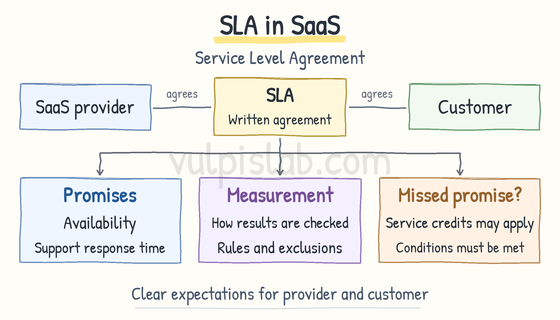
SLA stands for Service Level Agreement. It is an agreement between the SaaS provider and the customer that states the level of service the provider promises.
It can cover software availability, meaning how often the software is accessible, and support response times, meaning how quickly the provider responds to reported problems.
The SLA explains how these commitments are measured, which situations are excluded, and what happens if a commitment is missed. Customers may receive service credits, which reduce their service charges.
For example, Google Workspace commits to at least 99.9% monthly uptime for covered services. Eligible customers can claim service credits if this commitment is missed, subject to the agreement’s conditions.
What is the difference between SLI, SLO, and SLA in SaaS?
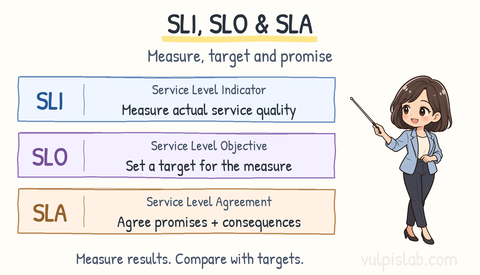
These terms explain what is measured, what should be achieved, and what is promised to customers.
| Term | Simple meaning |
|---|---|
| SLI — Service Level Indicator | A measure of actual service quality, such as how often the software is available. |
| SLO — Service Level Objective | A target for that measure over a defined period. |
| SLA — Service Level Agreement | The customer agreement stating service commitments and what happens if they are missed. |
These definitions follow Google’s reliability guidance.
For example: A SaaS provider measures monthly availability (SLI), aims for 99.95% availability (SLO), and promises customers 99.9% availability, with service credits under agreed conditions (SLA). These percentages are illustrative.
The team compares actual performance with the target to decide when improvements are needed.
What is an error budget in SaaS?
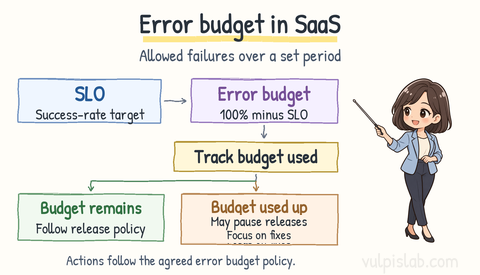
An error budget is the amount of failure a SaaS service can have while still meeting its agreed service quality target (SLO) during a set period. Depending on the target, it can be measured in failed requests or downtime.
For example, suppose 10,000 requests are made in a month. If the target is 99.9% successful requests, the error budget is 10 failed requests. More than 10 failures would mean missing that target.
The team tracks how much of this budget has been used. If it runs out, an agreed policy may pause new feature releases so the team can focus on fixing reliability problems. This helps balance new features with dependable service.
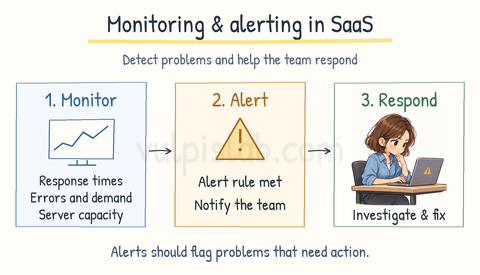
What are monitoring and alerting in SaaS?
Monitoring means continuously collecting and checking information about how the SaaS application is working. It tracks things such as response times, failed requests, user demand, and how much server capacity is being used.
Alerting means notifying the responsible team when monitoring detects a problem that needs attention. For example, the system can send a notification when many users cannot log in. Monitoring helps detect the problem; an alert tells the team to investigate.
Alerts should have clear rules and focus on problems that require action. Too many unnecessary notifications can cause teams to overlook important issues.
For example: A SaaS CRM monitors whether customer records open successfully. If the percentage of failed requests exceeds a defined limit, it alerts the support or engineering team so they can investigate and restore normal service.
What is observability in SaaS architecture?
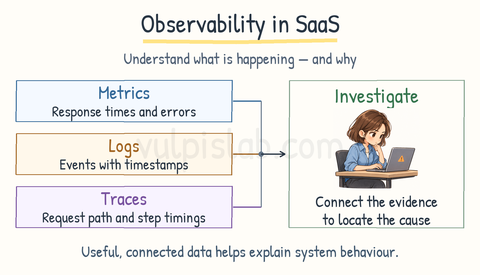
Observability is the ability to understand what is happening inside a SaaS application by examining the information it produces. It helps teams investigate why the software is slow, failing, or behaving unexpectedly.
Three common types of information support observability:
- Metrics: Numerical measurements, such as response times, failed requests, and server usage.
- Logs: Records of events with timestamps, such as when an error occurred and its details.
- Traces: Records showing how a request moves through different parts of the application and how long each step takes.
The application must be set up to collect useful information and connect related records so teams can investigate problems effectively.
For example: A SaaS CRM takes too long to open customer records. Metrics show increased response times, a trace identifies a slow database step, and related logs provide details that help the team investigate the cause.
What is incident management in SaaS?
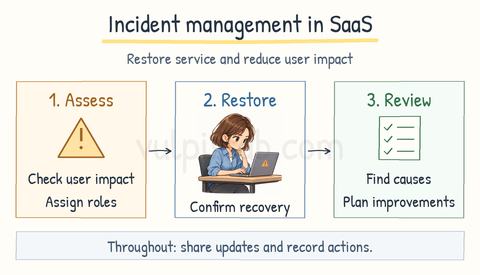
Incident management is the organised process of responding to problems that disrupt a SaaS service. An incident could be a login failure, unavailable software, or a major slowdown. The immediate goal is to reduce the impact on users and restore normal service quickly.
When an incident occurs, the team checks who is affected and how serious the problem is. Responsibilities are assigned so people know who coordinates the response, who restores the service, and who provides updates to customers and business teams.
The team records its actions and checks that the service is working again. Afterwards, it reviews what happened and identifies improvements to reduce the chance of a similar incident.
For example: After a software update, users cannot save customer records in a SaaS CRM. The team investigates and restores the previous working version, if safe to do so. It confirms that users can save records again, communicates the recovery, and then investigates the underlying fault.