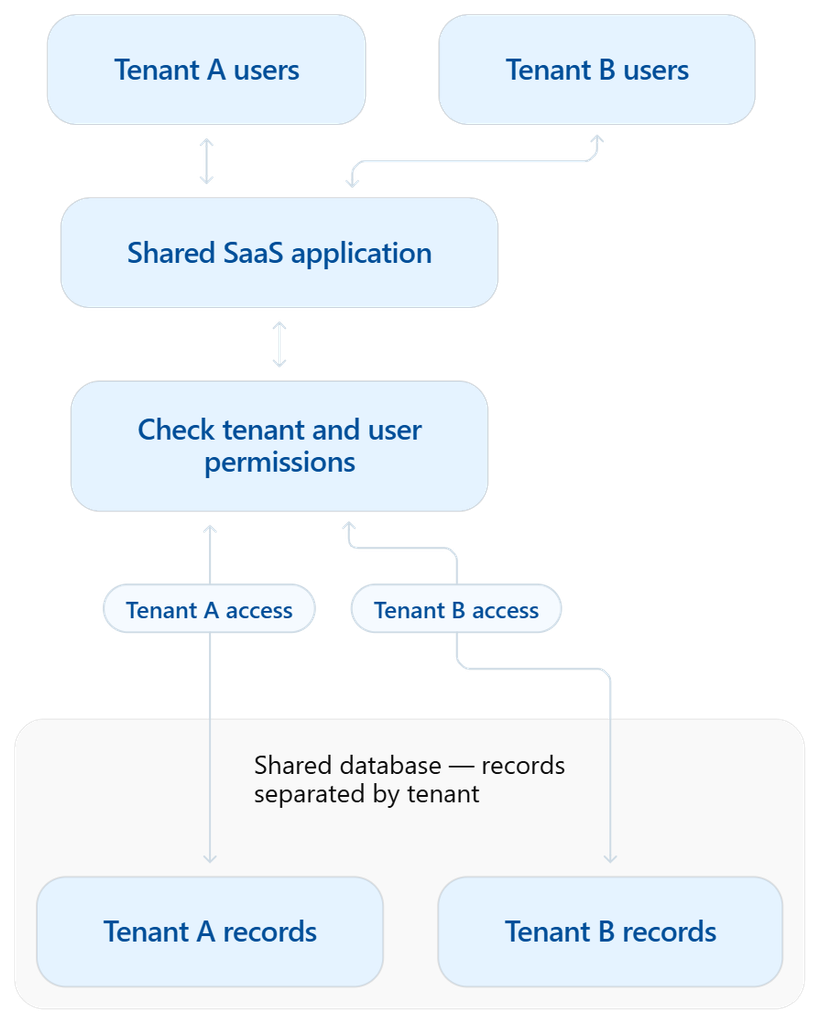
Multi-tenant architecture allows multiple customers to use a shared application environment. Each customer is a separate tenant.
Access controls keep each tenant’s private data and settings separate, even though the underlying resources are shared.
Sharing resources can reduce hosting and maintenance costs. However, heavy usage by one customer must be managed to avoid slowing down others.
For example, Salesforce uses multi-tenant architecture. Multiple organisations share its platform, while each organisation’s users access their own authorised data and settings. Salesforce documentation
8. What is tenant isolation in SaaS?
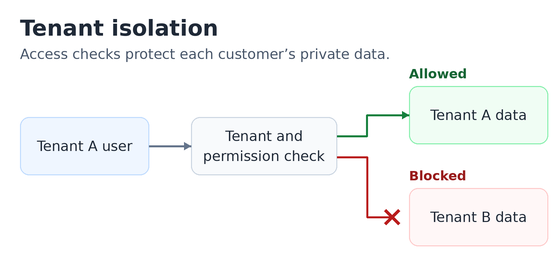
Tenant isolation prevents one customer from accessing another customer’s private data or resources, even when they share the same application.
The system checks which tenant a user belongs to and what that user is allowed to access.
These checks must protect every access route, including screens, reports, file downloads, and connections to other systems.
For example, Salesforce uses an organisation identifier to associate records with the correct customer. Its access controls use this information to keep each organisation’s private records separate. Salesforce documentation
9. How should a business choose between single-tenant and multi-tenant architecture?
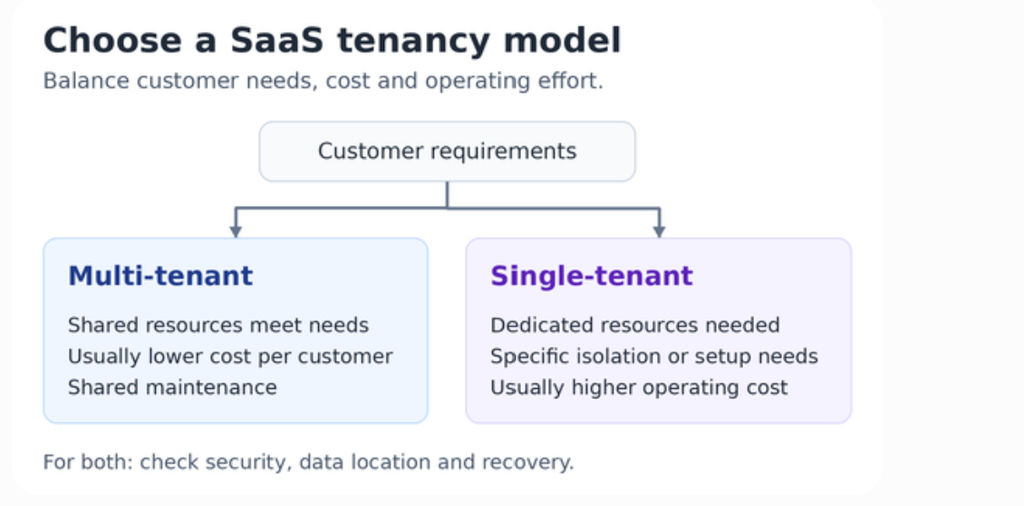
The choice depends on customer requirements, expected usage, and operating costs.
Multi-tenant architecture suits customers who can share resources. It can reduce costs and simplify maintenance across many customer accounts.
Single-tenant architecture suits customers who need dedicated resources or specific requirements for data separation, configuration, and performance.
The decision should also consider where data must be stored, how quickly service must recover after a failure, and the effort needed to maintain each environment.
Both models require strong security controls. A dedicated environment does not automatically make the software secure.
10. What is a business analyst’s role in SaaS architecture?
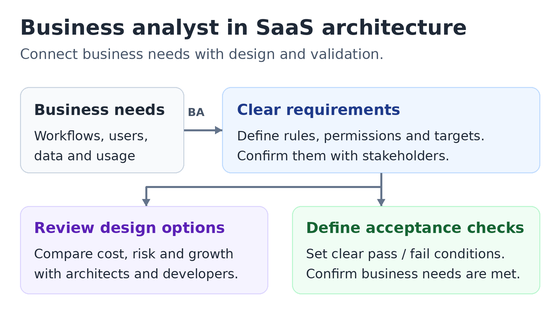
A business analyst translates business needs into clear requirements that help architects and developers design the SaaS application.
This includes understanding customer workflows, user permissions, subscription rules, data needs, and expected usage.
The business analyst helps compare design options based on cost, customer impact, risks, and future growth.
Requirements are converted into acceptance criteria—specific conditions the software must meet.
For example: “Only account administrators can change the subscription plan.” The acceptance criteria should verify that administrators can make the change and other users cannot.
11.What are functional requirements in a SaaS application?
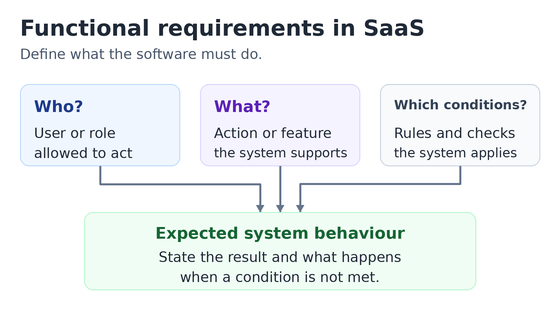
Functional requirements describe what the software must do. They cover features, user actions, and business rules.
Examples include creating accounts, changing subscription plans, generating reports, and sending notifications.
A clear requirement specifies who can perform the action, what the system should do, and any conditions that apply.
For example, Salesforce Sales Cloud supports managing sales enquiries, called leads. A functional requirement could state: “An authorised salesperson can create a lead, and the system must check that required fields are completed before saving it.”
12. What are non-functional requirements in a SaaS application?
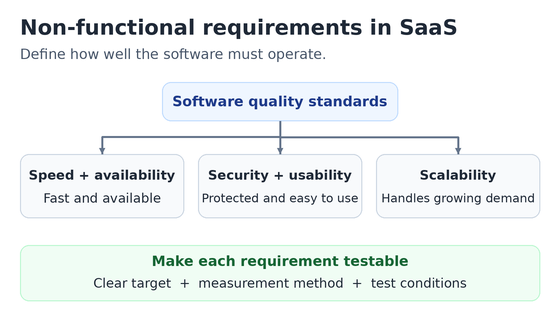
Non-functional requirements describe the quality standards the software must meet. They define how well the application should operate.
They cover areas such as speed, availability, security, ease of use, and the ability to handle growing demand.
Each requirement should be specific and testable, with a clear target and measurement conditions.
For example, a CRM performance requirement could state: “At least 95% of dashboard loads must complete within two seconds during a test with 500 simultaneous users following an agreed usage pattern.”