

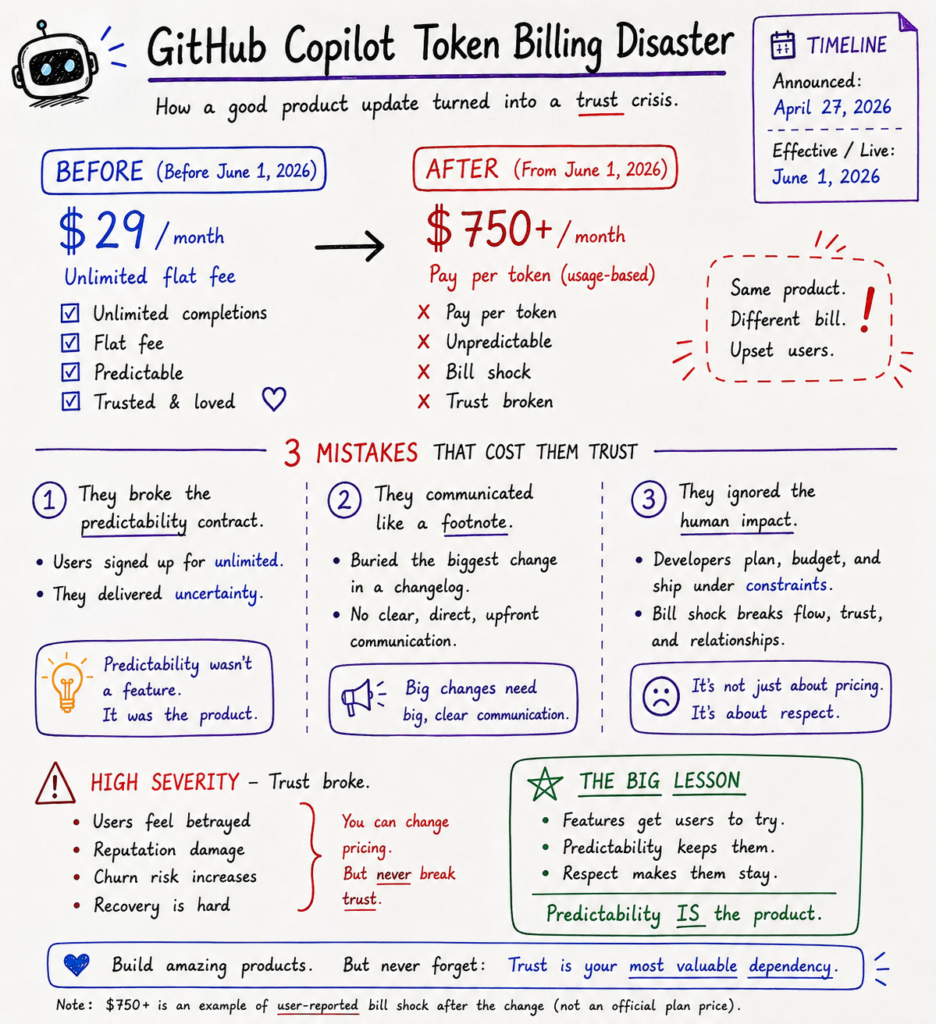
On June 1, 2026, GitHub Copilot switched from flat-rate to token-based billing. Within hours, developers were posting bills that jumped from $29 to $750 a month. One projection hit $3,000. TechCrunch called it the end of Copilot’s golden age. This is a teardown of how a pricing decision became a trust crisis.
Here is the number that broke developer trust: $750. That is what one developer projected their monthly GitHub Copilot bill would become — up from $29. Another developer projected a jump from $50 to $3,000. A single post that simply read “Goodbye, Copilot” was shared thousands of times within days.
On June 1, 2026, GitHub Copilot replaced its flat-rate subscription with token-based billing. Instead of paying a predictable $10 to $39 per month for effectively unlimited use, developers now pay for every input, output, and cached token consumed during coding sessions. The reaction was immediate, loud, and overwhelmingly negative across Reddit, X, and GitHub’s own forums.
This teardown is not about whether usage-based pricing is right or wrong. The underlying economics are real. This teardown is about the product management decisions that turned a defensible business model change into a trust crisis — and what every PM shipping AI pricing changes needs to learn from it.
💡 Core premise
GitHub Copilot’s billing change was economically necessary but executed as a product failure. The problem was never that prices went up. The problem was that GitHub removed cost predictability, killed the safety net, and changed the contract on users it had spent three years teaching to use Copilot freely. That is the teardown.
What Actually Changed in GitHub Copilot Billing
To understand the GitHub Copilot billing backlash, you need to know exactly what changed on June 1 — and what GitHub took away in the process.
From gym membership to metered taxi
For three years, GitHub Copilot worked like a gym membership. You paid a flat $10 to $39 per month and used it as much as you wanted. On June 1, 2026, that model ended. Every Copilot plan now includes a monthly allotment of “GitHub AI Credits,” consumed based on token usage — input, output, and cached tokens — calculated at API rates for each model. Once your credits run out, you either buy more or stop using premium features until the next billing cycle.
🔬 Technical Teardown — What Changed June 1, 2026
The pricing model flipped
Flat subscription became token-metered. Pro stays $10/month, Pro+ stays $39/month, Business stays $19/user, Enterprise stays $39/user — but each plan now only includes a fixed AI Credit allotment. Beyond that, you pay per token at API rates. The headline price stayed the same. The actual cost became unbounded.
The safety net was removed
Previously, when you exhausted premium requests, Copilot fell back to a lower-cost model so you could keep working. That fallback is gone. Now when your credits run out, premium features simply stop. The graceful degradation that protected users from disruption was deleted.
Code review now costs Actions minutes too
Copilot code review moved to an agentic architecture running on GitHub Actions. Starting June 1, reviewing a pull request with Copilot counts against your included Actions minutes at standard per-minute rates. A second metered cost, stacked on top of token billing, that most users did not see coming.
What stayed free matters too: code completions and Next Edit Suggestions remain included in all plans and do not consume AI Credits. GitHub did preserve the core autocomplete experience. The metering hit the premium features — chat, agents, and the agentic workflows that GitHub itself had spent the past year encouraging developers to adopt.
“Copilot is not the same product it was a year ago.”— Mario Rodriguez, Chief Product Officer, GitHub
That line, from GitHub’s own announcement, was meant to justify the change. To developers, it read as an admission that the product they had committed to had been redefined underneath them.
The GitHub Copilot Billing Numbers Developers Are Posting
The backlash was not abstract. Developers ran the numbers on their own usage and posted the projections. Here is what the GitHub Copilot billing change looked like in practice.
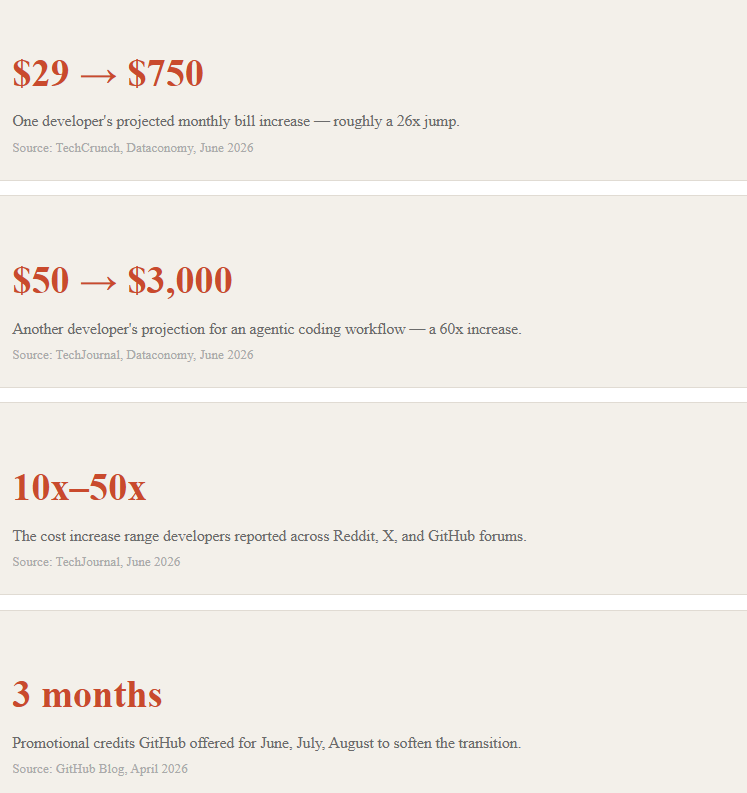
An important caveat: these are projections from power users with heavy agentic workflows, not average bills. GitHub introduced budget caps so administrators can prevent runaway costs, and pooled usage so light users’ unused credits offset heavy users in the same organisation. But the damage was done in the framing. When your most engaged users — the ones running agentic workflows GitHub actively promoted — are the ones facing 50x increases, you have punished your best customers for adopting your newest features.
⚠️ The trust whiplash
For three years, GitHub encouraged developers to lean into Copilot — use it more, adopt agents, build it into your workflow. Then it changed the billing model so that exactly that behaviour became expensive. One developer summed up the sentiment posted across forums: the heavier you followed GitHub’s own advice, the harder the new pricing hit you.
The Root Cause of the GitHub Copilot Billing Crisis
The economics behind the change are sound. The execution is where it fell apart. Both things are true at once — and separating them is the key to understanding this teardown.
Why the change was necessary
Running frontier AI models costs real money per token. A flat subscription that does not scale with usage loses money on power users — and Copilot’s power users were consuming far more than $39 of compute per month under the old model. The “unlimited AI for a flat fee” model that has defined AI products since ChatGPT launched in 2022 is fundamentally unsustainable. GitHub was not being greedy. It was being arithmetic. ChatGPT has begun moving the same direction, and Google’s Gemini Spark agent sits behind a $100/month tier. The whole industry faces the same wall.
Why the execution failed
The necessity of the change does not excuse how it was delivered. GitHub made three execution decisions that converted a reasonable business move into a trust crisis. It removed cost predictability without giving users adequate tools to regain control before the switch. It deleted the fallback safety net that had protected users from disruption. And it changed the fundamental contract — from “pay once, use freely” to “pay per use” — on a user base it had spent three years conditioning to use Copilot without thinking about cost.
The predictability problem is the real problem
Developers do not hate paying for value. They hate not knowing what they will pay. The old model gave them a number they could put in a budget. The new model gives them a meter that runs while they work, with a bill they cannot predict until it arrives. For an individual developer or a small company, an unpredictable monthly bill is not just inconvenient — it is unbudgetable. That is why the loudest complaints came from small teams and solo developers, not enterprises. Enterprises can absorb variance. The little guy cannot.
Where GitHub’s PM Team Got the Copilot Billing Change Wrong
The economic logic was right. The product management execution created avoidable damage. Here are the three mistakes.
PM mistake 1: removing the safety net without a replacement
The old fallback model — drop to a cheaper model when premium credits run out — was a graceful degradation feature. It meant users never hit a hard wall mid-task. Removing it meant that the moment credits run out, work stops. There was no replacement designed. A better version of this change would have kept some form of degraded-but-functional mode, exactly as the original design intended. Deleting graceful degradation to force credit purchases reads as extractive, even when that was not the intent.
PM mistake 2: punishing the behaviour you promoted
GitHub spent a year pushing developers toward agentic workflows — Copilot agents, autonomous coding, the expensive premium features. Then it shipped a pricing model where those exact features burn credits fastest. The users who followed GitHub’s roadmap most enthusiastically got the biggest bills. When your pricing punishes your most engaged users for adopting your newest features, you have created a misalignment between what you tell users to do and what you charge them for doing it.
PM mistake 3: leading with price stability while changing cost structure
GitHub’s messaging emphasised that headline prices stayed the same — Pro is still $10, Pro+ is still $39. But that framing obscured the real change: the cost structure flipped from bounded to unbounded. Telling users “the price hasn’t changed” while their actual bills jump 50x feels like misdirection, even if technically accurate. Visual Studio Magazine’s editor captured the gap bluntly: the official line was “you will get less but pay the same,” but the lived reality for many was getting less and paying more. When your messaging and your users’ experience diverge that sharply, you lose trust faster than you lose revenue.
“The golden age of Microsoft’s GitHub Copilot appears to be at an end — for the little guy, at least.”— TechCrunch, May 2026
How GitHub Should Have Shipped the Copilot Billing Change
The change was necessary. A better execution was available. Here is what would have preserved trust while still fixing the economics.
01. Ship the cost transparency tools first, then change the model
GitHub did launch a preview bill experience in early May, giving users visibility into projected costs before June 1. That was the right instinct — but it arrived weeks before the switch, not months. The correct sequence is to give users the dashboard, let them watch their projected costs for a full billing cycle or two, and only then flip the model. Let users discover their own number before you charge them for it.
02. Keep a functional fallback, not a hard wall
The deleted safety net should have been preserved in some form. When credits run out, dropping to a free or cheaper model keeps developers working and keeps GitHub from looking like it engineered a paywall mid-task. Graceful degradation is a trust feature. Removing it to force purchases is a short-term revenue decision with a long-term trust cost.
03. Align pricing with the behaviour you promote
If GitHub wants developers using agentic workflows, those workflows cannot be the ones that generate financial whiplash. Either subsidise the features you are promoting, or stop promoting features you are about to make expensive. The misalignment between roadmap and pricing is the single most damaging part of this change.
04. Lead with honesty about the cost structure change
“The price is the same” was technically true and strategically wrong. The honest message was: “The model is changing from flat to metered. Most light users will pay the same or less. Heavy users of premium features will pay more, and here is the dashboard to see exactly where you land.” Leading with that honesty would have cost some goodwill upfront but preserved far more trust than the gap between the messaging and the bills.
05. For developers: evaluate your real usage before switching away
The migration conversation is real — Cursor, Windsurf at $20 to $200 flat, and Claude Code at $17 to $100 are all being evaluated as alternatives. But before switching, developers should review their actual token consumption in GitHub’s billing dashboard after the first week. Code completions stayed free. For many light users, the new bill is the same or lower. The right move is to measure your own usage, not react to someone else’s $3,000 projection.
The VulpisLab Verdict on the GitHub Copilot Billing Change
🔍 VulpisLab Verdict
Severity: High. This is not a product that broke — it is a product whose contract with users broke. The economics forced a real decision, and GitHub made the defensible call on the model while making avoidable mistakes on the execution. The result is a trust crisis that is now driving genuine migration evaluation across the developer community.
Most exposed: Solo developers and small teams who built Copilot’s premium and agentic features into their daily workflow on the assumption of predictable cost. They are the ones facing unbudgetable bills and the ones evaluating Cursor, Windsurf, and Claude Code. Enterprises can absorb the variance. The independent developer — the user who made Copilot culturally dominant — is the one who feels betrayed.
The one lesson for PMs: When you change a pricing model, the thing users are buying is not just the product — it is the predictability. You can raise prices and keep trust. You can meter usage and keep trust. But the moment you remove a user’s ability to predict their bill, you have changed the deal in the way that hurts most. Ship the transparency before the meter, keep the safety net, and never let your pricing punish the behaviour your roadmap promotes.
The PM checklist before shipping any AI pricing change
- Can users predict their bill before the change takes effect?
- Did you ship the cost-visibility dashboard before the new model, not alongside it?
- Is there a graceful fallback when users hit their limit, or a hard wall?
- Does the new pricing punish the behaviour your product roadmap actively promotes?
- Is your messaging honest about the cost-structure change, or just the headline price?
- Have you protected your most engaged users, or charged them the most?
VulpisLab — AI product teardowns for PMs, engineers, and founders who build with and on top of AI. No hype. No vendor copy. Just teardown and verdict. Read Issue #01: The Hallucination Tax · Issue #02: Microsoft Copilot Reliability Crisis.