
Google just turned AI pricing into a weapon
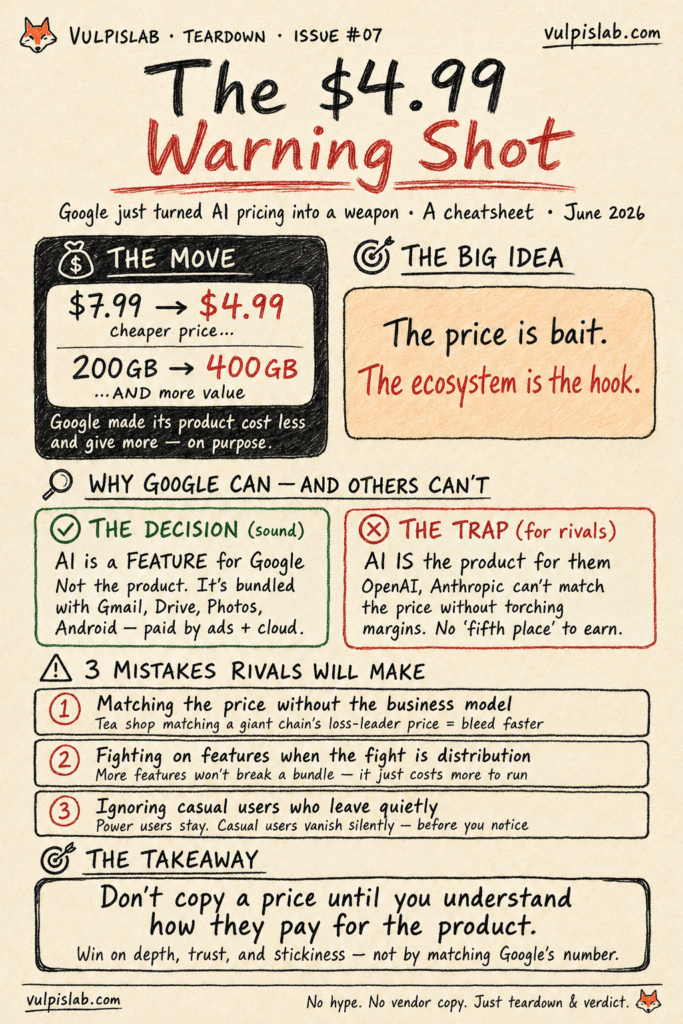
On Monday, June 8, Google quietly did something that should worry every team selling an AI subscription. It cut the price of Google AI Plus from $7.99 a month to $4.99 and doubled the storage that comes with it, from 200GB to 400GB. Cheaper price. More value. Same plan. In a market where everyone is bleeding money on compute, Google just made its product cost less and give more, on purpose.
Put yourself in the room where that call was made. It does not look reckless from the inside. Industry reporting suggests subscriber growth across consumer AI has slowed and companies are becoming more price-sensitive. Most people already pay for Netflix, Spotify, cloud storage, and a phone plan, asking them to add a $20 AI subscription is a hard sell. A price war was already running in India, where OpenAI launched its sub-$5 ChatGPT Go plan in August 2025 and Google followed with AI Plus in December 2025. Pulling that same cheap-and-bundled playbook into the US is not a wild gamble. It is the obvious next move for the one company that can actually afford it. The decision looked reasonable. That is exactly why it is dangerous for everyone else.
Here is my read: this is not a discount. It is Google using a weapon only Google has, and it puts every standalone AI subscription in a trap they cannot easily escape. The price cut is the visible part. The strategy underneath is the real story, and it is one most competitors cannot copy.
Google is not trying to win on AI features at $4.99. It is trying to make AI a cheap utility bundled into an ecosystem you already live in, before anyone locks you into ChatGPT or Claude instead. The price is bait. The ecosystem is the hook.
What Actually Changed
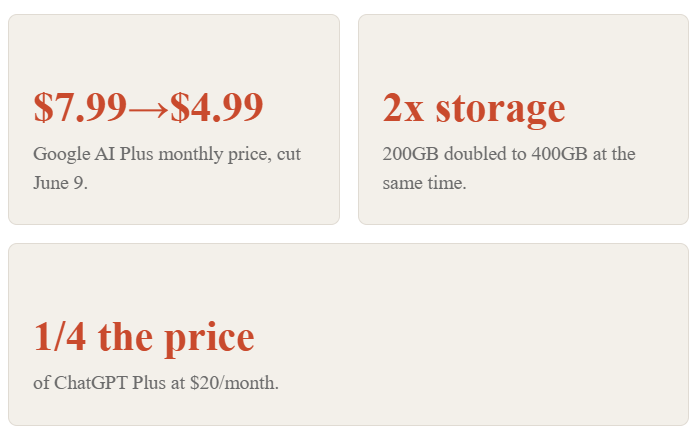
The facts are simple and worth getting exactly right. On June 9, 2026, Google cut Google AI Plus from $7.99 to $4.99 per month in the US. It doubled included storage from 200GB to 400GB at the same time. Vikas Kansal, Google’s product lead for Gemini subscriptions, confirmed the storage rollout would reach users over the following days.
The plan keeps its full feature set: double the free-tier usage limits in the Gemini app, a 128,000-token context window, video generation through Omni in Gemini, the Google Flow creative studio, and the NotebookLM research assistant. Nothing was taken away to fund the cut —> which, as we will see, is the part that makes it hard to answer. At its I/O conference in May, Google also reshuffled its top end: it dropped the AI Ultra plan from $250 to $200 a month and introduced a new $100 Ultra tier below it. The $4.99 move was not a one-off. It was the cheap end of a pattern.
At $4.99, Google AI Plus is now the lowest-priced AI subscription from any major provider in the US. For comparison: OpenAI’s standard ChatGPT Plus is $20 a month, and its budget ChatGPT Go plan is $8 in the US (it launched in India in August 2025 at roughly $4.60). Google did not just undercut the budget option. It undercut the budget option and doubled the storage.
The Receipts
The reaction tells you this landed as strategy, not a sale. PYMNTS and Reuters both reported that OpenAI is weighing significant price reductions of its own, anticipating similar moves from Anthropic. And the most telling signal: per TechCrunch, Anthropic had not introduced a budget tier or localized pricing for India anywhere — its public pricing runs Free, Pro at $20, and Max from $100 a month. That gap gets more exposed every time a rival cuts. Both OpenAI and Anthropic have filed confidentially to go public, which means their margins are about to be tested in public by exactly this kind of price pressure.
One quote frames the whole thing. Chi-Hua Chien of Goodwater Capital compared today’s AI providers to the last era’s infrastructure giants: “over time, you will see them get increasingly commoditized.” That is the fear Google is poking at — and it is worth marking this as an investor’s prediction, not a settled fact. Whether AI subscriptions truly commoditize is still unproven. But Google is betting they will, and pricing like it.
Why Google Can Do This — And Why Others Can’t
This is the part that matters for any PM, so let’s split it cleanly. There are two questions: was the decision to cut sound, and is the execution something rivals can match? The answers are very different.
The decision: sound, and almost free for Google
Google can sell AI at $4.99 with far more room than a standalone rival, because for Google, AI is not the product , it is a feature inside products you already use. Google can bundle AI with storage, Gmail, Docs, Photos, Android, Chrome, and Search. The AI subscription is a way to pull you deeper into an ecosystem that already makes money through ads and cloud. A $4.99 plan that increases stickiness across that entire stack does not have to pay for itself the way a pure-play subscription does. The decision to cut was not brave. For Google’s specific position, it had structural cover that rivals simply don’t have.
The execution: a trap rivals can’t copy by matching the number
Here is where standalone AI companies are stuck. OpenAI, Anthropic, and Perplexity sell AI as the product itself. Their compute cost per user is the core cost, not a side feature subsidized by an ad business. When Google drops to $4.99, a pure-play rival faces an ugly choice: match the price and torch their margins right before an IPO, or hold the price and watch casual users drift to the cheaper, “good enough” option bundled into the apps they already open every day. Matching Google’s number does not match Google’s economics. That is the trap, and it was built into Google’s structure long before this price cut.
Ask “why can Google afford this?” enough times and you do not land on a clever pricing team. You land on something structural: Google monetizes the user in five other places, so the AI tier never had to pay for itself. A standalone AI company has no fifth place. That is not an execution failure they can fix with a better spreadsheet. It is a position they cannot occupy.
The Real Risk for Everyone Else
If you are a PM at a standalone AI company, the biggest risk is not only Google’s price cut. The bigger risk is how you respond to it. A cheap bundle from Google can easily push teams into panic decisions, but every company cannot copy Google’s pricing strategy. These are the three mistakes to avoid.
Mistake 1: Copying Google’s price without Google’s business model
The first mistake is cutting your price only to match Google. Dropping your price to $4.99 works only if your business can afford it. If your cost of serving each user is higher than Google’s, then matching Google’s price will not make you more competitive. It will only make you lose money faster.
This is like a small tea shop trying to match the price of a giant chain that can afford to sell tea at a loss. The giant chain can survive that loss because it has other sources of revenue. The small shop cannot. That is why price should be the last lever you pull, not the first one.
Mistake 2: Adding more features when the real fight is distribution
The second mistake is thinking that adding more features will solve the problem. A standalone AI company may feel that the answer is to keep the same price but offer more features. But Google is not winning only because of features. Google is winning because its AI is connected to products people already use every day, such as Gmail, Drive, Photos, Docs, and Android.
So even if a standalone AI product adds more features, it may not break Google’s bundle. It may only increase its own cost. For many casual users, a “good enough” AI inside the apps they already use may feel easier than paying separately for another tool.
Mistake 3: Ignoring casual users who leave quietly
The third mistake is ignoring casual users. Power users are not the biggest risk because they care about better models, deeper reasoning, coding help, long context, and advanced workflows. Many of them may still pay for a premium AI product.
The real risk is casual users. These users do not need the most powerful AI. They only need a cheap, simple, and easy-to-access AI assistant. Google’s $4.99 plan is built exactly for these people. And casual users usually do not complain before leaving. They simply stop opening your product. By the time you notice the churn, they may already be using the cheaper AI inside Google’s ecosystem.
The real lesson is simple: do not copy a competitor’s price until you understand their business model. Google can make AI cheap because AI is part of a much bigger ecosystem. A standalone AI product has to win through depth, trust, workflow, or specialization — not by copying Google’s price.
What You Should Do If You Are at a Standalone AI Company
The good news is simple: you may not be able to beat Google on price, but you can still win through focus. Google’s $4.99 plan is strong because it is bundled with products people already use. So a standalone AI company should not blindly copy Google. It should choose a different battle.
1. Compete on depth, not breadth
Google’s low-price plan can win casual users. These are people who only need a simple AI assistant at a cheap price. But it may not win users who need deeper capability — like better coding support, stronger reasoning, longer context, or more reliable answers.
So a standalone AI company should focus on high-value users who care about quality, not just price. Do not chase every casual user. Instead, build for users who need the best output and are willing to pay for it.
The simple rule is: let Google own the cheap entry-level market. You own the serious, high-value use cases.
2. Build your own stickiness
Google has a natural advantage because its AI is connected to Gmail, Drive, Photos, Docs, Android, and Search. People already use these products every day, so Google does not have to work very hard to create habit.
A standalone AI company cannot borrow that ecosystem. It has to create stickiness in another way.
That can come from memory, workflows, integrations, saved projects, team collaboration, custom assistants, or deep use-case specific tools. The goal is simple: make the product so useful that users do not want to leave, even if a cheaper option exists.
The lesson is not “cut your price.” The lesson is “make your product harder to replace.”
3. If you go cheap, bundle something unique
Sometimes a company may still need a cheaper plan. But a cheap plan should not be just a lower price. It should include something unique that Google cannot easily copy.
That could be a special model capability, a private dataset, a workflow, a professional tool, or an industry-specific feature.
If you only match Google’s $4.99 price without offering anything different, you are entering a race you probably cannot win. Google can afford to make AI cheap because AI is part of its larger ecosystem. A standalone AI company needs a stronger reason for users to choose it.
The final lesson is simple: do not fight Google only on price. Fight on depth, workflow, trust, and specialization.
The Takeaway for Your Roadmap
The one lesson: Before you react to a competitor’s price cut, find out whether they are paying for the product the same way you are. Google can sell AI at $4.99 because AI is not how Google makes money — it is bait for the ecosystem that does. If a rival can subsidize a product from a business you don’t have, matching their price is matching their loss without their backup. The right question is never “can we match the price?” It is “what are they actually selling, and can we sell something they can’t?”
For Google, this was a move with structural cover , AI Plus sits inside an ecosystem that monetizes the user many other ways. For everyone else, it is a test of whether they have built anything a bundle can’t swallow. The companies that survive this price war won’t be the ones that matched $4.99. They’ll be the ones who made their users not want to leave.
The question to ask before you respond to any price war
- Is the competitor subsidizing this product from a business I don’t have?
- Am I about to compete on price, when my real edge is depth or stickiness?
- Which of my users are at risk — the power users, or the casual ones who leave quietly?
- Do I have something proprietary to bundle, or would I just be matching a number?
Sources
Primary reporting:
TechCrunch (price cut announced Mon June 8; Chien commoditization quote; Anthropic pricing gap): techcrunch.com — warning shot
TechCrunch (ChatGPT Go launched India August 2025, ~$4.60): techcrunch.com — ChatGPT Go
TechCrunch (Google AI Plus India, December 2025): techcrunch.com — Google India
Google blog (I/O 2026: Ultra $250→$200, new $100 tier): blog.google — AI subscriptions
Reuters (OpenAI + Anthropic confidential IPO filings): reuters.com — IPO queue
Supporting:
PYMNTS (OpenAI weighing cuts; subscriber growth slowing): pymnts.com — price war
Digital Trends (feature set; 128K context; ChatGPT Go $8 US): digitaltrends.com
Google Help (AI Plus 128k-token context window): support.google.com
Appcritica (bundling-as-weapon analysis): appcritica.com
Note: ChatGPT Go US price $8/month, Plus $20, Pro $200 (OpenAI). The “commoditization” framing is investor analysis (Chi-Hua Chien, Goodwater Capital), not a settled fact.
VulpisLab — AI product breakdowns for product managers. No hype. No vendor copy. Just the decision, the execution, and the lesson. Read Issue #03: GitHub Copilot Billing · Issue #06: The Sora Shutdown.