
Introduction
AWS AI Practitioner Exam Preparation: Simple AIF-C01 Roadmap
If you are planning to start your cloud AI journey, the AWS Certified AI Practitioner exam, also known as AIF-C01, is one of the best entry points.
This exam is not only for developers.
It is also useful for product managers, business analysts, project managers, solution architects, founders, and anyone who wants to understand how AI, machine learning, and generative AI work on AWS.
I am starting this blog series because I want to prepare for the AWS AI Practitioner exam in a structured way. At the same time, I want to document everything in simple language so that other beginners can also follow along.
This first blog is the starting point of the complete series.
Think of this article as the main index page.
Every topic that matters for the exam will be linked from here, one by one.
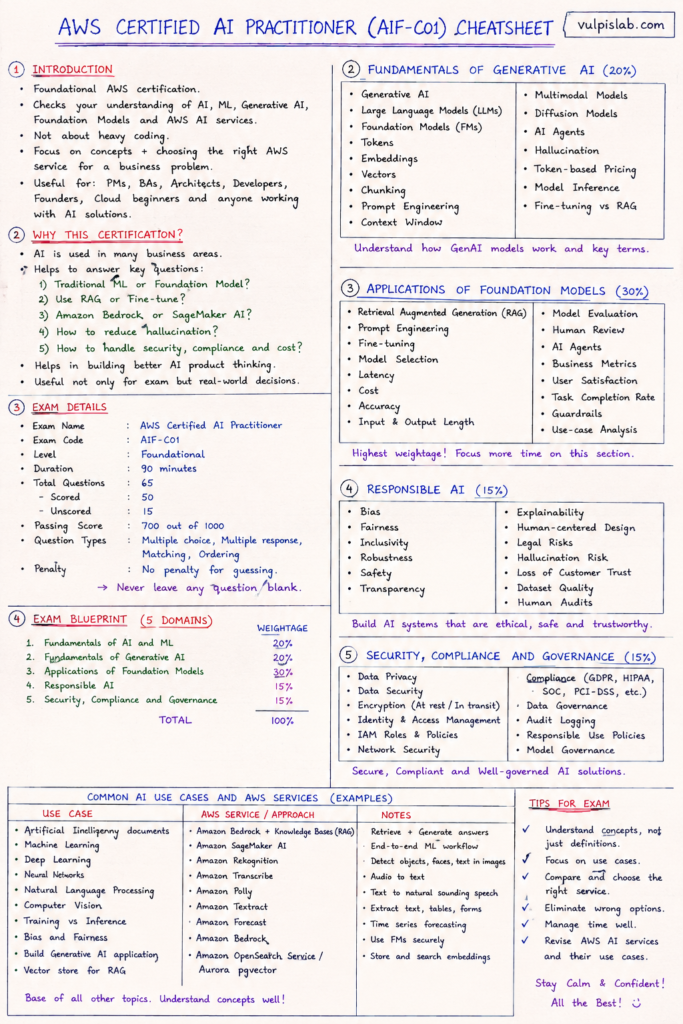
What is the AWS Certified AI Practitioner exam?
The AWS Certified AI Practitioner exam is a foundational AWS certification.
In simple words, it checks whether you understand the basics of:
- AI
- Machine learning
- Generative AI
- Foundation models
- AWS AI services
- Responsible AI
- AI security and governance
- Business use cases of AI
The exam is not focused on heavy coding.
It is not about building neural networks from scratch.
It is not about writing complex Python ML code.
Instead, this exam checks whether you can understand AI concepts and choose the right AWS service or approach for a business problem.
For example, the exam may not ask you to train a model from scratch.
But it may ask:
A company wants to build a chatbot that answers questions from internal documents. Which AWS service or approach is most suitable?
That is the real style of this exam.
It is concept plus use case.
Who should take this exam?
This exam is useful for you if you are:
A beginner in AI and AWS
A product manager working with AI products
A technical product manager
A solution architect starting with GenAI
A business analyst working with AI teams
A cloud beginner who wants to understand AWS AI services
A project manager managing AI or ML projects
A founder trying to understand AI product possibilities
You do not need to be an ML engineer to start.
However, you should understand basic cloud ideas such as storage, APIs, access control, pricing, security, and managed services.
Why I am preparing for this exam
AI is no longer only a research topic.
Today, companies are using AI for customer support, document processing, search, personalization, coding assistance, fraud detection, forecasting, summarization, and business automation.
But the problem is this:
Many people talk about AI, but they do not understand how to choose the right AI solution.
(1) Should we use traditional ML?
(2) Should we use a foundation model?
(3) Should we use RAG?
(4) Should we fine-tune a model?
(5) Should we use Amazon Bedrock?
(6) Should we use Amazon SageMaker AI?
(7) How do we reduce hallucination?
(8) How do we manage security and compliance?
(9) How do we estimate cost?
These are exactly the kind of questions this exam helps us think through.
That is why this certification is useful not only for passing an exam, but also for building better AI product thinking.
AWS AI Practitioner exam details
Here are the basic exam details:
Exam name: AWS Certified AI Practitioner
Exam code: AIF-C01
Level: Foundational
Duration: 90 minutes
Question count: 65 questions
Scored questions: 50 questions
Unscored questions: 15 questions
Passing score: 700 out of 1000
Question types: Multiple choice, multiple response, matching, and ordering
One important thing: there is no penalty for guessing.
So, in the actual exam, never leave a question blank.
What does this exam actually test?
The exam checks five main areas.
1. Fundamentals of AI and ML
This section covers the basic language of AI.
You need to understand terms like:
Artificial intelligence
Machine learning
Deep learning
Neural networks
Natural language processing
Computer vision
Training
Inference
Bias
Fairness
Supervised learning
Unsupervised learning
Reinforcement learning
This section is important because it creates the base for everything else.
If you do not understand the difference between classification, regression, and clustering, many scenario-based questions will feel confusing.
2. Fundamentals of Generative AI
This is one of the most important parts of the exam.
You need to understand:
Generative AI
Large language models
Foundation models
Tokens
Embeddings
Vectors
Chunking
Prompt engineering
Context window
Multimodal models
Diffusion models
AI agents
Hallucination
Token-based pricing
This is where the exam becomes very practical.
For example, AWS may ask you how token usage affects cost, or why a model may produce inaccurate but confident answers.
3. Applications of Foundation Models
This is the highest-weighted section of the exam.
That means you should spend extra time here.
You need to understand how foundation models are used in real applications.
Important topics include:
RAG
Prompt engineering
Fine-tuning
Model selection
Latency
Cost
Accuracy
Input and output length
Model evaluation
Human review
Agents
Business metrics
User satisfaction
Task completion rate
This is where product thinking becomes very useful.
A good AI solution is not just about using the most powerful model.
It is about choosing the right model for the right use case with the right cost, latency, accuracy, and risk level.
4. Responsible AI
This section is about building AI systems safely and responsibly.
You need to understand:
Bias
Fairness
Inclusivity
Robustness
Safety
Transparency
Explainability
Human-centered design
Legal risks
Hallucination risk
Loss of customer trust
Dataset quality
Human audits
This is very important in real AI products.
An AI product can fail not because the model is weak, but because users stop trusting it.
5. Security, Compliance, and Governance
This section is about protecting data and managing AI risk.
Important topics include:
IAM
Encryption
AWS KMS
Amazon Macie
AWS PrivateLink
AWS CloudTrail
Amazon CloudWatch
AWS Config
AWS Audit Manager
AWS Artifact
Data lineage
Audit logs
Prompt injection
Data leakage
Output validation
RAG grounding
Governance frameworks
This section is not about becoming a security expert.
But you should know which AWS service or principle helps with which kind of risk.
AWS services you must know for this exam
You do not need to memorize every AWS service deeply.
But you must know the purpose of important services.
Here is a simple mapping:
(1) Amazon Bedrock — Build generative AI applications using foundation models.
(2) Amazon SageMaker AI — Build, train, and deploy machine learning models.
(3) Amazon Q — AI assistant for business, development, and productivity use cases.
(4) Amazon Comprehend — Understand text, sentiment, entities, and key phrases.
(5) Amazon Lex — Build conversational chatbots.
(6) Amazon Polly — Convert text to speech.
(7) Amazon Transcribe — Convert speech to text.
(8) Amazon Translate — Translate text from one language to another.
(9) Amazon Rekognition — Analyze images and videos.
(10) Amazon Textract — Extract text and data from documents.
(11) Amazon Kendra — Enterprise search.
(12) Amazon Personalize — Build recommendation and personalization experiences.
(13) Amazon S3 — Store data.
(14) AWS Lambda — Run serverless code.
(15) IAM — Manage access and permissions.
(16) AWS KMS — Manage encryption keys.
(17) Amazon Macie — Discover sensitive data.
(18) AWS CloudTrail — Track API activity and audit events.
(19) Amazon CloudWatch — Monitor logs, metrics, and system behavior.
The exam often asks questions in a use-case format.
So, do not only memorize the service names.
Understand the business problem each service solves.
How AWS may ask questions
The questions are usually not like:
What is Amazon Bedrock?
They are more likely to be like:
A company wants to build a customer support assistant that uses foundation models and answers from approved company documents. Which approach should they use?
To solve this, you should identify the clues:
Customer support assistant means conversational GenAI.
Approved company documents means grounding or RAG.
Foundation models on AWS means Amazon Bedrock.
Reducing hallucination means use trusted data, citations, guardrails, and validation.
So the answer is not only about remembering a service.
It is about reading the scenario properly.
What not to over-study
Because this is a foundational exam, do not waste too much time on advanced topics in the beginning.
You do not need to go deep into:
Advanced Python coding
Building neural networks from scratch
Deep statistics
Advanced model optimization
Hyperparameter tuning
Complex MLOps pipelines
Advanced data engineering
Training large language models from zero
You should know what these things mean at a high level, but you do not need to master them for this exam.
Complete AWS AI Practitioner blog series index
This is the content list I will follow for the complete preparation series.
(A) Part 1: Exam Foundation
- AWS AI Practitioner Exam Preparation: Simple AIF-C01 Roadmap
- AWS AI Practitioner Syllabus Explained in Simple Language
- How to Study for AWS AI Practitioner Without Getting Overwhelmed
- AWS AI Practitioner Exam Pattern and Question Types
- 21-Day Study Plan for AWS AI Practitioner AIF-C01
(B) Part 2: AI and ML Basics
- AI vs ML vs Deep Learning vs GenAI: Simple Difference
- Supervised, Unsupervised, and Reinforcement Learning Explained
- Classification vs Regression vs Clustering
- Training vs Inference in Machine Learning
- Batch Inference vs Real-Time Inference
- Structured vs Unstructured Data in AI
- Accuracy, Precision, Recall, and F1 Score Explained Simply
- Bias, Fairness, Overfitting, and Underfitting
(C) Part 3: Generative AI Basics
- What is Generative AI?
- What is a Foundation Model?
- What is a Large Language Model?
- What are Tokens in GenAI?
- What are Embeddings and Vectors?
- What is Chunking in RAG?
- What is Prompt Engineering?
- What is a Context Window?
- What is Hallucination in AI?
- What are Multimodal Models?
- What are Diffusion Models?
- What is Agentic AI?
(D) Part 4: Foundation Model Applications
- RAG Explained for AWS AI Practitioner
- RAG vs Fine-Tuning: Which One Should You Choose?
- Zero-Shot, One-Shot, and Few-Shot Prompting
- Temperature and Inference Parameters Explained
- Model Selection: Cost, Latency, Accuracy, and Compliance
- How to Evaluate Foundation Model Performance
- Human-in-the-Loop Evaluation Explained
- LLM-as-a-Judge Explained Simply
- Business Metrics for GenAI Products
- How to Reduce Hallucinations in GenAI Applications
(E) Part 5: AWS AI Services
- Amazon Bedrock Explained Simply
- Amazon Bedrock Knowledge Bases Explained
- Amazon Bedrock Guardrails Explained
- Amazon SageMaker AI Explained
- Amazon Q Explained
- Amazon Lex vs Amazon Bedrock
- Amazon Comprehend Explained
- Amazon Textract Explained
- Amazon Rekognition Explained
- Amazon Transcribe, Polly, and Translate Explained
- Amazon Kendra Explained
- Amazon Personalize Explained
(F) Part 6: Responsible AI
- Responsible AI Explained for AWS AI Practitioner
- Bias and Fairness in AI
- Transparency and Explainability in AI
- Human-Centered AI Design
- Legal Risks of Generative AI
- Dataset Quality and Diversity
- Customer Trust in AI Products
(G) Part 7: Security, Compliance, and Governance
- IAM for AWS AI Practitioner
- Encryption and AWS KMS Explained
- Amazon Macie Explained
- AWS CloudTrail vs Amazon CloudWatch
- AWS Config, Audit Manager, and Artifact Explained
- Prompt Injection and AI Security Risks
- Data Leakage Prevention in AI Systems
- Data Lineage and Source Citation
- Governance for GenAI Applications
(H) Part 8: Exam Practice
- AWS AI Practitioner Service Selection Questions
- AWS AI Practitioner Scenario Questions
- AWS AI Practitioner Responsible AI Questions
- AWS AI Practitioner Security Questions
- AWS AI Practitioner Mock Test 1
- AWS AI Practitioner Mock Test 2
- Final Revision Cheat Sheet for AWS AI Practitioner
Suggested internal links for this article
When the series is live, this article should link to:
/aws-ai-practitioner-syllabus/
/ai-vs-ml-vs-deep-learning-vs-genai/
/aws-ai-practitioner-study-plan/
/amazon-bedrock-explained/
/rag-vs-fine-tuning/
/aws-ai-practitioner-practice-questions/
For now, this blog can act as the main index page.
Later, every new blog can link back to this page.
That will help both readers and SEO.
My preparation strategy
My preparation strategy is simple.
First, I will understand the exam structure.
Then I will study one topic at a time.
After each topic, I will solve practice questions.
Then I will connect the concept to a real business use case.
For example:
If I study hallucination, I will not only memorize the definition.
I will also understand:
Why hallucination happens
Why it is risky in business
How RAG helps reduce hallucination
How guardrails help
How human review helps
Which AWS services are involved
This is how I want to prepare.
Not just for passing the exam.
But also for becoming better at AI product thinking.
Final thoughts
The AWS AI Practitioner exam is a good starting point for anyone who wants to understand AI and GenAI on AWS.
It gives you a structured way to learn the language of AI, the business use cases, the AWS services, and the risks involved in building AI solutions.
The most important thing is not to study randomly.
(1) Study by domain.
(2) Study by use case.
(3) Study by service mapping.
And most importantly, keep asking:
(Q1) What problem are we solving?
(Q2) Which AI approach fits this problem?
(Q3) Which AWS service supports it?
(Q4) What are the risks?
(Q5) How do we measure success?
That is the mindset needed for this exam.
And that is also the mindset needed to build real AI products.
This is Blog 1 of the AWS AI Practitioner preparation series.
Next, we will start with the most basic but most important topic:
AI vs ML vs Deep Learning vs Generative AI.