
Introduction
If you are preparing for the AWS AI Practitioner exam, the first mistake you should avoid is studying randomly.
This exam has a clear syllabus.
AWS has divided the AIF-C01 exam into five main domains.
Each domain has a different weightage.
That means every topic is not equally important.
Some topics will appear more in the exam.
Some topics are important, but smaller in weight.
So, before learning Amazon Bedrock, SageMaker AI, RAG, responsible AI, or security, you should first understand the complete AWS AI Practitioner syllabus.
This blog explains the syllabus in very simple language.
This is Blog 2 of my AWS AI Practitioner preparation series.
If you have not read the first blog, start here:
Internal link: AWS AI Practitioner Exam Preparation: Simple AIF-C01 Roadmap
What is the AWS AI Practitioner syllabus?
The AWS AI Practitioner syllabus is the official list of areas that AWS expects you to understand for the AIF-C01 exam.
In simple words, the syllabus tells you:
What topics to study
Which topics are more important
Which AI concepts you should understand
Which AWS services you should know
What kind of questions can appear in the exam
Where you should spend more preparation time
The exam is not only about AI definitions.
It is also about applying AI to business problems.
For example, you should not only know what generative AI means.
You should also understand when a company should use generative AI, when it should use traditional machine learning, and when it should avoid AI completely.
That is why the syllabus is very important.
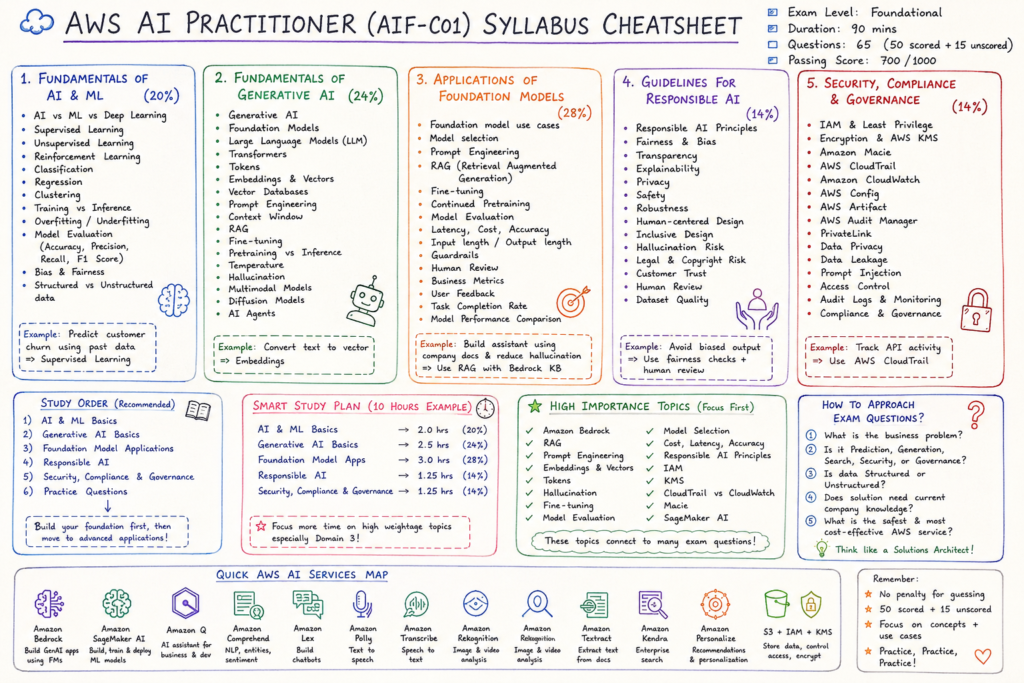
AWS AI Practitioner exam domains
The AIF-C01 exam has five domains:
- Fundamentals of AI and ML
- Fundamentals of Generative AI
- Applications of Foundation Models
- Guidelines for Responsible AI
- Security, Compliance, and Governance for AI Solutions
Here is the weightage:
| Domain | Weightage |
|---|---|
| Fundamentals of AI and ML | 20% |
| Fundamentals of Generative AI | 24% |
| Applications of Foundation Models | 28% |
| Guidelines for Responsible AI | 14% |
| Security, Compliance, and Governance | 14% |
The most important domain is Applications of Foundation Models because it has the highest weightage.
So, if you are preparing for this exam, do not spend all your time only on basic AI definitions.
You must also understand how foundation models are used in real-world applications.
Domain 1: Fundamentals of AI and ML
Weightage: 20%
This domain checks whether you understand the basic language of artificial intelligence and machine learning.
You should know the difference between:
- AI
- Machine learning
- Deep learning
- Generative AI
You should also understand common AI/ML use cases such as:
- Prediction
- Forecasting
- Classification
- Image recognition
- Text understanding
- Fraud detection
- Recommendation systems
- Document processing
This domain is like the foundation of the house.
If your basics are weak, the rest of the exam will feel confusing.
Topics to study in Domain 1
(1) AI vs ML vs deep learning
(2) Supervised learning
(3) Unsupervised learning
(4) Reinforcement learning
(5) Classification
(6) Regression
(7) Clustering
(8) Training
(9)Inference
(10)Overfitting
(11)Underfitting
(12)Model accuracy
(13)Precision
(14)Recall
(15)F1 score
(16)Bias
(17)Fairness
(18)Structured data
(19)Unstructured data
Simple example
Suppose a company has past customer data and wants to predict which customers may leave next month.
This is a machine learning problem.
Why?
Because the system learns from past data and predicts future customer churn.
If the company already has labeled examples, such as customers who left and customers who stayed, it becomes a supervised learning problem.
How AWS may ask this in the exam
The exam may give you a business scenario and ask which AI/ML approach fits best.
For example:
A company has labeled data and wants to predict whether an email is spam or not spam. Which learning type should be used?
The answer is supervised learning.
Why?
Because the model learns from labeled examples.
Common trap
- Do not confuse classification and regression.
- Classification predicts a category.
- Regression predicts a number.
- Spam or not spam is classification.
- House price prediction is regression.
Domain 2: Fundamentals of Generative AI
Weightage: 24%
This is one of the most important sections of the AWS AI Practitioner syllabus.
Generative AI is about creating new content.
It can generate:
- Text
- Images
- Code
- Audio
- Summaries
- Answers
- Conversations
- Documents
In this domain, AWS checks whether you understand the basic building blocks of generative AI.
Topics to study in Domain 2
(1) Generative AI
(2) Foundation models
(3) Large language models
(4)Transformers
(5) Tokens
(6) Embeddings
(7) Vectors
(8)Vector databases
(9) Prompt engineering
(10)Context window
(11) RAG
(12) Fine-tuning
(13) Pretraining
(14) Inference
(15) Temperature
(16) Hallucination
(17) Multimodal models
(18) Diffusion models
(19) AI agents
Simple example
When you ask ChatGPT or Amazon Bedrock to summarize a long document, it is using generative AI.
The model does not only search for the answer.
It generates a new response based on your prompt and available context.
How AWS may ask this in the exam
The exam may ask:
A company wants to convert text into vector representations so that similar documents can be searched. Which concept is being used?
The answer is embeddings.
Embeddings convert text into numerical meaning.
This helps systems compare similarity.
Common trap
Do not think that generative AI is always the best solution.
If the problem is simple prediction using structured historical data, traditional machine learning may be better.
For example, predicting sales for next month may not need a large language model.
A forecasting model may be enough.
Domain 3: Applications of Foundation Models
Weightage: 28%
This is the highest-weighted domain.
That means this domain can make a big difference in your score.
This domain is about applying foundation models to real business problems.
It is not enough to know what a foundation model is.
You should know how to use it properly.
Topics to study in Domain 3
(1)Foundation model use cases
(2) Model selection
(3) Prompt engineering
(4) RAG
(5) Fine-tuning
(6) Continued pretraining
(7) Model evaluation
(8) Latency
(9) Cost
(10)Accuracy
(11) Input length
(12) Output length
(13) Guardrails
(14) Human review
(15) Business metrics
(16) User feedback
(17) Task completion rate
(18) Model performance comparison
Simple example
Suppose a company wants to build a customer support assistant.
The assistant should answer only from company policy documents.
In this case, a foundation model alone may not be enough.
The company may need RAG.
RAG means the system retrieves trusted information first and then gives that information to the model to generate a grounded answer.
This reduces hallucination.
How AWS may ask this in the exam
The exam may ask:
A company wants a generative AI assistant to answer questions from internal documents and reduce hallucinations. Which approach should be used?
The likely answer is RAG.
On AWS, this can be implemented using Amazon Bedrock with a knowledge base.
Common trap
Do not choose fine-tuning for every knowledge problem.
If the company only wants the model to answer from updated internal documents, RAG is usually better.
Fine-tuning changes model behavior or style.
RAG connects the model to current external knowledge.
This difference is very important for the exam.
Domain 4: Guidelines for Responsible AI
Weightage: 14%
This domain is about using AI safely and ethically.
AI systems can create wrong, biased, harmful, or misleading outputs.
So AWS expects you to understand responsible AI principles.
Topics to study in Domain 4
(1) Responsible AI
(2) Fairness
(3) Bias
(4) Transparency
(5) Explainability
(6) Privacy
(7) Safety
(8) Robustness
(9)Human-centered design
(10)Inclusive design
(11) Hallucination risk
(12) Legal risk
(13) Copyright risk
(14) Customer trust
(15) Human review
(16) Dataset quality
Simple example
Suppose an AI hiring tool rejects candidates unfairly because the training data had bias.
That is a responsible AI problem.
The issue is not only technical.
It is also a trust, fairness, and business risk problem.
How AWS may ask this in the exam
The exam may ask:
A company wants to make sure its AI system does not produce biased or unsafe responses. What should it consider?
The answer may include responsible AI principles, human review, monitoring, fairness checks, and guardrails.
Common trap
Do not think responsible AI is only about security.
Security protects systems and data.
Responsible AI protects users, decisions, fairness, trust, and social impact.
Both are important, but they are not the same.
Domain 5: Security, Compliance, and Governance for AI Solutions
Weightage: 14%
This domain is about protecting AI systems, data, and access.
AI applications often deal with sensitive data.
So AWS expects you to understand basic security and governance ideas.
Topics to study in Domain 5
IAM
Least privilege
Encryption
AWS KMS
Amazon Macie
AWS CloudTrail
Amazon CloudWatch
AWS Config
AWS Artifact
AWS Audit Manager
PrivateLink
Data privacy
Data leakage
Prompt injection
Access control
Audit logs
Monitoring
Compliance
Governance
Simple example
Suppose a company is building an AI assistant for internal employees.
The assistant should not expose confidential data to unauthorized users.
This is a security and governance problem.
The company must use proper access control, encryption, monitoring, and logging.
How AWS may ask this in the exam
The exam may ask:
A company wants to make sure only authorized users can access AI resources. Which AWS service should help manage permissions?
The answer is IAM.
IAM is used for identity and access management.
Common trap
Do not confuse CloudWatch and CloudTrail.
CloudWatch is mainly for monitoring metrics and logs.
CloudTrail is mainly for recording API activity and audit history.
For exam questions, this difference matters.
Which domain should you study first?
My suggestion is:
Start with Domain 1.
Then study Domain 2.
After that, spend extra time on Domain 3.
Then complete Domain 4 and Domain 5.
So the preparation order should be:
(1) AI and ML basics
(2) Generative AI basics
(3) Foundation model applications
(4) Responsible AI
(5) Security and governance
(6) Practice questions
This order is better because each topic builds on the previous one.
For example, you cannot understand RAG properly if you do not understand embeddings and vectors.
You cannot understand hallucination mitigation if you do not understand how generative AI produces answers.
You cannot understand AI governance if you do not understand AI risks.
Smart study plan based on syllabus weightage
If you have 10 hours to prepare the syllabus, divide your time like this:
2 hours for AI and ML basics
2.5 hours for generative AI basics
3 hours for foundation model applications
1.25 hours for responsible AI
1.25 hours for security and governance
This is not a perfect formula.
But it helps you study based on exam weightage.
The biggest mistake is spending too much time on easy definitions and ignoring foundation model applications.
Most important topics for scoring well
If your exam date is close, focus on these topics first:
Amazon Bedrock
Foundation models
RAG
Prompt engineering
Embeddings
Vectors
Tokens
Hallucination
Fine-tuning
Model evaluation
Responsible AI
IAM
KMS
CloudTrail
CloudWatch
Macie
SageMaker AI
These topics connect to many questions.
They also help you answer scenario-based questions.
How to read exam questions
For every question, ask yourself five things:
(1) What is the business problem?
(2) Is the problem about prediction, generation, search, security, or governance?
(3) Is the data structured or unstructured?
(4) Does the solution need current company knowledge?
(5) What is the safest and most cost-effective AWS service?
This thinking pattern will help you eliminate wrong options.
For example:
(1) If the question says “extract data from invoices,” think Amazon Textract.
(2) If the question says “analyze images,” think Amazon Rekognition.
(3) If the question says “convert speech to text,” think Amazon Transcribe.
(4) If the question says “convert text to speech,” think Amazon Polly.
(5) If the question says “build GenAI app using foundation models,” think Amazon Bedrock.
(6) If the question says “train and deploy ML models,” think Amazon SageMaker AI.
Quick syllabus cheat sheet
Here is the simple version:
(1) Domain 1 is about AI and ML basics.
(2) Domain 2 is about GenAI basics.
(3) Domain 3 is about using foundation models in real applications.
(4) Domain 4 is about responsible and safe AI.
(5) Domain 5 is about security, compliance, and governance.
If you remember this, the syllabus becomes much easier.
Internal links to add later
Add these internal links when the blogs are published:
AWS AI Practitioner Exam Preparation: Simple AIF-C01 Roadmap
AI vs ML vs Deep Learning vs GenAI
What is Generative AI?
What is a Foundation Model?
RAG Explained for AWS AI Practitioner
RAG vs Fine-Tuning
Amazon Bedrock Explained
Amazon SageMaker AI Explained
Responsible AI Explained
IAM for AWS AI Practitioner
AWS AI Practitioner Practice Questions
FAQs
Is the AWS AI Practitioner exam difficult?
The exam is foundational, so it is not deeply technical. However, it can feel difficult if you only memorize definitions and do not practice scenario-based questions.
Which domain is most important for AWS AI Practitioner?
Applications of Foundation Models is the most important domain because it has the highest weightage. You should spend extra time on RAG, prompt engineering, model selection, evaluation, cost, latency, and hallucination mitigation.
Do I need coding for AWS AI Practitioner?
No, this exam does not require deep coding. You should understand AI, ML, GenAI concepts and AWS AI services at a practical level.
Should I study Amazon Bedrock first?
You should understand AI and GenAI basics first. After that, study Amazon Bedrock because many foundation model and GenAI application questions connect to Bedrock.
What is the best way to prepare for this syllabus?
Study one domain at a time. First understand the concept, then map it to a real business use case, then solve practice questions.
Final thoughts
The AWS AI Practitioner syllabus looks big at first.
But once you divide it into five domains, it becomes manageable.
Do not try to study everything randomly.
Follow the weightage.
Understand the concepts.
Learn the service mapping.
Practice scenario-based questions.
And most importantly, keep thinking like this:
What problem is the company trying to solve?
Which AI approach fits that problem?
Which AWS service should be used?
What are the risks?
How can we make the solution safe, reliable, and cost-effective?
That is the mindset you need to crack the AWS AI Practitioner exam.
This is Blog 2 of the AWS AI Practitioner preparation series.
In the next blog, we will start with the first core concept:
AI vs ML vs Deep Learning vs Generative AI.