
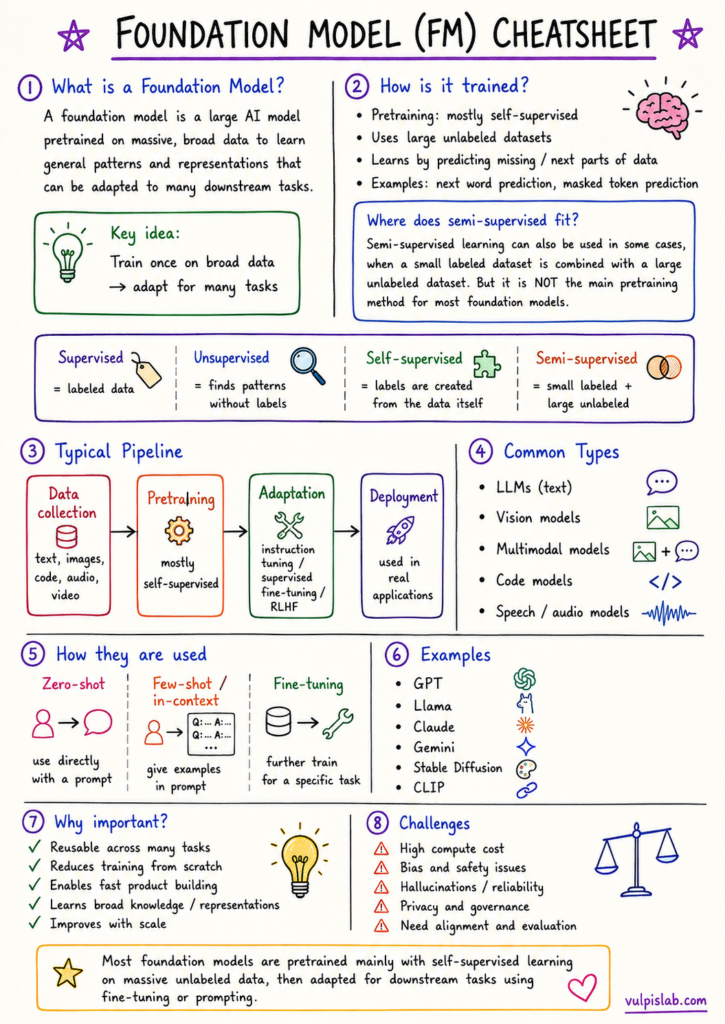
A foundation model is a large AI model trained on massive and broad data. This data can include text, images, code, audio, video, and documents.
The model learns general patterns from this data. Later, it can be adapted for many different tasks.
For example, one foundation model can help with writing, coding, summarizing, translation, customer support, legal research, image generation, and many more use cases.
That is why it is called a foundation model. It becomes the base on which many AI applications are built.
Think of It Like Makeup Foundation
To make this easier, think of a foundation model like makeup foundation.
Makeup foundation is not the final look. It is the base layer.
Once the base is ready, you can create many different looks on top of it. You can create a natural look, office look, party look, bridal look, or camera-ready look.
A foundation model works in a similar way.
It is not built for only one final task. First, it learns a broad base from massive data. Then, different AI products can be built on top of it.
So, in simple words:
Makeup foundation creates the base for many looks. An AI foundation model creates the base for many AI applications.
Simple Meaning of a Foundation Model
A foundation model learns general knowledge first.
It does not start by learning only one narrow task. Instead, it learns from a large and diverse collection of data.
After this, teams can adapt it for specific use cases.
For example, a foundation model can power many different AI products. It can work behind a chatbot that answers user questions. The same base model can also support a coding assistant that helps developers write and debug code.
In business use cases, it may become a customer support bot. In legal use cases, it can become a legal research copilot. For content teams, it can work as a writing assistant. For creative teams, it can support image generation. It can also improve search by understanding user intent better.
This is the power of a foundation model. One strong base can support many different applications.
Just like one good makeup foundation can support many makeup styles, one strong foundation model can support many AI products.
Why Is It Called a Foundation Model?
It is called a foundation model because it works like a base layer.
In makeup, foundation gives a smooth base before adding blush, contour, lipstick, or eye makeup.
In AI, a foundation model gives a strong base before building a chatbot, copilot, recommender, search tool, or automation system.
The final product may look different, but the base model supports it.
That is why companies do not always train a new AI model from zero. They often start with an existing foundation model and adapt it for their product.
How Is a Foundation Model Trained?
A foundation model is usually trained in two major stages.
The first stage is pretraining.
In this stage, the model learns from massive data. Most modern foundation models are pretrained using self-supervised learning.
This means the model creates learning signals from the data itself.
For example, a language model may learn by predicting the next word in a sentence.
Sentence:
“The capital of India is ____.”
The model learns that the likely answer is “New Delhi.”
It does this again and again on huge amounts of text. Over time, it learns patterns of language, meaning, structure, facts, and relationships.
This stage is like preparing the base layer. The model is not yet customized for one specific business use case. It is learning broad patterns first.
Is a Foundation Model Supervised or Unsupervised?
A foundation model is not purely supervised or purely unsupervised.
Most foundation models are mainly pretrained using self-supervised learning.
Let us understand this in simple language.
Supervised Learning
Supervised learning means the model learns from labeled data.
Example:
Image → Cat
Image → Dog
Here, the correct answer is already given.
This is like someone teaching you step by step with answers.
Unsupervised Learning
Unsupervised learning means the model gets data without labels and finds patterns on its own.
Example:
The model may group similar customer behavior without being told the category names.
This is like looking at many makeup products and arranging them by similarity without anyone giving labels.
Semi-Supervised Learning
Semi-supervised learning means the model uses a small amount of labeled data and a large amount of unlabeled data.
Example:
1,000 labeled legal documents
1 million unlabeled legal documents
The labeled data gives direction. The unlabeled data gives scale.
This can be useful in some foundation model workflows. However, it is usually not the main pretraining method for large foundation models.
Self-Supervised Learning
Self-supervised learning means the model creates labels from the data itself.
Example:
The model hides a word and tries to predict it.
Sentence:
“Foundation models are trained on massive ____.”
The model may predict “data.”
This is the most common method used during pretraining of foundation models.
So the simple answer is:
Most foundation models are pretrained mainly using self-supervised learning on massive unlabeled data. Later, they can be adapted using supervised fine-tuning, instruction tuning, RLHF, or sometimes semi-supervised methods.
Where Does Semi-Supervised Learning Fit?
Semi-supervised learning can be used when we have both labeled and unlabeled data.
For example, suppose a company is building a legal AI product.
It may have a small set of labeled legal documents where humans have marked sections like facts, issues, arguments, evidence, and judgment.
It may also have a very large set of unlabeled legal documents.
In this case, semi-supervised learning can help. The labeled data gives quality signals. The unlabeled data helps the model learn broader patterns.
But for large foundation models like GPT, Claude, Gemini, or Llama, the main pretraining approach is usually self-supervised learning.
So, semi-supervised learning is relevant, but it is not the main identity of most foundation models.
Typical Foundation Model Pipeline
A foundation model usually follows a simple pipeline.
The pipeline has four major steps:
Data collection
Pretraining
Adaptation
Deployment
Let us understand each step.
1. Data Collection
The first step is collecting large and diverse data.
This data may include:
Text
Images
Code
Audio
Video
Documents
Web pages
Research papers
The goal is to expose the model to many types of patterns.
For example, if the model only reads one type of data, it will become limited. But if it sees broad data, it can learn broader representations.
In the makeup example, this is like understanding different skin types, tones, textures, lighting conditions, and looks before creating a good base.
The better the base understanding, the better the final result.
However, data quality is very important.
If the data is biased, outdated, unsafe, or low quality, the model may also learn those problems.
That is why data collection is not just about quantity. It is also about quality.
2. Pretraining
After data collection, the model goes through pretraining.
This is where the foundation model learns general patterns.
For language models, pretraining may involve predicting the next word or missing word.
But for vision models, it may involve understanding image patterns.
And similarly,for multimodal models, it may involve connecting text, images, audio, and video.
Pretraining is expensive. It needs a lot of compute, engineering, storage, and time.
But this stage is important because it creates the base capability of the model.
In the makeup analogy, pretraining is like creating the base foundation layer. It prepares the surface before any final look is created.
3. Adaptation
After pretraining, the foundation model is adapted for real use cases.
This can happen through:
- Prompting
- Few-shot learning
- Instruction tuning
- Supervised fine-tuning
- RLHF
- Domain-specific fine-tuning
For example, a general model can be adapted for legal research. Another version can be adapted for customer support. Another one can be adapted for coding.
The base model may be the same, but the final use case can be different.
This is exactly like makeup foundation.
The base layer may be the same, but the final look can change based on what you add next.
For an office look, you keep it simple.
But, for a bridal look, you add more layers.
And for a camera look, you adjust it for lighting.
Similarly, for AI products, the foundation model is adjusted based on the use case, users, data, and risk level.
4. Deployment
The final stage is deployment.
Deployment means using the foundation model inside a real product or workflow.
Examples include:
- Chatbots
- Coding copilots
- Legal research tools
- AI writing tools
- Enterprise search tools
- Customer support agents
- Image generation tools
But deployment is not the end.
Teams must monitor the model after launch.
They need to check:
Accuracy
Latency
Cost
Hallucination
User feedback
Safety
Bias
Privacy
Reliability
A foundation model may perform well in testing but behave differently in real-world usage. That is why monitoring is very important.
Common Types of Foundation Models
Foundation models are not only used for text. They are used across many formats.
Large Language Models
Large language models, also called LLMs, mainly work with text.
Examples include:
GPT
Claude
Gemini
Llama
These models can write, summarize, translate, explain, classify, reason, and answer questions.
They are commonly used in chatbots, writing tools, search tools, and copilots.
Vision Models
Vision foundation models work with images.
They can understand image patterns, detect objects, classify images, and support image search.
Examples include CLIP, DINO, and Vision Transformers.
These models are useful in healthcare imaging, e-commerce search, security, design, and visual understanding.
Multimodal Models
Multimodal models can understand more than one type of input.
For example, they may work with text and images together.
Some advanced models can work with text, images, audio, and video.
This is useful because real-world problems are not always text-only.
For example, a user may upload a screenshot and ask a question about it. A multimodal foundation model can understand both the image and the text.
Code Models
Code foundation models are trained on programming data.
They can help developers write code, debug errors, explain code, create test cases, and generate documentation.
These models are useful in developer tools, software engineering workflows, and technical copilots.
Speech and Audio Models
Speech and audio foundation models work with voice, sound, and spoken language.
They can support transcription, translation, voice assistants, meeting summaries, and audio understanding.
These models are useful in customer support, accessibility, education, and communication products.
How Foundation Models Are Used
Foundation models can be used in different ways.
The most common ways are:
Zero-shot prompting
Few-shot prompting
Fine-tuning
Zero-Shot Prompting
In zero-shot prompting, you ask the model to do a task without giving examples.
Example:
“Summarize this article in five bullet points.”
The model uses its existing training to answer.
This is like applying makeup foundation and creating a simple natural look without much extra styling.
You are using the base capability directly.
Few-Shot Prompting
In few-shot prompting, you give the model a few examples before asking it to perform a task.
Example:
Input: “I love this product.”
Output: Positive
Input: “This app crashes every time.”
Output: Negative
Now classify this:
“The service was slow.”
The model looks at the examples and follows the pattern.
This is like showing a makeup artist a few reference looks before asking for a similar final look.
The base is already there, but examples guide the final output.
Fine-Tuning
Fine-tuning means further training the model on specific data.
For example, a company may fine-tune a model on legal documents, medical documents, product support tickets, or coding data.
Fine-tuning helps the model perform better in a specific domain.
This is like customizing makeup foundation for a specific skin tone, skin type, lighting condition, or event.
The base product exists, but it is adjusted for a more specific need.
However, fine-tuning requires care. It needs good data, evaluation, and safety checks.
Why Are Foundation Models Important?
Foundation models are important because they reduce the need to build every AI model from scratch.
Earlier, companies often built separate models for separate tasks.
One model for translation.
Another, model for classification.
One model for summarization.
One model for question answering.
Foundation models changed this approach.
Now, one broad model can be adapted for many tasks.
This saves time, reduces effort, and helps companies build AI products faster.
Foundation Models Help Product Teams Move Faster
For product teams, foundation models are very useful.
A team does not always need to train a model from zero.
Instead, the team can use an existing foundation model and build a product experience around it.
That product layer may include:
User interface
Prompt design
RAG pipeline
Safety checks
Human review
Evaluation system
Monitoring dashboard
Feedback loop
Business workflow
This is where real product thinking matters.
The foundation model is powerful, but it is not the complete product.
In makeup terms, foundation alone is not the final look. You still need the right technique, setting powder, lighting, finishing, and purpose.
Similarly, in AI, the foundation model is not the full product. You still need user experience, workflow design, safety, evaluation, and business logic.
Challenges of Foundation Models
Foundation models are powerful, but they also come with challenges.
High Compute Cost
Training and running foundation models can be expensive.
The cost depends on model size, usage, tokens, infrastructure, and latency needs.
For companies, cost is not only a technical issue. It is also a product and business issue.
If the model is too costly to run, the product may not scale profitably.
Bias and Safety Issues
Foundation models learn from large datasets.
If the training data has bias, the model may also learn that bias.
This can create unfair, unsafe, or harmful outputs.
That is why responsible AI practices are important.
Teams must test the model carefully before using it in sensitive use cases.
Hallucination
Hallucination happens when an AI model gives an answer that sounds confident but is wrong.
This is one of the biggest risks of foundation models.
For example, a model may create a fake legal citation, wrong medical explanation, or incorrect financial answer.
In casual use cases, this may be annoying. But in legal, healthcare, finance, and enterprise use cases, it can be serious.
To reduce hallucination, teams use methods like:
Retrieval-augmented generation
Citations
Guardrails
Human review
Evaluation systems
Confidence scoring
Source verification
A foundation model needs a strong safety layer, especially in high-risk domains.
Privacy and Governance
Foundation models may be used with sensitive information.
This creates privacy and governance concerns.
Companies need clear rules for:
Data storage
Data access
Logging
Consent
Security
Compliance
User permissions
Without governance, an AI product can become risky.
Alignment and Evaluation
A foundation model should behave in a way that matches user needs, business goals, and safety expectations.
This requires continuous evaluation.
Teams should test the model before launch and after launch.
They should track quality, safety, reliability, cost, and user trust.
Just like makeup needs touch-ups in different lighting, AI models need continuous checks in real-world usage.
Foundation Model Examples
Some common examples of foundation models are:
GPT
Claude
Gemini
Llama
Stable Diffusion
CLIP
Each model has different strengths.
Some are stronger in text.
Other are stronger in coding.
Some are stronger in images.
Some are stronger in multimodal tasks.
The right model depends on the use case.
For example, a legal research copilot may need accuracy, citations, and long-context understanding.
A design tool may need image generation and visual understanding.
A coding assistant may need strong code generation and debugging ability.
A customer support bot may need speed, consistency, and safe responses.
So, choosing the foundation model is not only a technical decision. It is also a product decision.
Foundation Model vs Traditional AI Model
A traditional AI model is usually trained for one specific task.
For example:
Spam detection
Fraud detection
Sentiment analysis
Image classification
A foundation model is different.
It is trained broadly first and then adapted for many tasks.
Simple difference:
A traditional AI model is like one fixed makeup look.
A foundation model is like the base that can support many looks.
This makes foundation models more flexible.
However, flexibility also brings responsibility. Teams must still design, test, and monitor them carefully.
Foundation Model in One Line
A foundation model is a large AI model trained on massive broad data to learn general patterns, which can later be adapted for many different tasks.
Or, in a relatable way:
A makeup foundation creates the base for many looks. An AI foundation model creates the base for many AI applications.
Final Thoughts
Foundation models are the base of many modern AI products.
They are not built for only one narrow task. Instead, they learn broad patterns from large data and can be adapted for different use cases.
The most important thing to remember is this:
Most foundation models are pretrained using self-supervised learning on massive unlabeled data. Later, they are adapted using prompting, fine-tuning, instruction tuning, RLHF, or other methods.
For beginners, the simplest way to understand foundation models is:
Train once on broad data.
Adapt for many tasks.
Use carefully in real products.
That is the power of a foundation model.
Just like makeup foundation is only the starting base for a final look, an AI foundation model is only the starting base for a final AI product.
The real value comes when the base is used thoughtfully, safely, and for the right user problem.
Note – Foundation models can hallucinate because they are trained to predict likely outputs, not to verify every answer like a fact-checking database. They learn patterns from massive data and generate fluent responses based on probability. However, a fluent answer is not always a correct answer. That is why high-risk AI products need grounding, citations, guardrails, evaluation, and human review.