
Introduction
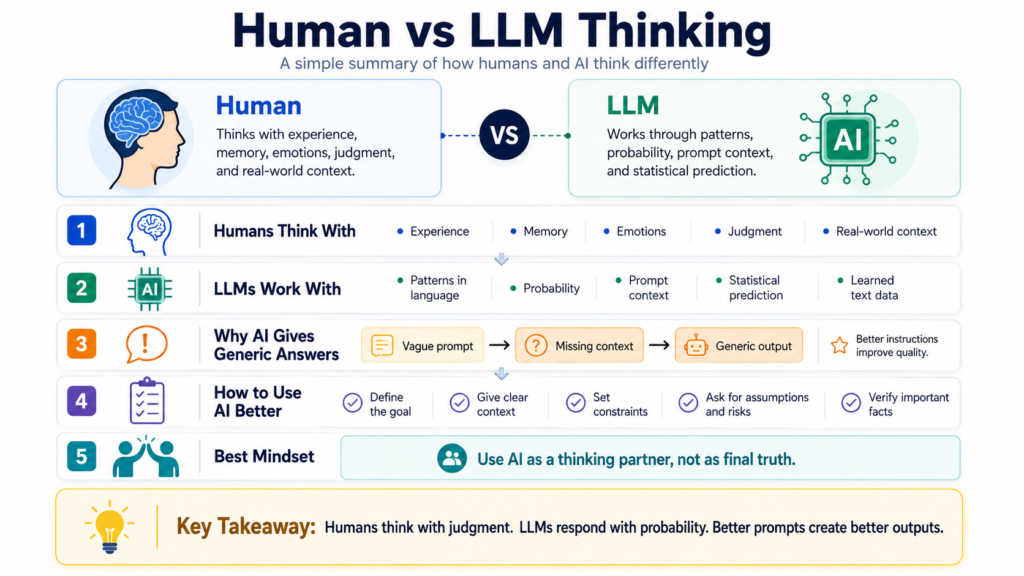
Human vs LLM Thinking is one of the most important concepts to understand before you start using AI tools like ChatGPT or Claude.
Many people open ChatGPT, type one simple question, and expect a perfect answer. However, when the answer sounds confident but turns out to be wrong, they feel confused.
This happens because we assume AI thinks like humans.
But it does not.
A human thinks with experience, memory, emotions, judgment, and real-world understanding. An LLM, on the other hand, generates answers by predicting patterns in language.
So, before we learn prompt writing or advanced AI workflows, we need to understand this basic difference.
Because once we understand how AI works, we can write better prompts, reduce mistakes, and use AI as a powerful thinking partner.
What Is Human Thinking?
Let’s start with something very simple.
When humans solve a problem, they do not only process words. They also use memory, emotions, past experience, judgment, and context.
For example, imagine your friend says, “I am fine.”
On paper, this sentence looks very clear. However, if your friend’s voice is low, their face looks tired, and they avoid eye contact, you may understand something else.
You may feel that they are not actually fine.
Why does this happen?
Because human thinking goes beyond words.
We notice tone. We notice body language. We remember past behavior. We understand emotions. Then, based on all these signals, we create meaning.
So, human thinking is not just about language. It is language plus experience, emotion, memory, judgment, and real-world awareness.
This is what makes human thinking powerful.
What Is LLM Thinking?
Now let’s compare this with an LLM.
An LLM, or Large Language Model, does not think like a human. Tools like ChatGPT and Claude do not feel emotions. They do not have lived experience. They do not understand pressure, fear, confusion, or urgency the way humans do.
Instead, they generate answers based on patterns.
When you give a prompt, the model looks at the words, context, and instructions. Then it predicts what response is most likely to be useful.
That is why people often say that LLMs are prediction machines.
However, this does not mean they are simple.
They can recognize patterns in writing, code, logic, product documents, interview answers, research summaries, and business content.
Because of this, they can help you write a PRD, summarize a report, create user stories, prepare for interviews, and even brainstorm strategy.
Still, the core difference remains the same.
A human thinks from lived experience. An LLM generates from learned patterns.
And this difference matters a lot.
Human vs LLM Thinking in Product Work
Let’s understand this with a product example.
Suppose you ask a Product Manager:
“Should we build this feature?”
A good Product Manager will not immediately say yes or no. Instead, they may ask a few important questions.
Who is the user?
What problem are we solving?
What data do we have?
What is the business goal?
What is the risk?
What happens if we do not build this feature?
Along with these questions, the Product Manager may also use experience.
Maybe they have seen a similar feature fail before. Maybe they know that stakeholders are pushing for something users do not actually need. Or maybe they can sense that the real problem is hidden behind the feature request.
Now ask the same question to an LLM:
“Should we build this feature?”
The model may still give you a polished answer.
It may say that you should evaluate user needs, business impact, feasibility, and success metrics.
Now, this answer is not wrong. However, it is generic.
Why?
Because the model does not know your product. It does not know your users. It does not know your business pressure. It does not know your data. So, when you do not give enough context, it fills the gap with a general answer.
This is why many people get average output from AI.
Not because the model is useless.
But because the prompt is unclear.
Why Prompt Quality Matters
The first lesson is simple.
AI output depends heavily on the quality of your input.
If your prompt is vague, the answer will also be vague.
For example, if you write:
“Write a PRD for an AI assistant.”
You will get a PRD. However, it will most likely be generic.
Now compare it with this prompt:
“Act as a Senior Product Manager. Create a PRD for an AI assistant that helps first-time investors from Tier 2 and Tier 3 Indian cities understand investment terms. The assistant should educate users but should not give direct stock advice. Include the problem statement, personas, user journey, key features, success metrics, risks, and acceptance criteria. Keep the language simple and business-ready.”
Now the output will be much stronger.
Why?
Because now the model has direction.
It knows the role. It knows the user. It knows the product goal. It knows the boundary. It knows the format. It also knows the tone.
As a result, the model is not guessing randomly. It is working inside the frame you gave it.
And that is what good prompting really means.
Good prompting is not about writing fancy English. It is about giving the model the right thinking frame.
The Main Difference Between Humans and LLMs
Now let’s make the difference very clear.
Humans think with judgment.
LLMs respond with probability.
Humans can say, “This does not feel right.”
However, an LLM may still produce a confident answer, even when the answer is not fully correct.
Humans can understand responsibility.
LLMs do not truly understand responsibility. They follow instructions and generate output.
Humans can connect real-world consequences.
LLMs can describe consequences, but they do not personally experience them.
This is why we should never use AI blindly, especially in areas like healthcare, finance, legal work, product decisions, technical architecture, or business strategy.
AI can help us think faster. However, it should not replace our judgment.
How to Use AI as a Thinking Partner
The best way to use AI is not to ask, “Give me the final answer.”
A better way is to ask, “Help me think through this problem.”
For example, instead of asking:
“Give me a product strategy.”
You can ask:
“Help me analyze this product problem. First identify the assumptions. Then explain the user pain points, business goals, risks, trade-offs, and possible solution options. Also tell me what data I should validate before making a final decision.”
Now see the difference.
In the first prompt, you are asking AI to give an answer.
In the second prompt, you are asking AI to support your thinking.
And that is where AI becomes powerful.
It becomes your thinking partner.
It can help you structure messy ideas. It can help you find missing points. It can help you create drafts faster. It can help you compare options. It can also help you prepare better.
But the final judgment still belongs to you.
You decide what is correct. You decide what is ethical. You decide what fits the business. You decide what users actually need. You also decide what needs verification.
A Simple Mental Model for AI
Whenever you use ChatGPT or Claude, use this simple mental model.
Treat AI like a smart but fast assistant.
It can do a lot. However, it needs clear direction.
If you say, “Make something good,” it may produce something average.
But if you say, “Here is the goal, here is the audience, here is the context, here are the constraints, and here is the format,” the output becomes much better.
So, the quality of AI output is not only about the model.
It is also about your thinking.
That is why this week is called Thinking Like a Model.
Because once you understand how the model works, you stop giving random prompts.
You start giving clear context. You define the goal. You set boundaries. You ask for assumptions, risks, and trade-offs. Most importantly, you stop treating AI as the final truth.
Key Takeaway
The key takeaway is simple.
Humans think with experience and judgment. LLMs generate responses through patterns and probability.
That means AI is powerful, but it needs guidance.
It can support your thinking, but it cannot replace your thinking.
So, before you write your next prompt, pause for a few seconds and ask yourself:
What is my goal?
What context does the model need?
What output format do I want?
Where can the model make a mistake?
What should I verify before using the answer?
Because AI does not read your mind.
It reads your prompt.
And better prompts come from better thinking.
That is the first step in learning how to think like a model.
FAQ
What is the difference between human thinking and LLM thinking?
Human thinking uses memory, emotion, experience, judgment, and real-world context. LLM thinking is based on patterns and probability. An LLM predicts the most likely useful response based on the prompt it receives.
Why do LLMs give generic answers?
LLMs give generic answers when the prompt does not include enough context. If you do not share the user, goal, problem, constraints, or format, the model fills the gap with a general response.
Can AI replace human judgment?
No, AI can support human thinking, but it should not replace human judgment. Humans still need to verify facts, check assumptions, understand real-world consequences, and make final decisions.
How can I get better answers from ChatGPT or Claude?
You can get better answers by giving clear context, defining the role, explaining the goal, setting boundaries, sharing the expected format, and asking the model to mention assumptions, risks, and trade-offs.
Why is prompt design important?
Prompt design is important because AI output depends on input quality. A clear prompt helps the model understand what you need and reduces the chances of vague, generic, or incorrect answers.