
A recommendation system is a technology that suggests products, videos, songs, movies, articles, or other things that a user may like.
It works like a friendly shopkeeper who remembers what you usually buy and shows you something similar the next time you visit.
For example, when Netflix recommends a movie, YouTube suggests another video, Spotify creates a playlist, or Amazon shows products under “You may also like,” a recommendation system is working behind the screen.
In the simplest words, a recommendation system looks at small clues about what you like and uses those clues to guess what may interest you next.
Recommendation system meaning in one sentence
A recommendation system is software that predicts what a user may like and shows relevant suggestions based on data, behaviour, similarity, and context.
Let us understand it with a small story
Imagine that you visit an ice cream shop every Sunday.
You usually choose chocolate ice cream.
The shopkeeper notices this.
One day, a new chocolate brownie flavour arrives, and the shopkeeper says, “You normally like chocolate, so you may enjoy this new flavour too.”
The shopkeeper is not reading your mind.
He is only remembering your earlier choices and making a sensible guess.
A recommendation system works in the same way, but instead of using human memory, it uses data collected by a website or an app.
It may look at what you watched, clicked, searched for, bought, saved, rated, or ignored.
It then uses those clues to decide what to show you next.
That is why the easiest way to understand a recommendation system is to think of it as a digital shopkeeper.
Where do we see recommendation systems?
We use recommendation systems almost every day, even when we do not notice them.
Netflix recommends movies and shows based on what you watched earlier.
YouTube suggests videos related to your viewing history.
Spotify recommends songs based on the artists, languages, and music styles you usually listen to.
Amazon recommends products based on what you searched for, viewed, saved, or purchased.
Instagram and other social platforms also recommend posts, videos, and accounts based on what you interact with.
For example, suppose you watch several videos about baking cakes.
YouTube may start recommending cake decoration videos, baking tools, dessert recipes, or cooking channels.
The system is making a simple prediction:
“You watched baking videos before, so you may also enjoy another baking-related video.”
Why do we need recommendation systems?
Recommendation systems are needed because the internet gives us too many choices.
A shopping website may contain millions of products.
A streaming platform may contain thousands of movies and shows.
A music app may contain more songs than anyone could listen to in a lifetime.
Having many choices sounds helpful, but too many choices can also make people confused.
Imagine entering a library with ten lakh books, but there are no shelves, no categories, no librarian, and no search box.
You may know that the library contains many good books, but you would not know where to begin.
A recommendation system acts like the librarian.
It looks at your interests and shows you a smaller group of options that may be relevant.
This saves time, reduces confusion, and helps users discover things they may not have found on their own.
How does a recommendation system know what you like?
A recommendation system learns from the small actions you perform on a website or app.
These actions are called signals.
The system may look at:
- What you search for.
- What you click.
- What you watch.
- How long you watch.
- What you buy.
- What you save.
- What you rate.
- What you skip.
- What you remove from your cart.
For example, suppose you search for running shoes, save fitness videos, and read healthy meal plans.
The system may notice a fitness-related pattern.
It may then recommend workout clothes, exercise equipment, running videos, or health-related articles.
The system does not truly understand you like another human being would.
It does not know your thoughts or feelings.
It simply studies patterns in your behaviour and makes a prediction.
So, a recommendation system does not read your mind.
It observes your actions and makes an educated guess.
What data does a recommendation system use?
A recommendation system can use different kinds of data.
Some information is given directly by the user.
This is called explicit data.
Explicit data may include:
- Ratings.
- Likes.
- Dislikes.
- Selected interests.
- Favourite categories.
- Reviews.
For example, when you give a movie five stars, you are directly telling the platform that you liked it.
Other information comes from what the user does.
This is called implicit data.
Implicit data may include:
- Clicks.
- Watch time.
- Search history.
- Purchases.
- Saved items.
- Scrolling.
- Abandoned carts.
For example, you may never press the “like” button on a cooking video, but if you watch the entire video and then watch three more cooking videos, the system may understand that you are interested in cooking.
The system may also use product information such as price, category, colour, brand, language, actor, topic, or description.
It may also use context such as time, location, season, weather, or device.
What are the main types of recommendation systems?
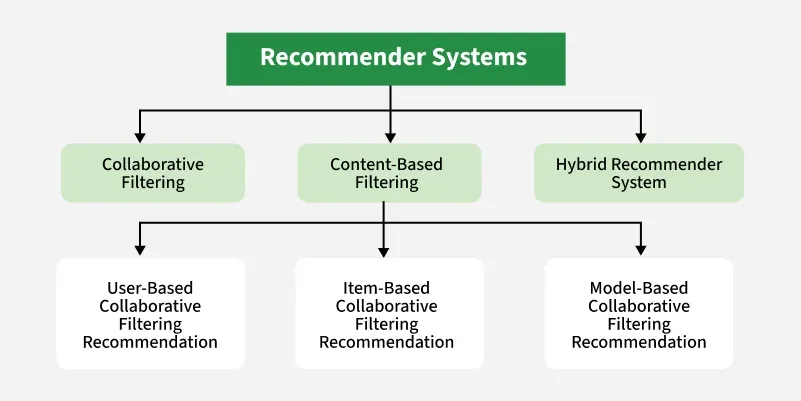
Recommendation systems can work in different ways, but four types are common.
1. Content-based recommendation system
A content-based recommendation system suggests things that are similar to what the user already liked.
Suppose you watch several beginner-level Python videos.
The platform may recommend more Python tutorials, coding exercises, or beginner programming courses.
It does this because the new content is similar to what you watched earlier.
For a movie, the system may compare genre, actors, language, director, or story type.
For a product, it may compare category, price, colour, brand, or material.
The simple idea is:
You liked this, so you may also like something similar.
2. Collaborative filtering
Collaborative filtering uses the behaviour of people with similar interests.
Imagine that you and another person watched and liked many of the same movies.
That person then watches a new movie and gives it a high rating.
The system may recommend that movie to you because both of you liked similar movies in the past.
This is also the idea behind messages such as:
“Customers who bought this also bought.”
“People with similar interests watched this.”
The system may not fully understand what the movie or product is about.
It simply notices that people with similar choices often like the same things.
The simple idea is:
People who liked what you liked also enjoyed this.
3. Context-based recommendation system
A context-based recommendation system looks at the user’s current situation.
A food delivery app may recommend breakfast in the morning and dinner in the evening.
A music app may suggest energetic songs during a workout and calm music at night.
A travel app may recommend nearby hotels based on location.
A shopping platform may recommend umbrellas during the rainy season.
The simple idea is:
This suggestion may be useful to you right now.
4. Hybrid recommendation system
A hybrid recommendation system combines several methods.
Large platforms usually do not depend on only one clue.
They may study:
- What you liked.
- What similar users liked.
- What is currently popular.
- What is similar to your earlier choices.
- What time it is.
- Where you are.
- What device you are using.
For example, Netflix may recommend a movie because it belongs to your favourite genre, people with similar viewing habits enjoyed it, and it is popular in your country.
The simple idea is:
Using several useful clues can create a better recommendation.
What is the difference between search and recommendation?
Search and recommendation are different.
Search begins when the user asks for something.
Recommendation begins when the system makes a prediction.
For example, when you type “black shoes under ₹2,000” into a shopping website, you are using search.
You already know what you want, so you enter a query.
When the same website later shows “You may also like these shoes,” it is using a recommendation system.
You did not search for those exact shoes.
The system predicted that they may interest you.
Search helps users find what they already know they want.
Recommendation helps users discover something they may not have considered.
What is the cold-start problem?
A recommendation system needs information before it can make a useful suggestion.
But what happens when the user is completely new?
The system does not know what the new user likes because there is no search history, watch history, purchase history, or rating.
This is called the cold-start problem.
A new product can create the same problem.
If a product has just been added to a shopping website, nobody has clicked, bought, or rated it yet.
The system may not know who should see it.
Platforms solve this problem in different ways.
They may ask new users to select a few interests during signup.
A music app may ask users to select favourite artists.
A video platform may ask users to choose topics such as cooking, sports, technology, or travel.
The platform may also show popular content until it learns more about the user.
It may recommend a new product based on its category, price, description, or similarity to older products.
The cold-start problem is similar to meeting someone for the first time.
You cannot immediately know what they like, but you can learn slowly by asking questions and observing their choices.
Can a recommendation system make mistakes?
Yes, a recommendation system can make mistakes.
It sees what you do, but it may not understand why you did it.
Suppose you search for a baby stroller because you want to buy a gift for someone.
The website may assume that you are interested in baby products.
It may then continue showing you baby clothes, toys, feeding bottles, and parenting products for several weeks.
The system saw your search, but it did not understand the reason behind it.
A recommendation system may also continue showing something you no longer like.
You may have watched cricket videos last year, but your interests may have changed.
The system may still continue recommending cricket content because it is using old information.
Therefore, good recommendation systems need options such as:
- Not interested.
- Hide this recommendation.
- Remove from watch history.
- Do not recommend this channel.
- Change preferences.
These controls help users teach the system when its prediction is wrong.
What is a filter bubble?
A filter bubble happens when a recommendation system keeps showing the user the same kind of content again and again.
Suppose you watch one video supporting a particular idea.
The platform may recommend another similar video.
Then it may recommend several more.
After some time, you may mostly see content that repeats the same opinion.
You may stop seeing different ideas, even though they exist.
This creates a narrow information bubble around the user.
For entertainment, repetition may simply become boring.
For news, health, politics, or financial information, it can become more serious because the user may start believing that one viewpoint is the only viewpoint.
A responsible recommendation system should balance relevance with variety.
It should sometimes show something different, useful, or unexpected instead of repeating the same content continuously.
Can recommendation systems be unfair?
Yes, recommendation systems can sometimes be unfair.
A recommendation system learns from data.
If the data contains bias, the recommendations may also contain bias.
For example, imagine that a job platform learns from older hiring data in which certain groups received more opportunities than others.
If the system copies those old patterns, it may continue recommending some jobs to one group and fewer jobs to another.
A shopping system may also keep recommending expensive products to users from particular locations without properly understanding their actual needs.
This is why recommendation systems should be tested for fairness.
Teams should check whether certain users, products, sellers, creators, or communities are being ignored without a valid reason.
A useful recommendation system should not only be accurate.
It should also be fair.
Why is diversity important in recommendations?
A recommendation system should not show the same type of item repeatedly.
Users may like familiar things, but they may also enjoy discovering something new.
For example, suppose a music app knows that you enjoy Hindi film songs.
If it recommends only the same ten songs every day, the suggestions will soon become boring.
A better system may recommend a new singer, a different album, or a similar music style.
This is called diversity in recommendations.
A good recommendation system balances two things:
It shows familiar options that the user is likely to enjoy.
It also introduces some new options that the user may discover.
Without relevance, recommendations feel random.
Without diversity, recommendations feel repetitive.
What about privacy?
Recommendation systems need data, but that does not mean companies should collect unlimited information.
A platform should collect only the data it genuinely needs.
It should clearly explain:
- What information is being collected.
- Why it is being collected.
- How recommendations are created.
- How long the data is stored.
- Whether users can delete their history.
- Whether users can turn personalisation off.
For example, a music app may need listening history to recommend songs.
It may not need unrelated personal information that has nothing to do with music preferences.
Personalisation should help the user.
It should not become an excuse to follow every action without clear permission.
Why do businesses use recommendation systems?
Businesses use recommendation systems because relevant suggestions can improve the customer experience.
When users find useful options quickly, they are more likely to stay on the platform, watch another video, buy another product, or return later.
For example, a person may visit an online bookstore to buy one book.
The “Readers also bought” section may help that person discover another useful book.
The user finds something relevant, and the business may receive another sale.
Recommendation systems can help businesses improve:
- Product discovery.
- Sales.
- Engagement.
- Retention.
- Customer satisfaction.
- Content consumption.
- Repeat visits.
However, businesses should not measure only clicks, watch time, or revenue.
A recommendation that increases clicks but gives the user a poor experience is not truly successful.
How should a recommendation system be measured?
A good recommendation system should be measured using both business value and user value.
Businesses may measure:
- Click-through rate.
- Conversion rate.
- Watch time.
- Sales.
- Repeat purchases.
- Retention.
But these numbers do not tell the complete story.
Teams should also measure:
- Whether recommendations are relevant.
- Whether suggestions are diverse.
- Whether users hide recommendations.
- Whether the system repeats too much.
- Whether different users are treated fairly.
- Whether users trust the suggestions.
- Whether privacy is protected.
For example, a video platform may increase watch time by recommending shocking content.
The number may look good on a dashboard, but the experience may not be healthy or useful.
A good recommendation system should create long-term value instead of only increasing short-term clicks.
Is a recommendation system artificial intelligence?
A recommendation system can use artificial intelligence, but not every recommendation system requires advanced AI.
A small website may recommend the most popular products in a category.
That is still a basic recommendation system.
A large platform such as Amazon, Netflix, Spotify, or YouTube may use machine learning to study millions of users, products, and interactions.
For example, a simple system may say:
“This toy is popular, so show it to everyone.”
An advanced system may say:
“This user likes building toys, usually shops in this price range, and has viewed similar products, so show this particular building set.”
Both systems make recommendations, but the second one uses more data and more advanced technology.
What makes a recommendation system good?
A good recommendation system should understand the user’s need without taking away the user’s control.
It should provide useful suggestions.
It should avoid repeating the same content continuously.
It should protect privacy.
It should treat users fairly.
It should allow users to correct wrong recommendations.
It should also explain recommendations when possible.
For example, messages such as “Because you watched this,” “Based on your recent search,” or “Popular in your area” help users understand why something is being shown.
Clear explanations can improve trust.
The easiest way to remember a recommendation system
Think of a recommendation system as a digital shopkeeper.
A good shopkeeper remembers what you like, suggests something useful, and still allows you to make your own decision.
A bad shopkeeper keeps pushing expensive products even when they are not useful to you.
A good recommendation system should behave like the good shopkeeper.
It should guide the user, not control the user.
It should make discovery easier, not create confusion.
It should offer relevant choices while still leaving the final decision with the user.
Final takeaway
A recommendation system is a technology that uses data such as searches, clicks, ratings, purchases, and viewing history to predict what a user may like next.
It exists because websites and applications contain too many choices, and people need an easier way to discover relevant products, movies, songs, videos, courses, or articles.
Netflix recommending a movie, Spotify suggesting a song, Amazon showing a product, and YouTube offering another video are all everyday examples of recommendation systems.
The best recommendation system is not the one that simply makes people click more.
It is the one that helps the right person discover the right option at the right time while respecting privacy, fairness, diversity, and user choice.
So, whenever an app says, “You may also like this,” remember that a recommendation system is working behind the screen like a digital shopkeeper.
Frequently Asked Questions
What is a recommendation system in simple words?
A recommendation system is software that suggests products, movies, songs, videos, articles, or other items that a user may like.
What is the easiest example of a recommendation system?
When YouTube suggests another video after you finish watching one, it is using a recommendation system.
How does a recommendation system know what I like?
It studies signals such as searches, clicks, watch history, ratings, purchases, and saved items, and then uses those patterns to predict what may interest you.
What are the main types of recommendation systems?
The main types are content-based recommendation, collaborative filtering, context-based recommendation, and hybrid recommendation.
What is collaborative filtering?
Collaborative filtering recommends items based on the behaviour of users who have similar interests.
What is a content-based recommendation system?
A content-based recommendation system suggests items that are similar to something the user already liked.
What is the cold-start problem?
The cold-start problem happens when a recommendation system does not have enough information about a new user or a new item.
What is a filter bubble?
A filter bubble happens when a recommendation system repeatedly shows similar content and limits the variety of information a user sees.
Can recommendation systems be unfair?
Yes. If the data contains bias, the recommendations may also become unfair to certain users, products, sellers, or communities.
Are recommendation systems safe for privacy?
They can be, but platforms should collect only necessary data, explain how it is used, and give users control over their history and preferences.
Is a recommendation system artificial intelligence?
Many recommendation systems use AI and machine learning, while simpler systems may use popularity, categories, or fixed business rules.
What is the main goal of a recommendation system?
The main goal is to help the right user discover the right item at the right time with less effort.