

What Is a REST API? Quick Answer
A REST API is the most common type of API on the web. It lets two programs talk to each other using simple web rules. In short, REST is a popular style that keeps APIs clean, predictable, and easy to use.
A Quick Reminder About APIs
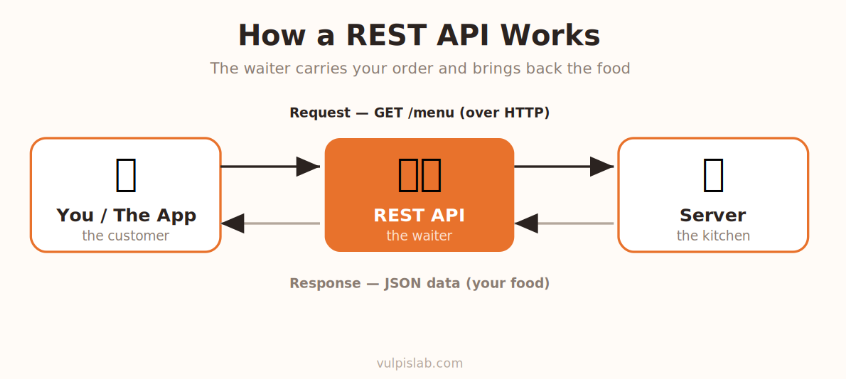
In our last post, we learned that an API works like a waiter. You place an order, the waiter carries it to the kitchen, and then returns with your food. A REST API follows that same idea. It just adds a clear set of rules for how the order should be placed.
What Does REST Stand For?
REST stands for Representational State Transfer. That sounds complex, but the meaning is simple. REST is just a style, or a set of rules, for building APIs. When an API follows these rules, we call it a “RESTful” API.
REST Uses the Language of the Web
Every time you open a website, your browser talks to a server using a language called HTTP. A REST API uses that same language.
This is one reason REST is so popular. It uses tools the web already has, so developers do not need to learn anything new.
The Four Main Actions
A REST API works through a few simple actions. Think of them as the things you can do at our restaurant. There are four you will see most often:
- GET means “show me.” You use it to read or fetch information, like asking to see the menu.
- POST means “add this.” You use it to create something new, like placing a fresh order.
- PUT means “change this.” You use it to update something, like changing your order before it reaches the kitchen.
- DELETE means “remove this.” You use it to delete something, like cancelling your order.
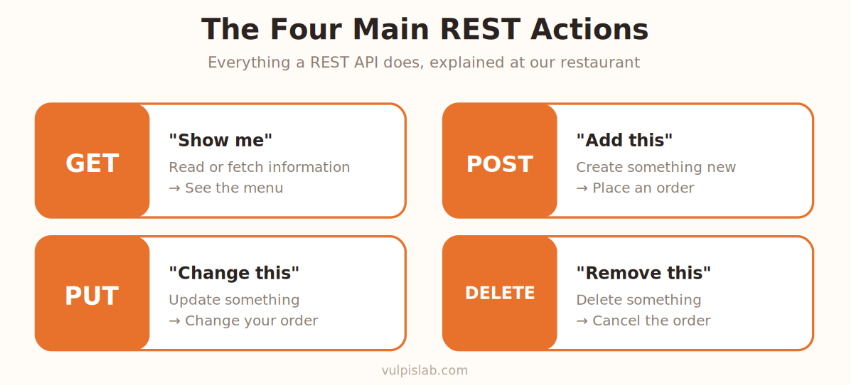
With just these four actions, a REST API can handle almost anything.
Endpoints and Web Addresses
Remember endpoints from the last post? In a REST API, each endpoint looks like a normal web address, also known as a URL.
For example, a weather service might use /today for today’s weather and /forecast for the week ahead. You simply visit the right address to get the result you want. It is clean and predictable, just like a good menu.
What Do You Get Back?
When you make a request, the REST API sends back data. Most of the time, this data arrives in a format called JSON.
JSON is just a simple way to organise information so both humans and computers can read it. You do not need to master it today. Simply know that JSON is the neat little package your food arrives in.
Why REST APIs Are So Popular
REST APIs are popular because they are simple, flexible, and reliable. They use the web’s own rules, they are easy to read, and they work with almost any programming language.
As a result, most apps and services you use every day rely on REST APIs quietly in the background.
Quick Recap
Here are the key points to remember:
- A REST API is the most common type of web API.
- REST is a set of rules that keeps APIs clean and predictable.
- It uses HTTP, the same language as the web.
- The four main actions are GET, POST, PUT, and DELETE.
- Endpoints look like normal web addresses, and answers usually arrive as JSON.
Frequently Asked Questions
Is a REST API hard to learn?
No. The basic idea is simple. Once you understand GET, POST, PUT, and DELETE, you already know the core of REST.
What is the difference between an API and a REST API?
An API is any messenger between two programs. A REST API is one that follows the specific rules of REST.
What is JSON in simple words?
JSON is a tidy way to write data so both people and computers can read it easily.
What’s Next
Now you know what a REST API is and how it works. Next, we will look at API authentication: how apps prove who they are before they are allowed to make requests. We will keep it just as simple.