
Cloud computing for Product Managers means understanding how computing resources such as servers, storage, databases, networking and security help a digital product work, grow and stay reliable.
Think about electricity.
You probably do not have your own power station at home. Instead, an electricity company produces electricity. You use what you need.
Cloud computing follows a similar idea.
A company does not always have to buy and maintain all the physical computers required to run its products. It can use computing resources provided by cloud platforms.
For a Product Manager, however, cloud computing is not only about technology.
Cloud decisions can affect:
- How fast the product feels.
- How many customers it can support.
- How reliable it is.
- How securely it handles data.
- How quickly teams can launch changes.
- How much the product costs to operate.
That is what we will learn today.
Simple rule: Start with the product problem. Understand the requirement. Then think about the technology.
What Will You Learn in Day 1?
By the end of this lesson, you should be able to explain:
- What cloud computing is.
- Why companies use cloud computing.
- What happened before cloud computing became common.
- What capacity planning means.
- What scalability means.
- What elasticity means.
- The difference between vertical and horizontal scaling.
- Why cloud is not automatically cheaper.
- How cloud decisions affect product and business KPIs.
- Why cloud matters differently to Technical, AI/ML and Data PMs.
- What questions a PM should ask before discussing cloud architecture.
You will also complete a Free PM lab. No paid cloud account is required.
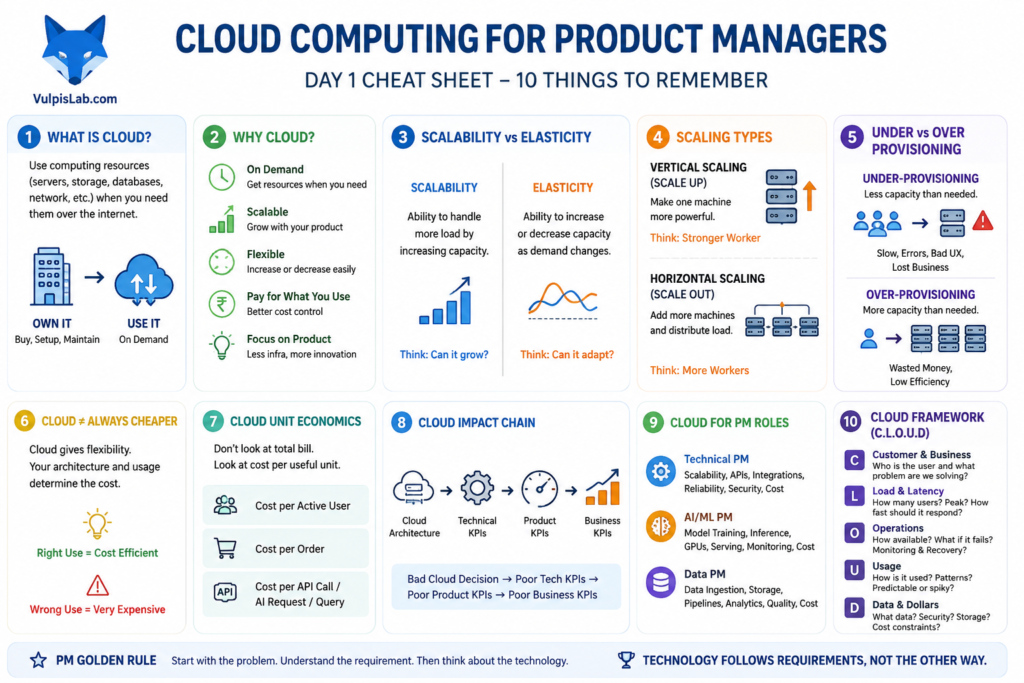
1. What Is Cloud Computing?
Here is the simple answer:
Cloud computing is a way to use computing resources when you need them without having to own and operate all the underlying physical infrastructure yourself.
Those resources can include:
Compute — power for running applications.
Storage — space for storing files and data.
Databases — systems for organizing and retrieving data.
Networking — connections that allow systems to communicate.
Security — services that help control and protect access.
Analytics — tools for processing and understanding data.
AI/ML — infrastructure and services for building and running AI systems.
We will study each of these later in the course.
For today, remember one thing:
Cloud is much more than “a computer on the internet.”
Cloud Computing Explained
Imagine you want to eat ice cream.
One option is to build your own ice-cream factory.
You would need:
Milk.
Machines.
Freezers.
Workers.
Electricity.
Storage.
Maintenance.
That’s a lot of work when all you wanted was ice cream.
Another option is to go to an ice-cream shop.
The shop already has the machines, freezers and workers.
You simply choose what you need.
Cloud computing works on a similar principle.
A cloud provider operates large amounts of computing infrastructure. Organizations consume services from that infrastructure according to their requirements.
The analogy is simplified, but it gives us a useful starting point.
2. Is AWS the Same as Cloud Computing?
No.
This is an important distinction.
Cloud computing is the concept.
Platforms such as Amazon Web Services, Microsoft Azure and Google Cloud provide cloud services.
Think about it this way:
Cloud computing = the idea
AWS / Azure / Google Cloud = platforms implementing that idea
Why does this matter?
Because a good Product Manager should learn the concept before memorizing product names.
For example, first understand:
What is object storage?
Later, you can learn how different providers implement object storage.
This approach makes your knowledge transferable.
3. Why Was Cloud Computing Needed?
To understand cloud computing properly, imagine that you are a Product Manager launching an online shopping application.
Your team expects:
10,000 customers in Month 1.
After six months, you expect:
100,000 customers.
Your company needs computing infrastructure to run the application.
But there is a problem.
How much infrastructure should you prepare?
Suppose you prepare for 100,000 customers.
Then your product goes viral.
Suddenly:
1,000,000 people arrive.
Your infrastructure may not have enough capacity.
Now imagine the opposite.
You prepare infrastructure for one million customers.
But only 20,000 customers arrive.
A lot of your purchased capacity may remain unused.
This gives us two important problems.
4. What Is Under-Provisioning?
Under-provisioning means having less capacity than your workload requires.
Imagine a supermarket with only one checkout counter.
Ten customers arrive.
No problem.
Then 500 customers arrive at the same time.
One checkout counter cannot handle them efficiently.
A long queue forms.
Your application can experience a similar problem.
For example:
Customer demand increases
↓
Infrastructure becomes overloaded
↓
Application becomes slow
↓
Errors increase
↓
Customers become frustrated
↓
Transactions may fail
↓
Business KPIs may suffer
For a Product Manager, infrastructure problems therefore do not necessarily remain infrastructure problems.
They can become customer and business problems.
5. What Is Over-Provisioning?
Now imagine a supermarket with 100 checkout counters.
But only ten customers visit every day.
Most counters remain empty.
The supermarket is paying for capacity it does not need.
That is similar to over-provisioning.
Over-provisioning means providing significantly more capacity than the workload currently requires.
This can increase unnecessary infrastructure costs.
So businesses face a balancing problem:
Too little capacity → performance and reliability risk
Too much capacity → cost and efficiency risk
This brings us to an important cloud concept.
6. What Is Capacity Planning?
Capacity planning means estimating how much computing capacity a product needs to handle its expected workload.
Imagine you are organizing a birthday party.
You expect 20 children.
You need to decide:
(1) How many chairs?
(2) How much food?
(3)How many drinks?
(4) How large should the room be?
That is capacity planning.
For a digital product, instead of chairs and food, teams think about resources such as:
- Compute
- Memory
- Storage
- Database capacity
- Network capacity
A PM may therefore need to understand questions such as:
(1)How many users do we have today?
(2) How quickly are we growing?
(3) How many users might use the product at the same time?
(4) When does traffic peak?
(5) Are there seasonal spikes?
(6) What happens during a marketing campaign?
Cloud computing does not make capacity planning disappear.
It can make capacity more flexible to obtain and adjust.
7. How Does Cloud Change the Traditional Infrastructure Model?
Let’s simplify the difference.
Traditional model
Estimate demand
↓
Plan infrastructure
↓
Procure infrastructure
↓
Configure it
↓
Deploy the product
↓
Serve customers
With cloud services, many resources can instead be provisioned when required.
A simplified cloud model becomes:
Understand demand
↓
Provision resources
↓
Deploy product
↓
Observe usage
↓
Adjust resources
↓
Continue serving customers
The important idea is not merely:
“Someone else owns my server.”
The bigger idea is that infrastructure can become more:
On-demand
Programmable
Measurable
Scalable
Adaptable
These characteristics can influence how quickly a product organization responds to changing demand.
8. What Does “On Demand” Mean in Cloud Computing?
Imagine you want to watch a movie tonight.
You do not want to buy a cinema.
You want access to the movie when you need it.
Similarly, cloud services can often be provisioned when a team needs them.
For example, a development team may need additional computing resources for:
Development → Testing → Launch → Growth
Instead of waiting for physical hardware procurement each time, teams can provision suitable cloud resources.
Why should a PM care?
Because infrastructure availability can affect:
Time to build → Time to test → Time to launch → Time-to-market
That makes infrastructure a potential product delivery concern, not merely an engineering concern.
9. What Is Resource Pooling?
Imagine a large hotel with 500 rooms.
You do not own Room 212 forever.
You use a room when you need it.
Other guests use other rooms.
The hotel manages the entire building.
Cloud providers similarly operate large pools of computing resources.
Customers consume resources from those pools while cloud systems provide logical isolation between customers.
Again, the hotel analogy is not technically exact.
But it helps explain the idea:
You consume resources from infrastructure operated at a much larger scale.
10. What Is Measured Usage?
Think about your electricity bill.
The electricity company measures how much electricity you consume.
Many cloud services also measure usage.
Depending on the service, cost may be influenced by things such as:
- Computing time.
- Amount of storage.
- Number of requests.
- Database capacity.
- Data transferred.
- AI model usage.
- Other consumed resources.
This creates an important PM connection:
Product Usage → Infrastructure Usage → Infrastructure Cost
Therefore, cloud architecture can affect product unit economics.
We will study this in much more detail later.
11. What Is Scalability?
Here is the simple definition:
Scalability is the ability of a system to handle increased workload by increasing its capacity.
Imagine a small pizza shop.
At first, it receives:
10 orders per hour.
One cook can manage the work.
Then the shop becomes famous.
Now it receives:
500 orders per hour.
The restaurant needs more capacity.
A digital product faces the same problem.
Product example
Suppose your application supports:
10,000 users.
After a successful campaign:
100,000 users arrive.
The system needs enough capacity to handle the additional workload.
That is a scalability problem.
12. What Is Vertical Scaling?
Imagine one person carrying a small bag.
The bag becomes heavier.
Instead of adding another person, you replace the person with someone stronger.
That is similar to vertical scaling.
Vertical scaling means increasing the capacity of an existing machine.
For example:
4 CPUs + 16 GB RAM
↓
16 CPUs + 64 GB RAM
Remember:
Vertical scaling = bigger machine.
13. What Is Horizontal Scaling?
Now imagine 100 boxes need to be moved.
Instead of finding one super-strong person, you bring in ten workers.
Everyone shares the work.
That is similar to horizontal scaling.
Horizontal scaling means adding more machines or instances so the workload can be distributed across them.
Conceptually:
1 server
becomes:
Server 1 + Server 2 + Server 3 + Server 4
Remember:
Horizontal scaling = more machines.
14. Vertical vs Horizontal Scaling
| Vertical Scaling | Horizontal Scaling |
|---|---|
| Make one machine larger | Add more machines |
| Scale up | Scale out |
| More CPU/RAM on a machine | More instances |
| Simple mental model: stronger worker | Simple mental model: more workers |
A PM does not need to treat this as a vocabulary test.
The useful question is:
What workload are we trying to support, and what architecture gives us the required scalability, reliability and economics?
That is product thinking.
15. What Is Elasticity?
This is another word you will hear constantly in cloud discussions.
Elasticity is the ability to adjust resources as demand changes, including increasing resources when demand rises and reducing them when demand falls.
Let’s make it simple.
Imagine a restaurant.
At 4 PM, only ten customers are inside.
The restaurant needs a small team.
At 8 PM, 200 customers arrive.
More staff are needed.
At midnight, most customers leave.
The restaurant no longer needs the larger team.
Cloud elasticity follows a similar idea.
Demand increases
↓
Resources increase
Then:
Demand decreases
↓
Resources decrease
16. Scalability vs Elasticity: What Is the Difference?
This is a common question.
Scalability
Can the system handle more work by increasing capacity?
Elasticity
Can the system adjust resources as demand changes?
Think:
Scalability = ability to grow capacity
Elasticity = ability to adapt capacity to changing demand
Why does elasticity matter to a PM?
Because it connects:
Customer Experience + Cost
Too little capacity can hurt performance.
Too much unnecessary capacity can increase cost.
Good architecture tries to balance both.
17. Is Cloud Computing Always Cheaper?
No.
This is one of the most important lessons in Day 1.
Using cloud does not automatically make infrastructure cheaper.
Imagine leaving every light, fan and air conditioner in your house switched on 24 hours a day.
Electricity is convenient.
But wasteful usage can still create a huge bill.
Cloud works similarly.
Cloud costs can increase because of:
- Unused compute.
- Oversized resources.
- Unnecessary storage.
- Expensive database configurations.
- Excessive data transfer.
- Inefficient applications.
- Uncontrolled GPU usage.
- Inefficient AI inference.
Therefore:
Cloud gives flexibility. Architecture and usage determine economics.
18. What Are Cloud Unit Economics?
Suppose your cloud infrastructure costs ₹1,00,000 per month.
Is that expensive?
We cannot answer yet.
Imagine the platform serves only 100 customers.
Now compare that with a platform serving one million paying customers.
The same infrastructure bill has a very different business meaning.
Therefore, PMs should look beyond the total cloud bill.
Useful measures can include:
(1) Infrastructure cost per active user
(2) Infrastructure cost per transaction
(3) Infrastructure cost per order
(4) Infrastructure cost per API request
For an AI product:
(1) Inference cost per request
For a data product:
(1) Cost per query or workload
This is called thinking in unit economics.
19. Why Should Product Managers Understand Cloud Computing?
Because cloud decisions can affect the product at several levels.
Customer experience
Cloud architecture can influence:
- Speed
- Latency
- Availability
- Reliability
Business
It can influence:
- Cost
- Margins
- Growth
- Time-to-market
Engineering
It can influence:
- Deployment
- Scalability
- Maintainability
- Observability
Risk
It can influence:
- Security
- Privacy
- Compliance
- Business continuity
Therefore, we can create an important chain:
Cloud Architecture
↓
Technical KPIs
↓
Product KPIs
↓
Business KPIs
Let’s understand this with an example.
20. How Can a Cloud Problem Affect Revenue?
Imagine an online shopping application.
A festival sale starts.
Thousands of customers arrive.
The infrastructure cannot handle the traffic.
Now watch what happens:
Infrastructure becomes overloaded
↓
API latency increases
↓
Product becomes slow
↓
Checkout takes longer
↓
Some customers leave
↓
Checkout conversion decreases
↓
Completed orders decrease
↓
Revenue can decrease
Notice what happened.
We started with a technical problem.
We ended with a business problem.
This is one of the most important skills for a Technical Product Manager:
Connect technical decisions with customer and business outcomes.
21. Cloud Computing for Technical Product Managers
Imagine you are the PM for a SaaS platform.
Today:
50,000 users
Future target:
5 million users
Your questions might include:
- Can our architecture scale?
- What are the critical APIs?
- Where could bottlenecks appear?
- How should data be stored?
- What happens if a service fails?
- What availability do customers need?
- What security requirements exist?
- How much does each customer cost us to serve?
Technical PM cloud discussions therefore often involve:
Compute + APIs + Networking + Databases + Security + Reliability + Observability + Cost
22. Cloud Computing for AI/ML Product Managers
Now imagine you manage an AI assistant.
You have:
1,000 users today.
You want:
1 million users.
The AI system needs computing resources to process those requests.
Your questions may include:
- Where will the model run?
- Does it need CPUs or GPUs?
- How fast should responses be?
- How many requests can it process?
- How will usage scale?
- What happens when demand suddenly increases?
- How will we monitor the model and system?
- What will each AI request cost?
Later, this track will cover concepts such as:
GPU compute → model serving → inference → scaling → monitoring → AI cost
This is why an AI/ML PM needs cloud foundations.
23. Cloud Computing for Data Product Managers
Now imagine your company collects data from:
Website.
Mobile application.
CRM.
Payments.
Customer support.
Marketing systems.
Leadership wants reliable analytics.
AI teams want trustworthy data.
Your questions may include:
- Where will the data live?
- How will data reach the platform?
- How frequently should it update?
- Who can access it?
- How do we maintain data quality?
- How much will storage and processing cost?
- What security and governance rules apply?
Data PM cloud discussions may therefore involve:
Ingestion → Storage → Pipelines → Databases → Warehouses/Lakehouses → Quality → Governance → Cost
Again, the foundation is cloud computing.
The specialization comes later.
24. Technical PM vs AI/ML PM vs Data PM
| PM Role | Typical Cloud Question |
|---|---|
| Technical PM | How should our application run, integrate and scale? |
| AI/ML PM | How should AI workloads run, serve predictions and scale economically? |
| Data PM | How should data move, live, stay trustworthy and become usable? |
This is why our course starts with one Common Cloud Foundation.
Later, the paths separate.
25. Is Cloud Always Better Than On-Premises?
No.
Suppose someone asks:
“Should we move everything to cloud?”
A good PM should not immediately say yes.
Instead, ask:
What problem are we solving?
Then investigate factors such as:
- Workload
- Security
- Data sensitivity
- Regulations
- Latency
- Existing infrastructure
- Cost
- Required control
- Team capability
Depending on these requirements, an organization might consider:
Public cloud
Private cloud
On-premises
Hybrid cloud
Multi-cloud
We will learn these models in detail later.
For now, remember:
Technology decisions should follow requirements. Requirements should not be invented to justify a technology.
26. The CLOUD Framework for Product Managers
How does a PM start a cloud conversation?
You need questions.
To make them easy to remember, we will use the CLOUD Framework throughout this course.
C — Customer & Business
Ask:
(1) Who is the customer?
(2) What problem are we solving?
(3) What customer journey matters most?
(4) What business outcome are we trying to achieve?
L — Load & Latency
Ask:
(1) How many users do we have?
(2) How many could arrive at the same time?
(3)When does traffic peak?
(4) How quickly should the product respond?
O — Operations
Ask:
(1) How important is availability?
(2) What happens if the system fails?
(3) How quickly should it recover?
(4) What should we monitor?
U — Usage
Ask:
(1) How often is the product used?
(2) Is usage predictable?
(3) Does traffic change during the day?
(4) Are there seasonal spikes?
D — Data & Dollars
Ask:
(1) What data are we processing?
(2) Is any of it sensitive?
(3) How much data will we store?
(4) Where can it be stored?
(5) What are our cost constraints?
(6) What should it cost to serve one user, order, transaction or AI request?
Put it together:
Customer & Business
↓
Load & Latency
↓
Operations
↓
Usage
↓
Data & Dollars
↓
Architecture Discussion
This is your first reusable PM framework from the course.
27. Cloud Case Study: Quick-Commerce App
Imagine you are the Product Manager for a grocery delivery application.
Normally:
100,000 people use the product each day.
A festival campaign is coming.
Marketing predicts:
700,000 users.
The worst-case forecast is:
1.2 million users.
Your primary business KPI is:
Completed Orders
Important product KPIs include:
Checkout conversion rate
Cart abandonment rate
Order completion rate
Technical KPIs might include:
API latency
Error rate
Availability
Throughput
Now connect everything.
Customer demand increases
↓
Infrastructure load increases
↓
Application performance can change
↓
Checkout experience can change
↓
Order completion can change
↓
Revenue can change
This is the PM lens we will repeatedly use.
28. What Should the PM Ask?
Using CLOUD:
Customer
Which customer journeys matter most during the sale?
Perhaps:
Search → Product → Cart → Payment → Order Confirmation
Load
What traffic do we expect?
What is our peak estimate?
Operations
How much downtime can we tolerate?
What happens if checkout fails?
Usage
At what time will customers arrive?
Will demand spike suddenly?
Data & Dollars
What customer/payment data is involved?
What infrastructure cost increase is acceptable?
Now engineering has much better information for architecture discussions.
29. The PM Cloud Decision Chain
This is the most important framework from Day 1.
Do not think:
AWS → EC2 → Database → Product
Think:
Business Outcome
↓
Customer Need
↓
Product Requirement
↓
Non-Functional Requirements
↓
Cloud Requirements
↓
Architecture Options
↓
Trade-offs
↓
Technical KPIs
↓
Product KPIs
↓
Business Outcome
We will keep returning to this chain throughout the course.
30. ₹0 PM Lab: Design Cloud Requirements
You do not need AWS, Azure, Google Cloud or a credit card for this exercise.
Scenario
You are the Product Manager for a workplace collaboration application.
Current users:
20,000
After an enterprise launch, the business expects:
500,000 users.
Your task is to apply CLOUD.
Step 1 — Customer
Write:
Who are the users?
What are their most important jobs?
Which journey cannot fail?
Step 2 — Load
Estimate:
Normal traffic.
Peak traffic.
Concurrent usage.
Step 3 — Operations
Define:
Required availability.
Critical failures.
Recovery expectations.
Step 4 — Usage
Identify:
Peak hours.
Usage patterns.
Potential spikes.
Step 5 — Data & Dollars
Identify:
Data collected.
Sensitive data.
Storage requirements.
Cost considerations.
Finally, create:
Business Requirement
↓
Product Requirement
↓
NFR
↓
Cloud Requirement
Do not select a cloud service yet.
The objective is to learn requirements before solutions.
31. Optional Hands-On Lab
This activity is optional.
Choose one major cloud provider and explore its introductory learning resources or console.
Do not worry about deploying anything yet.
Find where the provider groups services for:
Compute
Storage
Databases
Networking
Security
Monitoring
Now ask yourself:
What product requirement could make my team need this category?
For example:
Requirement: Store millions of customer images.
That creates a storage requirement.
We will learn how to select the appropriate storage approach later.
Important: Cloud pricing and free-use conditions can change. Always check the provider’s current terms before creating resources that could incur charges.
32. Product Manager Interview Corner
Interview Question: What is cloud computing?
A concise answer:
Cloud computing provides on-demand access to computing resources such as compute, storage, databases and networking through provider-managed infrastructure. It allows organizations to provision and adjust resources according to workload requirements while measuring resource consumption.
Interview Question: Why should a Product Manager understand cloud computing?
A strong answer:
Cloud architecture can affect product scalability, performance, reliability, security, delivery speed and unit economics. As a Product Manager, I want to understand these relationships so I can translate business and customer needs into product and technical requirements, evaluate trade-offs with engineering teams, and connect technical decisions with measurable product and business outcomes.
Interview Question: Would you always choose cloud over on-premises?
A strong answer starts with:
It depends on the requirements and constraints.
Then consider:
Workload → Data → Security → Compliance → Latency → Control → Cost → Existing Infrastructure → Team Capability
33. Day 1 Knowledge Check
Try answering these without looking above.
1. What is cloud computing?
2. Is AWS the same thing as cloud computing?
3. What is under-provisioning?
4. What is over-provisioning?
5. What is capacity planning?
6. What is scalability?
7. What is vertical scaling?
8. What is horizontal scaling?
9. What is elasticity?
10. How is elasticity different from scalability?
11. Why isn’t cloud automatically cheaper?
12. What are cloud unit economics?
13. How can infrastructure latency affect revenue?
14. Why does an AI/ML PM need cloud knowledge?
15. Why does a Data PM need cloud knowledge?
16. What does CLOUD stand for?
17. Why should requirements come before cloud services?
If you can explain these answers in your own words, you have understood Day 1.
34. Day 1 Cheat Sheet
Remember these five ideas.
1. Cloud = computing resources when needed
Think:
Compute + Storage + Database + Network + Security + More
2. Scalability = handle more work
Think:
More demand → more capacity
3. Vertical scaling = bigger machine
Think:
One stronger worker
4. Horizontal scaling = more machines
Think:
More workers
5. Elasticity = adapt capacity with demand
Think:
Busy → increase
Quiet → decrease
And remember:
Cloud is not automatically cheap. Good architecture, measurement and optimization matter.
Frequently Asked Questions About Cloud Computing for Product Managers
What is cloud computing in simple words?
Cloud computing means using computing resources such as servers, storage and databases through provider-managed infrastructure instead of owning and operating all the physical infrastructure yourself.
Why is cloud computing important for Product Managers?
Cloud decisions can affect scalability, latency, reliability, security, cost and time-to-market. These technical factors can influence customer experience and business outcomes.
Do Technical Product Managers need cloud knowledge?
Technical PMs can benefit significantly from cloud knowledge because they often work with engineering teams on APIs, databases, integrations, scalability, reliability, security and technical architecture.
Do AI Product Managers need cloud computing?
Cloud knowledge is useful for AI Product Managers because AI products may require model training, inference, GPUs, storage, databases, monitoring and scalable model-serving infrastructure.
Do Data Product Managers need cloud computing?
Yes. Data products commonly involve storage, databases, ingestion, pipelines, warehouses, lakehouses, analytics, security and governance.
What is the difference between scalability and elasticity?
Scalability is the ability to increase capacity to handle more workload. Elasticity is the ability to adjust resources as demand rises or falls.
Is cloud computing cheaper than on-premises infrastructure?
Not necessarily. The answer depends on workload, architecture, utilization, pricing, operational requirements and other factors. Poorly managed cloud resources can become expensive.
Should I learn AWS, Azure or Google Cloud first?
Learn the underlying cloud concepts first. Once you understand compute, storage, databases, networking and security, it becomes easier to map those concepts to individual cloud providers.
Is hands-on cloud practice compulsory for this course?
No. The course includes mandatory ₹0 PM exercises that focus on requirements, architecture and decisions. Hands-on technical exercises are optional for learners who want deeper technical proficiency.
Final Takeaway
If you remember only one thing from Day 1, remember this:
Cloud computing is not the starting point of a product decision. The product requirement is.
A Product Manager should learn to move through this chain:
Business Goal
(1) Customer Need
(2) Product Requirement
(3) NFRs
(4)Cloud Requirement
(5) Architecture Decision
(6) Technical KPI
(7)Product KPI
→ Business Outcome
Once this mental model becomes natural, AWS, Azure and Google Cloud services become much easier to understand.
You stop asking:
“Which cloud service should I use?”
and start asking:
“What requirement am I trying to satisfy?”
That is the mindset we will carry into Day 2: IaaS, PaaS, SaaS, Managed Services and the Shared Responsibility Model.