
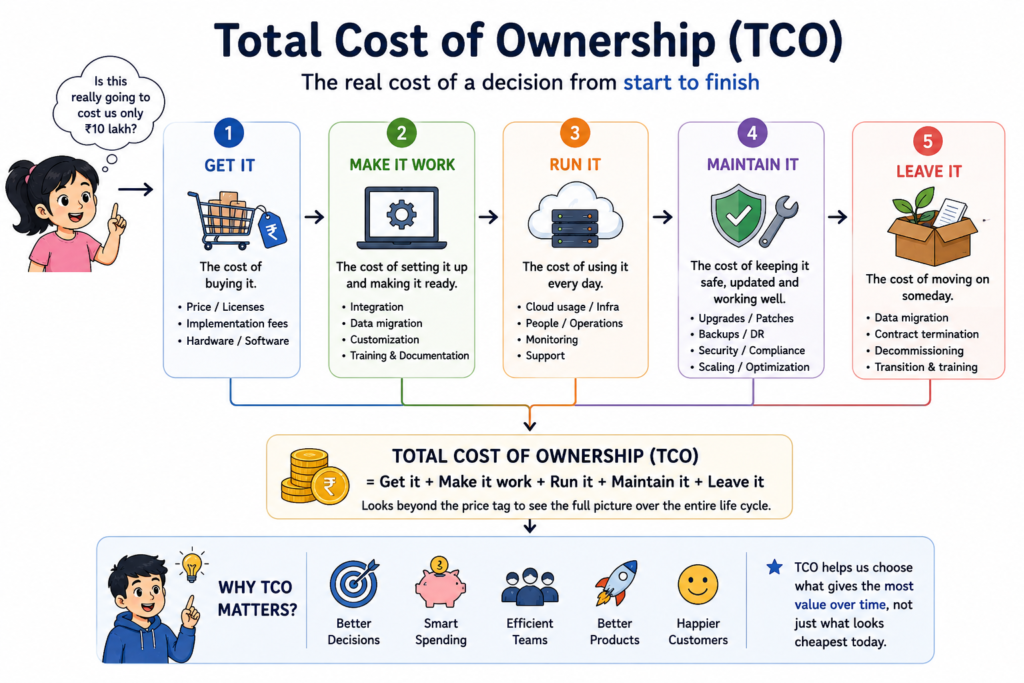
A vendor tells you:
“This solution will cost ₹10 lakh.”
It sounds like you have your cost.
But what happens after you buy it?
Your team may need to integrate the solution, migrate existing data, train employees, purchase additional licences, monitor the system, maintain it, secure it, and eventually replace or retire it.
Suddenly, ₹10 lakh was never really ₹10 lakh.
It was simply the price you could see first.
This is the problem Total Cost of Ownership (TCO) helps us solve.
What is Total Cost of Ownership?
Total Cost of Ownership, or TCO, is an estimate of the complete cost of buying, implementing, operating, maintaining, and eventually retiring a product, system, or technology over its useful life.
In simpler words:
TCO asks: “What will this decision really cost us from beginning to end?”
That is different from asking:
“How much does it cost to buy?”
TechTarget similarly defines TCO around the expenses involved in purchasing, deploying, managing, using and retiring an IT asset across its lifecycle. Gartner’s TCO guidance also emphasizes looking beyond purchase price toward lifecycle costs and value.
This difference becomes especially important when Product Managers are comparing cloud platforms, SaaS tools, AI infrastructure, databases, build-vs-buy options, or major architecture changes.
Think about TCO like buying a car
Suppose two cars are sitting in front of you.
Car A costs ₹10 lakh.
Car B costs ₹12 lakh.
If purchase price were the only thing that mattered, Car A would clearly win.
But then you investigate further.
Car A consumes more fuel, requires expensive servicing, has higher insurance costs, needs frequent repairs, and is expected to have a lower resale value.
Car B costs more today but may cost less to operate over the next seven years.
Which car is actually cheaper?
We cannot answer from the showroom price alone.
We need to know the total cost of owning the car.
Technology decisions work the same way.
A server may look cheaper than cloud infrastructure until we include maintenance, electricity, software licences, backup infrastructure, operational staff, replacement cycles, and unused capacity.
A SaaS product may appear expensive until we calculate what it would cost our engineers to build, secure, operate, support, and continuously improve the same capability ourselves.
Price tells us what we pay to get something. TCO helps us understand what we may pay to live with it.
What actually goes into TCO?
There isn’t one universal TCO formula that works perfectly for every technology decision because the relevant costs depend on what we are evaluating.
But I find it easier to think about TCO as a journey.
First, there is the cost of getting it
This is the cost most people notice.
It could include hardware purchases, software licences, cloud setup, vendor fees, implementation services, or initial subscriptions.
For physical infrastructure, this may involve significant capital expenditure (CapEx).
But this is only the beginning.
Then there is the cost of making it work
A technology rarely arrives ready to create value immediately.
Someone may need to configure it, integrate APIs, migrate data, test it, customize workflows, establish security controls, write documentation, and train users.
Engineering time belongs here too.
This is one of the costs that can disappear when we compare solutions using only vendor pricing.
Then comes the cost of keeping it alive
This is where TCO becomes particularly useful.
The product may need infrastructure, support contracts, monitoring, backups, upgrades, patches, security operations, database administration, network capacity, and people who understand how to operate it.
These costs repeat.
A small monthly cost multiplied across several years can eventually become more important than the original purchase price.
And eventually, there is the cost of leaving
Technology decisions have endings too.
Data may need to be migrated somewhere else. Contracts may need to be terminated. Infrastructure may need to be decommissioned, while customers and internal teams may need to transition to another system.
Even switching away from a technology can cost money.
That means the simplest mental model for me is:
TCO = Get it + Make it work + Run it + Maintain it + Eventually leave it
It isn’t an accounting formula for every situation.
It is a way to stop ourselves from forgetting important costs.
A cheap technology decision can become an expensive product decision
Suppose I am choosing between two solutions for a product.
Solution A costs ₹5 lakh annually.
Solution B costs ₹8 lakh.
Looking only at the licence price makes Solution A appear to save ₹3 lakh every year.
But now discovery begins.
Solution A requires two engineers to maintain custom integrations. Upgrades regularly break those integrations, monitoring needs additional tooling, and the team spends significant time troubleshooting the environment.
Solution B costs more to purchase but removes much of that operational work.
At that point, the Product Manager should not say:
“A is cheaper.”
We don’t know that yet.
We should ask:
“What will each option cost the organisation over the period we expect to use it?”
That is a TCO question.
Notice that we are no longer comparing products only by price.
We are comparing economic consequences.
People are part of TCO too
This is one of the easiest costs to overlook.
Suppose running a system requires an engineer to spend ten hours every week maintaining it.
Those ten hours have a cost.
But there is another cost hiding behind them.
What could that engineer have built during those ten hours?
Perhaps they could have improved onboarding, fixed an important customer problem, reduced latency, or delivered a feature tied to revenue.
This is where opportunity cost enters the conversation.
A useful community example appears in a data-engineering discussion about calculating infrastructure TCO. The proposed calculation included not only software and infrastructure, but implementation, migration, documentation, maintenance, supporting infrastructure, team costs, and time that engineers could otherwise spend on the core product.
That last part matters to me as a Product Manager.
A technology can have a low invoice and still consume expensive engineering capacity.
TCO becomes especially important in cloud decisions
This connects directly with the cloud decisions we’ve been working through.
Suppose an organisation owns a data centre and wants to compare it with public cloud.
Someone might compare:
Current server cost → expected AWS/Azure/GCP bill
That comparison is incomplete.
The existing environment may also include hardware replacement, electricity, cooling, networking, storage, backup systems, licences, physical space, disaster recovery, security operations, and people maintaining the infrastructure.
Cloud changes the cost structure, but it doesn’t make costs disappear.
Cloud introduces compute, storage, databases, network traffic, backups, monitoring, support, managed services, and potentially other consumption-based costs.
Microsoft’s current Cloud Adoption Framework therefore recommends defining the platform and workload architecture when developing accurate cloud cost estimates; without understanding the architecture and dependencies, the estimate lacks the specificity needed for meaningful planning.
So the useful question isn’t:
“Is cloud cheaper than on-prem?”
It is:
“What is the TCO of delivering the same required business outcome under each realistic option?”
Now we are comparing like with like.
The hidden cost can be somewhere you didn’t expect
A real large-scale computing project gives us a particularly useful example.
The ATLAS Collaboration at CERN evaluated Google Cloud resources as part of its distributed computing environment. The project successfully demonstrated that commercial cloud could provide flexible additional computing capacity.
But its TCO analysis surfaced something important.
For certain data-intensive workflows, network usage became a significant cost driver, and network connectivity represented the primary expense when cloud resources were used extensively.
Imagine evaluating the decision using compute prices alone.
You could conclude that the workload looks economical.
Then the data starts moving.
The bill changes.
This is exactly why TCO exists.
The most visible cost is not necessarily the most important cost.
For one product, the hidden cost may be network traffic. For another, it may be licences. Somewhere else, it may be engineering maintenance, support, compliance, migration, or idle infrastructure.
TCO forces us to go looking for those costs before making the decision.
But lower TCO doesn’t automatically mean “choose it”
This is where I think Product Management adds another layer.
Imagine Option A has a five-year TCO of ₹1 crore.
Option B has a five-year TCO of ₹1.2 crore.
Should we automatically choose A?
Not necessarily.
What if B allows us to launch six months earlier?
What if it provides much higher availability?
What if it allows the product to enter three new markets?
What if it reduces an important security risk?
Or what if it enables a product capability that generates significantly more revenue?
TCO tells us about cost.
It doesn’t tell us the complete value of the investment.
That is why TCO should inform a business decision rather than make the decision by itself. Gartner similarly frames TCO as going beyond unit price toward lifecycle costs and business value.
The Product Manager still needs to ask:
What value do we receive in exchange for this cost?
A higher-TCO option can still be the better product decision if the additional value justifies the additional cost.
TCO and ROI are not the same thing
These two terms are easy to mix up.
TCO asks: How much will this cost us over its lifecycle?
Return on Investment (ROI) asks: What return do we receive relative to what we invested?
Think again about our two technology options.
One might have a lower TCO but create little new value.
The other might cost more but dramatically increase revenue, productivity, customer retention, or speed.
TCO helps us understand the cost side of the decision.
ROI helps us think about the return side.
Good product decisions often need both.
How I would calculate TCO as a Product Manager
I wouldn’t start by opening a spreadsheet and immediately entering numbers.
I would first define exactly what decision we are making.
Are we comparing cloud with on-prem?
Building with buying?
Two SaaS vendors?
Two databases?
An existing architecture with a new one?
Then I would define the time period. A one-year comparison can look very different from a five-year comparison because implementation costs may happen once while operational costs repeat.
Next, I would map the entire lifecycle.
What will it cost to acquire?
What will implementation and migration require?
What infrastructure will be needed?
What licences are involved?
How much engineering and operational effort will it consume?
What will security, monitoring, backup, support, and compliance cost?
How will costs change as usage grows?
And what happens when we eventually migrate away?
Only after that would I calculate and compare the options.
This matters because a precise calculation based on incomplete costs is still a bad TCO calculation.
One thing I would never do with TCO
I would not use it to make a predetermined decision look financially correct.
If leadership has already decided:
“We are moving to cloud because cloud is cheaper,”
and we calculate only the costs that support that argument, we aren’t doing TCO.
We are just creating a justification.
The same applies to staying on-prem, buying software, building internally, or choosing a particular vendor.
A useful TCO analysis should be willing to produce an answer we did not expect.
What I learned from looking at TCO more closely
Earlier, I thought of cost mostly as the amount attached to a technology.
A server costs this much.
A SaaS subscription costs this much.
Cloud costs this much per month.
TCO changed the way I look at those numbers.
The number attached to a product is only one part of its economic story.
The better question is:
“What resources will this decision consume across its entire life?”
That includes money, infrastructure, licences, operational effort, engineering capacity, migration work, and sometimes the opportunity we lose by putting those resources here instead of somewhere else.
For me, this is what makes TCO useful for Product Managers.
It turns a technology-price conversation into a product economics conversation.
Questions I would ask before accepting a TCO estimate
If someone presents me with a TCO number, I would want to understand what is inside it.
Does it include implementation and migration?
Does it include licences?
Does it include people?
Does it include monitoring and backup?
Does it include security and compliance?
Does it include expected growth in customers or transactions?
Does it include network and data-transfer costs?
Does it include downtime or operational risk where relevant?
Does it include the cost of eventually switching or retiring the solution?
And most importantly:
Are we comparing the same workload, service level, and business outcome across both options?
If one option provides 99.9% availability and another is designed for 99.99%, comparing their costs without acknowledging the difference can lead us to the wrong conclusion.
Frequently Asked Questions
What does TCO stand for?
TCO stands for Total Cost of Ownership. It estimates the complete lifecycle cost of acquiring, implementing, operating, maintaining, and eventually retiring a product, system, or technology.
What costs are included in Total Cost of Ownership?
Depending on the decision, TCO can include purchase or subscription costs, implementation, migration, infrastructure, licences, staffing, maintenance, support, monitoring, security, training, upgrades, networking, backups, and retirement or switching costs.
Why is TCO important in Product Management?
TCO helps Product Managers compare technology options based on their broader economic impact rather than purchase price alone. This is especially useful for build-vs-buy, cloud migration, SaaS procurement, infrastructure, architecture, and AI-platform decisions.
Is TCO the same as ROI?
No. TCO estimates how much an investment costs across its lifecycle. ROI evaluates the return generated relative to the investment. A product decision may therefore have a higher TCO but still produce a better ROI.
Is the cheapest option always the one with the lowest TCO?
No. TCO is only one input into the decision. Customer value, revenue potential, reliability, risk, time-to-market, scalability, and strategic value can justify selecting an option with a higher TCO.
The definition I want you to remember
You don’t need to memorise a complicated formula.
When someone tells you:
“This technology costs ₹X.”
ask:
“Is that the price, or is that what it will really cost us?”
That second question is where Total Cost of Ownership begins.
And for a Product Manager, that distinction matters because we are not simply choosing technology.
We are deciding where the business should invest its resources to create value.
Glossary : CapEx, OpEx, cloud computing, on-premises infrastructure, workload, opportunity cost, unit economics, ROI, time-to-market, availability, SLA, disaster recovery, data egress, build vs buy, and FinOps.
Sources: Gartner — TCO principles, TechTarget — TCO definition, Microsoft Cloud Adoption Framework — TCO estimation, and the ATLAS Collaboration’s published cloud TCO study.
[…] I first looked at TCO, I thought its purpose was mainly to […]