
The Tokenmaxxing Hangover :How companies turned AI into a spending contest and lost
Uber reportedly used up its entire 2026 AI coding budget by April. That is the precise version of the story. It was not Uber’s entire company AI budget. It was the budget connected to AI coding and token usage.
Still, the lesson is big. The money did not disappear because of a system error. It disappeared because the company had been pushing employees to use AI heavily. At the time, that felt logical. AI tools looked powerful. Leaders wanted faster teams. Developers wanted better workflows. So the message became simple: use more AI.
Then the bill arrived.
The uncomfortable part is that the people making these choices were not foolish. They were reacting to a real technology shift. When a new tool looks useful, leaders naturally want adoption. They want employees to experiment. They want the company to move before competitors do.
But adoption is not the same as value.
Here is my read: the companies did not fail because they used AI. They failed because they measured the wrong thing. They counted how much AI was used instead of checking whether the work became more useful, faster, cheaper, or better for customers.
Imagine judging a sales team only by the number of emails sent. People would send more emails, but that would not prove more customers were won. That is what happened with AI usage. The activity became the score, so people chased the activity.
What Actually Happened
First, one simple thing. AI systems often charge based on tokens. A token is a small unit of text processed by the model. OpenAI’s own rule of thumb says one token is roughly four characters, or about three quarters of an English word. So higher usage can quickly mean higher cost.
In 2026, some companies started treating token usage like a sign of AI adoption. If an employee used more AI, the assumption was that they were more productive, more experimental, or more AI ready.
This created a trend called tokenmaxxing. It means trying to maximize AI token usage. In plain language, it means burning more AI usage to look more advanced.
Fortune reported that companies including Meta, Amazon and others had formal or informal token usage leaderboards. Business Insider reported that Amazon shut down an employee made leaderboard called KiroRank after it encouraged some people to use AI in ways that did not necessarily solve real problems.
That is where the problem became clear. A metric that was supposed to encourage AI learning started encouraging scoreboard behavior.
The Receipts
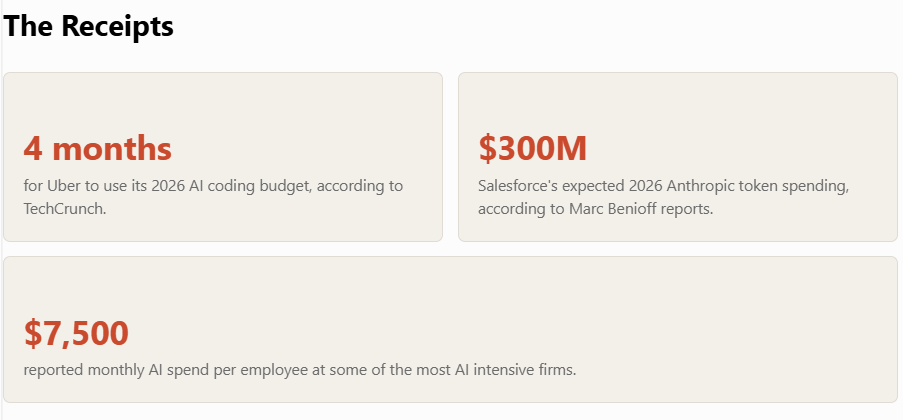
The numbers show why leaders started getting nervous. TechCrunch reported that Uber used its 2026 AI coding budget by April and later added spending caps. Reports also say Salesforce CEO Marc Benioff expected roughly $300 million in Anthropic token spending in 2026. The Next Web reported that some AI intensive firms were seeing monthly AI costs reach $7,500 per employee.
At Amazon, the issue was not just the bill. It was the incentive. Business Insider reported that Amazon deprecated KiroRank and told employees not to use AI just for the sake of using AI. The message was simple: use AI to solve customer and business problems, not to climb a leaderboard.
Where It Went Wrong
To understand the mistake, separate the decision from the execution.
The decision was reasonable
Encouraging people to learn AI was not a bad idea. AI coding assistants can help teams write, test, review and explore faster. In a fast moving market, asking employees to experiment with new tools is sensible.
The execution was weak
The problem was the scorecard. Instead of asking whether AI helped ship better work, some teams asked who used the most AI. That changed the behavior. People chase whatever gets measured, especially when the metric is visible.
This is Goodhart’s Law in action. When a measure becomes a target, it stops being a good measure. Token usage can help track cost, but it should not become the definition of productivity.
The Three Mistakes
Mistake one: treating more usage as more value. More AI activity does not automatically mean better work. A person can spend a lot on AI and still produce very little that matters.
Mistake two: weak cost guardrails. Usage based pricing needs limits, alerts and ownership. Without those controls, teams learn about the problem only when the invoice becomes painful.
Mistake three: turning adoption into a competition. A leaderboard can make experimentation visible, but it can also reward waste. When people compete on token usage, the winning behavior may be expensive and useless.
What They Should Have Done Instead
Measure outcomes, not raw usage. Ask whether AI reduced cycle time, improved quality, helped ship customer value, lowered support load, improved test coverage or removed repetitive work.
Set spending limits from day one. Uber later set a reported $1,500 monthly cap per employee per AI coding tool. Controls like this are not anti innovation. They make adoption sustainable.
Route simple tasks to cheaper models. Not every request needs the most expensive model. Benioff’s smart router idea is practical: send each task to the lowest cost model that can do the job well.
Keep usage tracking private and operational. Track tokens to understand cost. Do not turn token usage into a status game.
The Takeaway
The lesson: Be careful what you reward. If you reward AI usage, you will get AI usage. If you reward useful outcomes, you have a better chance of getting real business value.
The tool was not the real problem. The scoreboard was.
Four questions before pushing any new AI tool
- Are we measuring usage or business value?
- Do we have spending limits and alerts?
- Are we accidentally rewarding waste?
- Are we using the right model for the right task?
Sources
Primary and supporting reporting:
TechCrunch: The token bill comes due
Fortune: Tokenmaxxing is over
Business Insider: Amazon shuts down KiroRank
The Next Web: Tokenminimizing and AI spending caps
OpenAI: What are tokens and how to count them
Fact note: Some media reports use shorthand such as AI budget. In this article, I use the more precise wording AI coding budget or token budget where the source supports that wording.
VulpisLab: AI product breakdowns in plain language. No hype. No jargon. Just the decision, execution and lesson.