
Introduction
If you are preparing for the AWS AI Practitioner exam, you must understand supervised, unsupervised, and reinforcement learning clearly.
These three learning types are part of machine learning basics. They help you understand how a model learns from data, how it finds patterns, and how it improves decisions over time.
This topic is important for the AIF-C01 exam because AWS expects you to understand different types of AI and machine learning methods. The exam may not ask you to build a model, but it can ask which learning type fits a business problem.
For example, if a company has past customer data with known outcomes, the answer may be supervised learning. If the company wants to find hidden groups in customer behavior, the answer may be unsupervised learning. If a system learns by taking actions and receiving rewards, the answer may be reinforcement learning.
This is Blog 4 of my AWS AI Practitioner preparation series.
Before this, you can read:
- AWS AI Practitioner Exam Preparation: Simple AIF-C01 Roadmap
- AWS AI Practitioner Syllabus Explained in Simple Language
- AI vs ML vs Deep Learning vs Generative AI
Now, let us understand the three major learning types in simple language.
Why learning types matter in machine learning
Machine learning is not one single method.
Different problems need different learning approaches. That is why you should first understand what kind of data you have and what kind of outcome you want.
Before choosing a machine learning method, ask these questions:
- Do we have labeled data?
- Do we know the correct answer for past examples?
- Are we trying to predict a category or a number?
- Are we trying to find hidden patterns?
- Is the system learning through actions, feedback, and rewards?
These questions help you identify the right learning type.
For the AWS AI Practitioner exam, this is very useful because many questions are scenario-based.
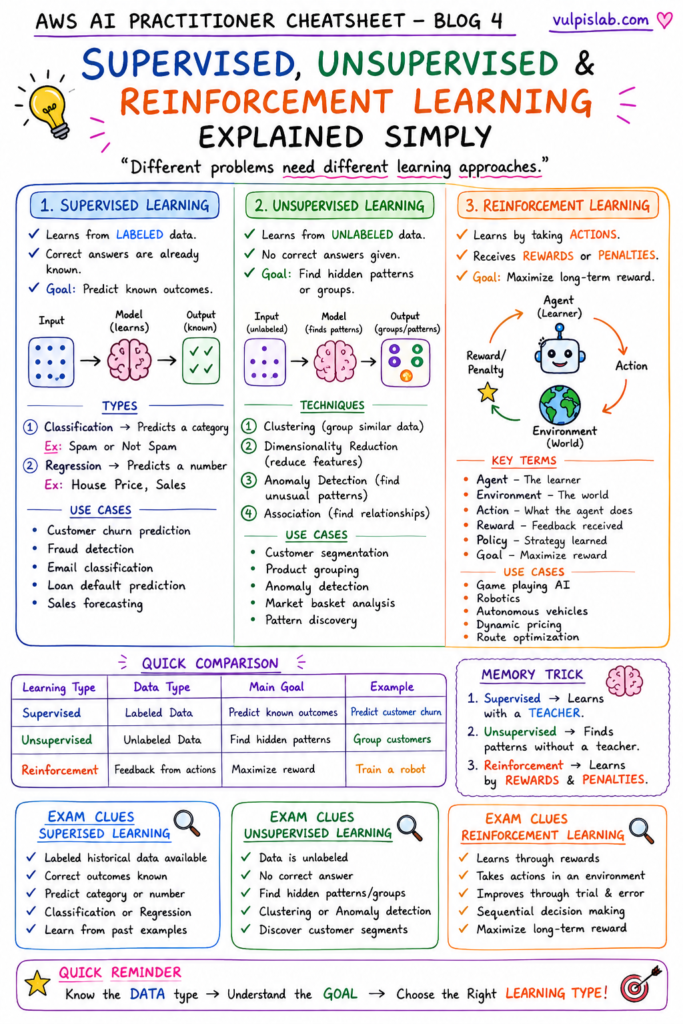
What is supervised learning?
Supervised learning is a machine learning method where the model learns from labeled data.
Labeled data means the input already has the correct output attached to it.
In simple words, the model learns from examples where the answer is already known.
For example, suppose you have customer data and you already know which customers cancelled their subscriptions. The model can learn from this past data and predict which current customers may cancel in the future.
That is supervised learning.
Simple supervised learning example
Imagine a teacher showing a child many pictures of fruits.
The teacher says:
- This is an apple.
- This is a banana.
- This is an orange.
- This is a mango.
After seeing enough examples, the child starts identifying new fruits correctly.
Supervised learning works in a similar way.
The model learns from examples where the correct answer is already provided.
Common supervised learning use cases
Supervised learning is commonly used when we want to predict a known outcome.
Here are some examples:
- Predict whether a customer will churn.
- Predict whether an email is spam or not spam.
- Predict whether a transaction is fraud or genuine.
- Predict the price of a house.
- Predict loan default risk.
- Classify support tickets into categories.
- Predict sales for the next month.
In all these cases, the model learns from past examples where the answer is already known.
Types of supervised learning
Supervised learning is usually divided into two main types:
- Classification
- Regression
1. Classification
Classification is used when the output is a category.
Examples:
- Spam or not spam.
- Fraud or not fraud.
- High risk or low risk.
- Approved or rejected.
- Positive, negative, or neutral sentiment.
If the answer is a label or class, it is usually a classification problem.
2. Regression
Regression is used when the output is a number.
Examples:
- Predicting house price.
- Predicting monthly sales.
- Predicting delivery time.
- Predicting customer lifetime value.
- Predicting electricity demand.
If the answer is a numeric value, it is usually a regression problem.
AWS exam clue for supervised learning
In the exam, look for these clues:
- Historical data is available.
- Correct outcomes are known.
- The model must predict a future result.
- The problem is about classification or regression.
- The company wants to learn from labeled examples.
If you see these clues, supervised learning may be the correct answer.
What is unsupervised learning?
Unsupervised learning is a machine learning method where the model learns from unlabeled data.
Unlabeled data means the data does not have a correct answer attached to it.
In simple words, the model tries to find hidden patterns, groups, or relationships on its own.
For example, suppose an e-commerce company has customer behavior data, but it does not know the exact customer segments. An unsupervised learning model can group customers based on similar behavior.
That is unsupervised learning.
Simple unsupervised learning example
Imagine you have a basket full of mixed fruits, but nobody tells you their names.
Firstly, You start grouping them by color, size, shape, and smell.
Then, You may put apples in one group, bananas in another group, and oranges in another group.
You did not receive labels, but you found patterns.
That is the idea behind unsupervised learning.
Common unsupervised learning use cases
Unsupervised learning is useful when we want to discover patterns without predefined answers.
Here are some examples:
- Customer segmentation.
- Product grouping.
- Anomaly detection.
- Pattern discovery.
- Market basket analysis.
- Document clustering.
- Similar user grouping.
- Recommendation pattern discovery.
In these cases, the model is not trying to predict a known label. It is trying to organize or understand data.
Common unsupervised learning techniques
For the AWS AI Practitioner exam, you do not need to go too deep into algorithms.
But you should know these common ideas:
- Clustering: Grouping similar data points together.
- Dimensionality reduction: Reducing many features into fewer important ones.
- Anomaly detection: Finding unusual patterns or outliers.
- Association: Finding relationships between items.
Example of clustering
An online store may group customers into:
- Price-sensitive customers.
- Premium buyers.
- Frequent buyers.
- Occasional buyers.
- Discount-driven buyers.
The business may not know these groups in advance. The model discovers them from behavior.
That is clustering.
AWS exam clue for unsupervised learning
In the exam, look for these clues:
- Data is unlabeled.
- No correct answer is given.
- The company wants to find hidden patterns.
- The problem is about grouping or clustering.
- The company wants to detect unusual behavior.
- The company wants to discover customer segments.
If you see these clues, unsupervised learning may be the correct answer.
What is reinforcement learning?
Reinforcement learning is a machine learning method where an agent learns by taking actions and receiving rewards or penalties.
In simple words, the system learns through trial and error.
It tries an action, sees the result, and improves its future behavior based on feedback.
This is different from supervised learning because the model is not simply learning from labeled examples. It is learning by interacting with an environment.
Simple reinforcement learning example
Think of training a dog.
If the dog follows a command, it gets a treat.
If it does not follow the command, it does not get the reward.
Over time, the dog learns which behavior gives a reward.
Reinforcement learning works in a similar way.
The system learns what actions lead to better outcomes.
Key terms in reinforcement learning
Here are the basic terms you should understand:
- Agent: The learner or decision-maker.
- Environment: The world where the agent acts.
- Action: What the agent does.
- Reward: Feedback the agent receives.
- Policy: The strategy the agent learns.
- Goal: The outcome the agent tries to maximize.
For example, in a game, the agent is the player, the environment is the game world, the actions are moves, and the reward is the score.
Common reinforcement learning use cases
Reinforcement learning is useful when a system must make a sequence of decisions.
Examples include:
- Game-playing AI.
- Robotics.
- Autonomous vehicles.
- Dynamic pricing.
- Resource optimization.
- Route optimization.
- Industrial control systems.
- Recommendation optimization over time.
In these cases, the system learns from feedback after actions.
AWS exam clue for reinforcement learning
In the exam, look for these clues:
- The system learns through rewards.
- The system takes actions in an environment.
- The system improves through trial and error.
- The problem involves sequential decision-making.
- The objective is to maximize long-term reward.
- The use case involves robotics, games, or optimization.
If you see these clues, reinforcement learning may be the correct answer.
Supervised vs Unsupervised vs Reinforcement Learning
Here is a simple comparison table.
| Learning type | Data type | Main goal | Simple example |
|---|---|---|---|
| Supervised learning | Labeled data | Predict known outcomes | Predict customer churn |
| Unsupervised learning | Unlabeled data | Find hidden patterns | Group customers into segments |
| Reinforcement learning | Feedback from actions | Maximize reward | Train a game-playing agent |
This table is very useful for revision.
Easy memory trick
Use this simple memory trick:
- Supervised learning: The model learns with a teacher.
- Unsupervised learning: The model finds patterns without a teacher.
- Reinforcement learning: The model learns by rewards and penalties.
This is the easiest way to remember the difference.
Real-world example: Online shopping app
Let us understand all three learning types using one online shopping app.
1. Supervised learning in shopping
The app wants to predict whether a customer will buy a product.
It uses past data where customers either bought or did not buy.
Since the outcome is already known in historical data, this is supervised learning.
2. Unsupervised learning in shopping
The app wants to group customers based on browsing behavior.
It does not already know the customer groups.
The model finds patterns and creates segments.
This is unsupervised learning.
3. Reinforcement learning in shopping
The app wants to learn which product recommendation should be shown first to increase long-term engagement.
It tries different recommendations and learns from user clicks, purchases, and feedback.
This can be reinforcement learning because the system improves based on rewards over time.
How this connects to AWS services
For the AWS AI Practitioner exam, you should not only know the learning type. You should also understand how it connects to AWS.
1. Amazon SageMaker AI
Amazon SageMaker AI is important when a team wants to build, train, and deploy machine learning models.
It can support supervised learning, unsupervised learning, and reinforcement learning use cases depending on the problem and data.
For exam thinking, connect SageMaker AI with custom ML model development.
2. Amazon Personalize
Amazon Personalize is useful for recommendation and personalization use cases.
If a question is about giving users personalized product, content, or experience recommendations, Amazon Personalize may be relevant.
3. Amazon Fraud Detector
Amazon Fraud Detector is useful for fraud detection use cases.
Fraud detection often uses supervised learning because the model learns from past fraud and non-fraud examples.
4. Amazon Lookout for Metrics
Amazon Lookout for Metrics can help detect anomalies in business and operational metrics.
Anomaly detection can connect with unsupervised learning because the system may find unusual patterns without predefined labels.
5. Amazon SageMaker AI Reinforcement Learning
For reinforcement learning use cases, Amazon SageMaker AI can support training agents that learn in interactive environments.
For the AWS AI Practitioner exam, you mainly need to understand the concept and suitable use case, not the deep implementation.
How to choose the right learning type in the exam
Use this simple decision guide.
1. Choose supervised learning when:
- You have labeled historical data.
- You know the correct answers in past examples.
- You want to predict a category or number.
- The problem is classification or regression.
- The business wants prediction from known outcomes.
Example:
A bank wants to predict whether a loan applicant may default.
This is supervised learning.
2. Choose unsupervised learning when:
- You have unlabeled data.
- You do not know the correct answers.
- You want to find hidden groups.
- You want to discover patterns.
- The problem is clustering or anomaly detection.
Example:
A retailer wants to group customers based on buying behavior.
This is unsupervised learning.
3. Choose reinforcement learning when:
- The system learns from actions.
- Feedback comes as rewards or penalties.
- The goal is to improve decisions over time.
- The problem involves an agent and environment.
- The objective is long-term optimization.
Example:
A robot learns how to move through a warehouse efficiently.
This is reinforcement learning.
Common exam traps
Trap 1: Confusing classification with clustering
Classification uses labeled data.
Clustering uses unlabeled data.
If the categories are already known, it is classification. If the model has to discover groups, it is clustering.
Trap 2: Thinking every prediction is generative AI
Prediction from historical data is usually machine learning, not generative AI.
Generative AI creates new content. Machine learning often predicts outcomes.
Trap 3: Choosing reinforcement learning just because the system improves
Many machine learning systems improve with better data or retraining.
Reinforcement learning specifically learns through actions, rewards, and an environment.
Trap 4: Confusing anomaly detection with fraud classification
If the model learns from labeled fraud and non-fraud examples, it is supervised learning.
If it finds unusual patterns without labels, it may be unsupervised learning.
Trap 5: Ignoring the data type
The data type gives a big clue.
Labeled data points toward supervised learning.
Unlabeled data points toward unsupervised learning.
Reward-based interaction points toward reinforcement learning.
Exam-style practice questions
Question 1
A company has historical data of customers who stayed and customers who cancelled. It wants to predict future customer churn. Which learning type should it use?
A. Supervised learning
B. Unsupervised learning
C. Reinforcement learning
D. Random guessing
Answer: A. Supervised learning
The company has labeled historical data with known outcomes, so supervised learning is the best fit.
Question 2
A retailer wants to group customers based on purchase behavior, but it does not already know the customer groups. Which learning type is most suitable?
A. Supervised learning
B. Unsupervised learning
C. Reinforcement learning
D. Text-to-speech
Answer: B. Unsupervised learning
The retailer wants to discover hidden customer groups from unlabeled data.
Question 3
A robot learns how to move through a warehouse by trying actions and receiving rewards for efficient movement. Which learning type is this?
A. Supervised learning
B. Unsupervised learning
C. Reinforcement learning
D. Regression
Answer: C. Reinforcement learning
The robot learns through actions, feedback, and rewards in an environment.
Question 4
A company wants to predict house prices based on past house sales data. Which supervised learning type is most relevant?
A. Classification
B. Regression
C. Clustering
D. Reinforcement learning
Answer: B. Regression
The output is a number, so this is a regression problem.
Question 5
A company wants to classify emails as spam or not spam using labeled training examples. Which supervised learning type is most relevant?
A. Regression
B. Classification
C. Clustering
D. Anomaly detection
Answer: B. Classification
The output is a category, so this is a classification problem.
Quick revision points
Before the exam, remember these points:
- Supervised learning uses labeled data.
- Unsupervised learning uses unlabeled data.
- Reinforcement learning uses rewards and penalties.
- Classification predicts categories.
- Regression predicts numbers.
- Clustering finds hidden groups.
- Anomaly detection finds unusual patterns.
- Reinforcement learning is useful for sequential decisions.
- Amazon SageMaker AI is connected with custom ML model development.
- Always identify the data type before choosing the learning method.
Interview explanation
If someone asks me to explain supervised, unsupervised, and reinforcement learning, I would say:
Supervised learning is used when we have labeled historical data and want to predict a known outcome, such as churn, fraud, or sales. Unsupervised learning is used when we do not have labels and want to discover hidden patterns, such as customer segments or anomalies. Reinforcement learning is used when an agent learns through actions, feedback, and rewards, especially in decision-making environments like robotics, games, or optimization problems. From a product point of view, I would first check the data type, the business goal, and the feedback mechanism before choosing the learning approach.
Internal links to add
Add these internal links when your AWS AI Practitioner series is live:
- AWS AI Practitioner Exam Preparation: Simple AIF-C01 Roadmap
- AWS AI Practitioner Syllabus Explained
- AI vs ML vs Deep Learning vs Generative AI
- Classification vs Regression vs Clustering
- Training vs Inference in Machine Learning
- Amazon SageMaker AI Explained
- Amazon Personalize Explained
- AWS AI Practitioner Practice Questions
Suggested image alt text
Use this alt text for the blog image:
Supervised, unsupervised, and reinforcement learning explained simply for AWS AI Practitioner exam preparation.
FAQs
What is supervised learning?
Supervised learning is a machine learning method where the model learns from labeled data. It is used when the correct answers are already known in historical examples.
What is unsupervised learning?
Unsupervised learning is a machine learning method where the model learns from unlabeled data. It is used to find hidden patterns, groups, or unusual behavior.
What is reinforcement learning?
Reinforcement learning is a machine learning method where an agent learns by taking actions and receiving rewards or penalties from an environment.
What is the main difference between classification and clustering?
Classification uses labeled data and predicts known categories. Clustering uses unlabeled data and finds hidden groups.
Which learning type is used for churn prediction?
Churn prediction usually uses supervised learning because the model learns from past customer data where the outcome is already known.
Which learning type is used for customer segmentation?
Customer segmentation often uses unsupervised learning because the model finds groups based on customer behavior.
Which AWS service is connected with custom ML model training?
Amazon SageMaker AI is connected with building, training, deploying, and managing machine learning models on AWS.
Final thoughts
Supervised, unsupervised, and reinforcement learning are three basic machine learning methods.
Supervised learning is used when we have labeled data and want to predict a known outcome.
Unsupervised learning is used when we have unlabeled data and want to find hidden patterns.
Reinforcement learning is used when a system learns through actions, feedback, and rewards.
For the AWS AI Practitioner exam, do not memorize only definitions. Read the scenario carefully and identify the data type.
(1) If the question mentions labeled data, think supervised learning.
(2) If it mentions hidden groups or patterns, think unsupervised learning.
(3) If it mentions rewards, penalties, agents, and actions, think reinforcement learning.
This clarity will help you answer many Domain 1 questions with confidence.
This is Blog 4 of the AWS AI Practitioner preparation series.
In the next blog, we will study:
Classification vs Regression vs Clustering Explained Simply.