
Introduction
If you are preparing for the AWS AI Practitioner exam, one of the first topics you should understand is AI vs ML vs Deep Learning vs Generative AI.
Many beginners use these terms together, but they do not mean the same thing. They are connected, but each one has a different role in the AI world.
This topic is important because AWS expects you to understand the basic difference between artificial intelligence, machine learning, deep learning, and generative AI before you move to advanced topics like Amazon Bedrock, Amazon SageMaker AI, RAG, foundation models, and responsible AI.
In this blog, I will explain the difference in very simple language. I will also connect each concept with AWS services and exam-style thinking.
This is Blog 3 of my AWS AI Practitioner preparation series.
Before this, you can read:
- AWS AI Practitioner Exam Preparation: Simple AIF-C01 Roadmap
- AWS AI Practitioner Syllabus Explained in Simple Language
Now, let us start with the most basic question.
Why this topic matters for the AWS AI Practitioner exam
The AWS AI Practitioner exam is not only about definitions. It checks whether you can understand a business problem and choose the right AI approach.
For example, the exam may give you a situation like this:
A company wants to predict which customers may cancel their subscription next month.
In this case, the answer is not generative AI. The company wants prediction from past data, so machine learning is a better fit.
Now look at another example:
A company wants to generate product descriptions automatically from product details.
Here, the company wants to create new text. So, this is a generative AI use case.
This is why you must understand the difference clearly. If your foundation is strong, scenario-based questions become much easier.
Simple difference between AI, ML, Deep Learning, and Generative AI
Here is the simple version:
- AI means machines performing tasks that usually need human intelligence.
- ML means machines learning patterns from data.
- Deep Learning means machines learning complex patterns using neural networks.
- Generative AI means machines creating new content like text, images, code, audio, or summaries.
The easiest memory line is:
AI is the big idea, ML is the learning method, Deep Learning is the power, and Generative AI is the creation layer.
What is Artificial Intelligence?
Artificial intelligence, or AI, is the broad field of making machines behave intelligently.
In simple words, AI means building systems that can perform tasks that normally need human thinking. These tasks may include understanding language, recognizing images, making decisions, solving problems, or recommending something useful.
AI is not always a robot. It can be a chatbot, a recommendation engine, a fraud detection system, a route planner, or a document processing tool.
Examples of AI
Here are some simple examples of AI:
- A virtual assistant that understands your voice command.
- A maps app that suggests the fastest route.
- A shopping app that recommends products.
- A support chatbot that answers customer questions.
- A fraud detection system that flags unusual activity.
In all these examples, the system is doing something that looks intelligent. That is why AI is the largest umbrella.
What is Machine Learning?
Machine learning, or ML, is a subset of AI.
It means machines learn patterns from data instead of being programmed with every rule manually.
In traditional programming, humans write fixed rules. In machine learning, we give the system data, and the model learns patterns from that data.
For example, instead of writing every rule to detect spam emails, we can train a model using many examples of spam and non-spam emails. The model learns the patterns and then predicts whether a new email is spam.
Examples of Machine Learning
Machine learning is commonly used for:
- Customer churn prediction.
- Fraud detection.
- Sales forecasting.
- Spam detection.
- Product recommendation.
- Credit risk scoring.
- Price prediction.
For the AWS AI Practitioner exam, remember this line:
If the problem is about prediction or classification using past data, think machine learning.
What is Deep Learning?
Deep learning is a more advanced type of machine learning.
It uses neural networks with many layers to learn complex patterns from large amounts of data. These layers help the model understand features that may be difficult to define manually.
Deep learning is especially useful when the data is complex, such as images, speech, videos, and large text data.
For example, if a system needs to identify whether an image contains a cat, dog, car, or person, deep learning can help because it can learn visual patterns from many images.
Examples of Deep Learning
Deep learning is commonly used for:
- Image recognition.
- Speech recognition.
- Face detection.
- Object detection.
- Medical image analysis.
- Language translation.
- Large language models.
For the exam, remember this clearly:
Deep learning is part of machine learning, but it is used for more complex patterns.
What is Generative AI?
Generative AI is a type of AI that creates new content.
It can generate text, images, code, audio, video, summaries, reports, answers, and conversations.
Traditional ML usually predicts something. Generative AI creates something.
For example, if you ask an AI tool to write an email, summarize a document, generate an image, or create a code snippet, that is generative AI.
Examples of Generative AI
Generative AI can be used for:
- Writing blog outlines.
- Creating product descriptions.
- Summarizing long documents.
- Generating customer support responses.
- Creating images from text prompts.
- Writing or explaining code.
- Building conversational assistants.
For the AWS AI Practitioner exam, remember this line:
If the problem is about creating new content, think generative AI.
AI vs ML vs Deep Learning vs Generative AI table
| Concept | Simple meaning | Common use case | Exam clue |
|---|---|---|---|
| AI | Machines doing intelligent tasks | Virtual assistant, route planning, automation | Intelligent behavior |
| ML | Machines learning from data | Churn prediction, fraud detection, forecasting | Prediction or classification |
| Deep Learning | ML using neural networks | Image recognition, speech recognition, language models | Complex data patterns |
| Generative AI | AI creating new content | Text generation, image generation, summarization | Create or generate content |
This table is useful for quick revision before the exam.
Cheatsheet
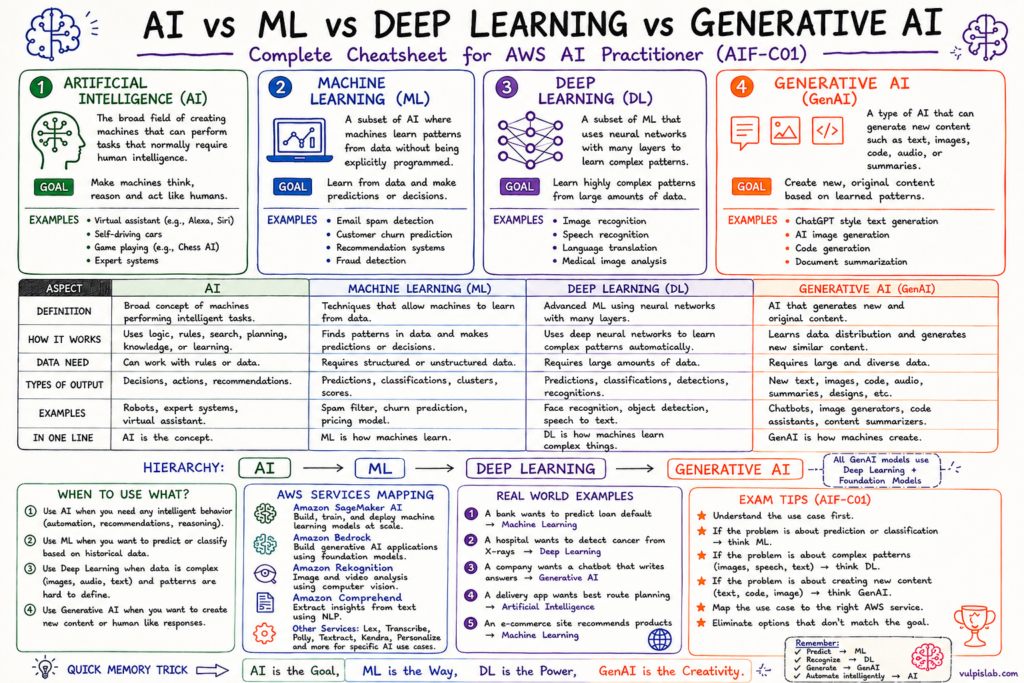
How these concepts are connected
These concepts are connected like a hierarchy.
- AI is the broadest concept.
- ML is a subset of AI.
- Deep Learning is a subset of ML.
- Generative AI often uses deep learning and foundation models to create new content.
You can think of it like this:
AI → Machine Learning → Deep Learning → Generative AI
However, one thing is important.
Generative AI is not the only type of AI. It is one powerful category of AI that became popular because it can generate human-like content.
Real-world example: Food delivery app
Let us understand the difference with one simple food delivery app example.
A food delivery company may use all four concepts in different ways.
1. AI in a food delivery app
The app may use AI to make the overall experience smarter.
For example, it may suggest restaurants, estimate delivery time, detect fraud, or support customers through a chatbot.
This is AI because the system is performing intelligent tasks.
2. ML in a food delivery app
The app may use ML to predict which customer is likely to order again this week.
It can learn from past order history, cuisine preference, location, time of day, and discount usage.
This is machine learning because the model is learning from historical data.
3. Deep Learning in a food delivery app
The app may use deep learning to analyze food images uploaded by restaurants.
It can check whether an image is clear, relevant, or inappropriate.
This is deep learning because image understanding involves complex visual patterns.
4. Generative AI in a food delivery app
The app may use generative AI to create personalized messages.
For example:
“Hi Riya, your favorite paneer thali is trending near you today.”
This is generative AI because the system is creating new text.
Same company, same product, but different AI techniques are used for different problems.
AWS service mapping for this topic
For the AWS AI Practitioner exam, you should connect concepts with AWS services.
1. Amazon SageMaker AI
Amazon SageMaker AI is mainly used for building, training, and deploying machine learning models.
Use SageMaker AI when the question is about:
- Training a custom ML model.
- Deploying a machine learning model.
- Managing ML workflows.
- Building predictive models from data.
In simple words, SageMaker AI is strongly connected with machine learning model development.
2. Amazon Bedrock
Amazon Bedrock is mainly used for building generative AI applications with foundation models.
Use Amazon Bedrock when the question is about:
- Foundation models.
- Generative AI applications.
- Text generation.
- Summarization.
- Chatbots using large language models.
- RAG-based applications.
- Prompt-based AI solutions.
In simple words, Amazon Bedrock is strongly connected with generative AI and foundation models.
3. Amazon Rekognition
Amazon Rekognition is used for image and video analysis.
Use Amazon Rekognition when the question is about:
- Detecting objects in images.
- Analyzing videos.
- Face-related image analysis.
- Computer vision use cases.
4. Amazon Comprehend
Amazon Comprehend is used for natural language processing.
Use Amazon Comprehend when the question is about:
- Sentiment analysis.
- Entity detection.
- Key phrase extraction.
- Text understanding.
5. Amazon Transcribe and Amazon Polly
(1) Amazon Transcribe converts speech to text.
(2) Amazon Polly converts text to speech.
Use them when the question gives audio or voice-related clues.
How to choose the right answer in exam questions
Use this simple decision guide.
1. If the question says “predict”
Think machine learning.
Examples:
- Predict customer churn.
- Predict sales for next month.
- Predict loan default.
- Predict fraud risk.
2. If the question says “classify”
Think machine learning or deep learning.
Examples:
- Classify emails as spam or not spam.
- Classify support tickets by category.
- Classify images by object type.
3. If the question says “recognize image or speech”
Think deep learning or AWS managed AI services.
Examples:
- Image analysis means Amazon Rekognition.
- Speech to text means Amazon Transcribe.
- Text to speech means Amazon Polly.
4. If the question says “generate”
Think generative AI.
Examples:
- Generate emails.
- Generate summaries.
- Generate product descriptions.
- Generate code.
- Generate chatbot responses.
5. If the question says “foundation model”
Think Amazon Bedrock.
Foundation model questions usually point toward generative AI applications on AWS.
6. If the question says “train a custom ML model”
Think Amazon SageMaker AI.
SageMaker AI is more suitable when the team wants to build, train, deploy, or manage machine learning models.
Common exam traps
The AWS AI Practitioner exam can test your understanding through small traps. Here are the most common ones.
Trap 1: Thinking all AI is generative AI
This is incorrect.
Generative AI is only one type of AI. Fraud detection, churn prediction, route optimization, and sales forecasting can be AI use cases, but they are not always generative AI use cases.
Trap 2: Choosing generative AI for every problem
Generative AI is powerful, but it is not always the best solution.
If a company only wants to predict a number or classify a record, traditional machine learning may be better and cheaper.
Trap 3: Confusing ML and deep learning
Deep learning is a type of machine learning, but not every machine learning model is deep learning.
A simple churn prediction model may use traditional ML, while image recognition often uses deep learning.
Trap 4: Confusing SageMaker AI and Bedrock
This is a very important exam point.
Amazon SageMaker AI is mainly for building, training, and deploying ML models.
Amazon Bedrock is mainly for building generative AI applications using foundation models.
Trap 5: Ignoring the business goal
Do not select an AI approach just because it sounds advanced.
First understand the problem. Then choose the simplest and most suitable solution.
Exam-style practice questions
Question 1
A company has past customer data and wants to predict which customers may cancel their subscription. Which approach is most suitable?
A. Generative AI
B. Machine learning
C. Text-to-speech
D. Image generation
Answer: B. Machine learning
The company wants to make a prediction using historical data, so machine learning is the best fit.
Question 2
A marketing team wants to automatically create product descriptions from product attributes. Which type of AI is most suitable?
A. Generative AI
B. Regression
C. Clustering
D. Monitoring
Answer: A. Generative AI
The system is creating new text, so this is a generative AI use case.
Question 3
A hospital wants to detect disease patterns from medical images. Which AI approach is most relevant?
A. Deep learning
B. Text-to-speech
C. Simple reporting
D. Translation
Answer: A. Deep learning
Medical image analysis involves complex visual patterns, so deep learning is highly relevant.
Question 4
A company wants to build a generative AI assistant using foundation models on AWS. Which AWS service is most suitable?
A. Amazon Bedrock
B. Amazon S3
C. AWS CloudTrail
D. AWS KMS
Answer: A. Amazon Bedrock
Amazon Bedrock is used to build generative AI applications with foundation models.
Question 5
A data science team wants to build, train, and deploy a custom machine learning model. Which AWS service should they use?
(1) Amazon SageMaker AI
(2) Amazon Polly
(3) Amazon Rekognition
(4) Amazon Translate
Answer: 1. Amazon SageMaker AI
SageMaker AI is used for machine learning model development, training, and deployment.
Quick revision points
Before the exam, revise these points:
- AI is the broad field of intelligent systems.
- ML is a subset of AI that learns from data.
- Deep learning is a subset of ML that uses neural networks.
- Generative AI creates new content from prompts or context.
- ML is useful for prediction and classification.
- Deep learning is useful for images, speech, and complex data.
- Generative AI is useful for text, image, code, and summary generation.
- Amazon SageMaker AI is important for ML model building.
- Amazon Bedrock is important for foundation models and GenAI applications.
- Always read the business problem before choosing the service.
Interview explanation
If someone asks me the difference between AI, ML, deep learning, and generative AI, I would explain it like this:
AI is the broad goal of making machines perform tasks that usually need human intelligence. Machine learning is one way to build AI because it allows machines to learn patterns from data. Deep learning is a more advanced form of machine learning that uses neural networks and works well with complex data like images, audio, and large text. Generative AI is a type of AI that creates new content such as text, images, code, or summaries. So, from a product point of view, I would choose ML for prediction problems, deep learning for complex pattern recognition, and generative AI for content creation or natural language interaction.
FAQs
What is the difference between AI and ML?
AI is the broad field of making machines intelligent. ML is a subset of AI where machines learn patterns from data and make predictions or decisions.
Is deep learning the same as machine learning?
No, deep learning is a type of machine learning. It uses neural networks with many layers to learn complex patterns from large datasets.
Is generative AI the same as AI?
No, generative AI is one type of AI. It focuses on creating new content like text, images, code, audio, summaries, or responses.
Is ChatGPT an example of generative AI?
Yes, ChatGPT is an example of generative AI because it generates text responses based on user prompts.
Which AWS service is used for generative AI?
Amazon Bedrock is commonly used for building generative AI applications with foundation models on AWS.
Which AWS service is used for machine learning models?
Amazon SageMaker AI is used for building, training, deploying, and managing machine learning models.
Final thoughts
AI, ML, deep learning, and generative AI are connected, but they are not interchangeable terms.
AI is the broad concept. ML is the method of learning from data. Deep learning is the power layer for complex patterns. Generative AI is the creation layer that produces new content.
For the AWS AI Practitioner exam, do not only memorize definitions. Try to understand the business use case behind every question.
(1) If the problem is about prediction, think ML.
(2) If the problem is about complex patterns like images or speech, think deep learning.
(3) If the problem is about creating content, think generative AI.
(4) If the problem mentions foundation models on AWS, think Amazon Bedrock.
(5) If the problem mentions building and training custom ML models, think Amazon SageMaker AI.
This clarity will help you answer many exam questions with confidence.
This is Blog 3 of the AWS AI Practitioner preparation series.
In the next blog, we will study:
Supervised, Unsupervised, and Reinforcement Learning Explained Simply.