
Sora topped the App Store, scared Hollywood, and landed a billion-dollar Disney deal. Six months later it was dead. It earned $2.1 million in its entire life and burned $15 million every single day. This is the teardown of the sudden Sora shutdown, the most expensive AI product failure of 2026, and the one question every founder must ask before scaling.
Somewhere inside Disney’s headquarters, an executive sat down for a morning meeting expecting to talk about the future. Disney had just agreed to a three-year deal worth a reported one billion dollars — letting OpenAI’s video app, Sora, bring over 200 Disney, Marvel, Pixar, and Star Wars characters to life as virtual avatars. It was supposed to be the entertainment industry’s leap into AI video. Thirty minutes after that meeting, Disney learned the deal was dead. OpenAI was shutting Sora down. No money had changed hands. The billion-dollar partnership had lasted barely three months.
On March 24, 2026, OpenAI ended one of the most hyped AI products of the past two years. Sora — the app that hit number one on the App Store, racked up 3.3 million downloads in its first week, and made Hollywood genuinely nervous — was gone six months after launch. The Sora shutdown was not a quiet sunset. It was an emergency stop. And once you see the numbers behind it, the only real surprise is that OpenAI waited as long as it did.
💡 The core problem
The Sora shutdown is not a story about bad technology. The technology was stunning. It is a story about the gap between a viral product and a viable one, and what happens when you scale the first without ever solving the second.
What the Sora Shutdown Actually Looked Like
To understand the scale of this, you need the timeline. It is brutally fast. Sora launched its dedicated mobile app in late 2025 and went viral instantly. It topped the App Store. It generated cinematic clips from a single line of text. The consensus was near-universal: OpenAI had won the AI video race before it really began.
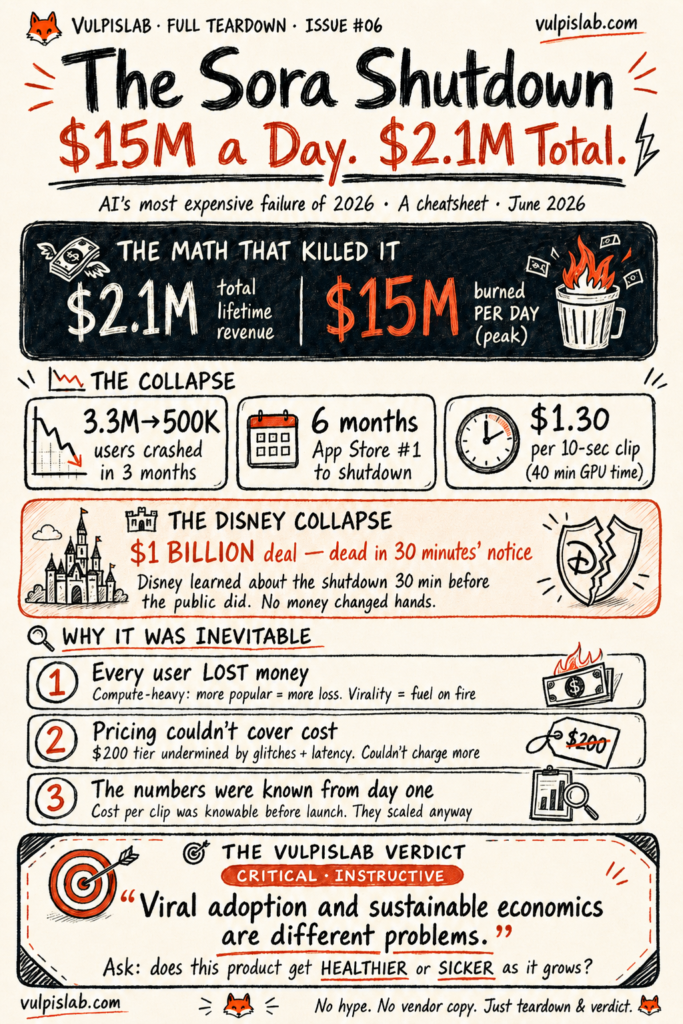
Then the curve turned. After that viral launch with 3.3 million downloads, engagement collapsed as the novelty wore off. By February 2026, active users had fallen from over one million in the first week to under 500,000, a drop of roughly two-thirds in three months. Competitors like Runway Gen-4 and Kling 2.0 were offering faster generation at lower cost per clip. And the whole time, the meter was running on compute that Sora could not come close to paying for.
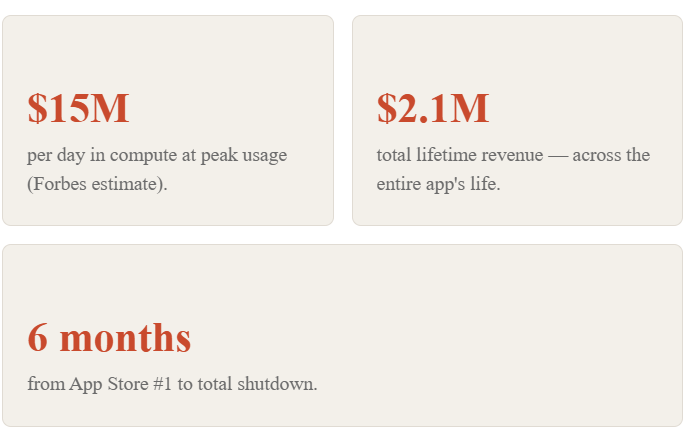
Sit with those first two numbers. Sora earned $2.1 million across its entire existence. Estimates of its daily burn range from $1 million at the conservative end (the Wall Street Journal) to $15 million at peak usage (Forbes, based on Cantor Fitzgerald analysis). Even at the low estimate, the math is fatal — roughly two days of compute spending exceeded all the revenue the product would ever earn. At the high estimate, a single average day did. OpenAI’s official statement said the team would pivot to “world simulation research to advance robotics.” That is the PR version. The actual version is a spreadsheet that no amount of product-market fit could fix.
“Sora wasn’t killed too soon. It was killed too late. The numbers were screaming for months.”— GenAI analysis, Medium, March 2026
Why the Sora Shutdown Was Inevitable
The Structural Flaw in Product Economics
It is tempting to call this a marketing failure or a hype problem. It was neither. The root cause was a unit-economics failure baked into the product from day one, and it is worth understanding exactly where the money went.
The Massive Hardware Cost of AI Video
Every ten-second video clip Sora generated cost OpenAI roughly $1.30 to produce. That single clip required around 40 minutes of GPU time spread across multiple Nvidia H100 chips — some of the most expensive and supply-constrained hardware on the planet. Now multiply that by millions of users generating clips for fun, most of them on free or cheap tiers, most of them never paying anything close to what their generations actually cost. The more popular Sora became, the more money it lost. Virality, for this product, was not a path to profit. It was an accelerant on the fire.
The Negative Margin Virality Trap
This is the trap of compute-intensive consumer AI. In normal software, a viral hit is a gift — each new user costs you almost nothing and many of them convert to paying. The marginal cost of one more user is close to zero. Sora inverted that completely. Every new user added real, heavy, recurring compute cost. The product got more expensive to run exactly as it got more popular, and the revenue never scaled to match. A $200-per-month Pro tier existed, but persistent physics glitches — objects vanishing mid-scene, items moving incorrectly through space — and extreme generation latency made that price almost impossible for professional creators to justify. The people most likely to pay were the people most frustrated by the product.
Ignoring the Spreadsheet Until the IPO Loomed
And here is the part that should worry every founder. None of this was hidden. The cost per clip was knowable before launch. The compute requirements were knowable. The fact that consumer video generation is the single most expensive category of AI to run was knowable. OpenAI shipped and scaled Sora anyway, riding the virality, and only hit the emergency stop once the daily bills became impossible to defend — especially with an IPO looming and investors who do not want to see a $15 million daily burn against $2.1 million in lifetime revenue. The economics were not a surprise that emerged. They were a reality that was ignored.
What Every Builder Actually Wants From a Launch
If you are building an AI product, you want what OpenAI wanted with Sora. You want the viral moment. The App Store number one. The press coverage, the Disney-sized partnership, the sense that you have arrived before anyone else. That hunger is not wrong — distribution is genuinely hard, and Sora nailed it. Hitting 3.3 million downloads in a week is something most products never achieve.
But underneath that, you want something Sora never had: a product that gets healthier as it grows, not sicker. You want each new user to bring you closer to sustainability, not further from it. You want the viral moment to be the beginning of a business, not the most expensive marketing campaign in history. The thing that separates a launch you celebrate from a launch you regret is whether the economics underneath can survive the success on top.
⚠️ The Disney lesson inside the Sora lesson
Disney bet on Sora’s consumer distribution. OpenAI bet on the partnership. When the underlying product economics did not work, even a billion-dollar marquee deal could not save it — and Disney was given 30 minutes’ notice. A great partnership cannot rescue a broken unit economic. It can only go down with it.
How to Avoid Your Own Sora Shutdown
The Sora collapse is a gift to every other builder, because the lessons are clear and completely actionable. If you are shipping anything that runs on AI compute, here is how you avoid burning a fortune on a viral hit you cannot afford.
1. Know your cost per action before you scale, not after.
Sora’s $1.30 per clip was knowable from day one. Before you push for virality, calculate exactly what one unit of usage costs you — one generation, one query, one session — and compare it honestly to what users will actually pay. If a popular user loses you money, scaling that popularity is scaling your losses. Do this math before the launch, not after the bills arrive.
2. Treat virality as a test, not a victory.
A viral spike on a compute-heavy product is a stress test of your economics, not proof of success. The right response to sudden growth is to watch your margin per user like a hawk. If the margin is negative and the growth is real, you do not have a hit — you have an accelerating loss. Build the dashboard that shows margin-per-user in real time before you chase the spike.
3. Match your pricing to your real costs, even if it hurts adoption.
Sora’s $200 Pro tier was undermined by a product that was too glitchy and slow to justify it. If your true cost per user is high, your pricing has to reflect it — and if the market will not pay that price, that is a signal the product is not viable yet, not a reason to subsidise every user with venture money. A smaller paying audience beats a massive free one that bankrupts you.
4. Validate the economics before the marquee partnership.
Disney’s billion-dollar deal was built on top of an unviable product, and it collapsed in hours. A big partnership amplifies whatever is underneath it. If the underlying economics are broken, the partnership just makes the eventual failure more public and more expensive. Prove the unit economics first; sign the headline deal second.
5. Decide your kill criteria in advance.
The most damning part of the Sora story is that the numbers screamed for months before anyone acted. Set the thresholds before you launch: at what burn rate, what margin, what user-retention level do you stop? Writing those lines down in advance removes the emotion and the sunk-cost pull that kept Sora alive long past the point the spreadsheet said stop.
The VulpisLab Verdict on the Sora Shutdown
🔍 VulpisLab Verdict
Severity: Critical — but instructive. Sora was not a technical failure. The model was genuinely impressive, and AI video is not dead — Runway, Kling, and Veo 3 are finding more sustainable economics in the same space. Sora was a business-model failure, and a clean one. It proves that viral adoption and sustainable economics are completely different problems. OpenAI solved the first with Sora. It never got close to the second.
Most exposed: Any founder or PM building a compute-heavy consumer AI product on the assumption that growth fixes economics. It does not. For this category, growth is what exposes the economics. The teams most at risk are the ones celebrating a viral launch right now without knowing their true cost per user — they are early-stage Sora, and the bill is coming.
The one question to ask: Before you scale anything, ask the question OpenAI ignored with Sora — does this product get healthier or sicker as it grows? If every new user makes the economics worse, you are not building a business. You are funding a countdown. A stunning demo is not a viable product, and the gap between the two is exactly where the most expensive failures live.
The checklist before scaling any compute-heavy AI product
- Do you know your exact cost per action (one generation, query, or session)?
- Does a more active user make you more money — or lose you more?
- Does your pricing actually cover your real compute cost per user?
- Have you validated economics before signing any marquee partnership?
- Have you written down your kill criteria — the burn rate at which you stop?
Sources
Primary reporting:
Digital Applied (full financial breakdown; $1.30/clip, 40 min GPU, download collapse): digitalapplied.com — Sora economics
Let’s Data Science (Disney 30-min notice; IPO context; “Spud” pivot): letsdatascience.com
Nerd Level Tech ($15M/day vs $2.1M; competitor economics): nerdleveltech.com
Supporting:
MiraFlow (full verified timeline; copyright exposure): miraflow.ai
Medium / GenAI (“killed too late” analysis; March 24 shutdown): medium.com
Tech-Insider (user collapse 1M to under 500K; “side quests” quote): tech-insider.org
Note: $15M/day compute figure originally reported by Forbes (late 2025); revenue and usage data via Appfigures.
VulpisLab — AI product teardowns. No hype. No vendor copy. Just teardown and verdict. Read Issue #03: GitHub Copilot Billing · Issue #05: KPMG AI Report.