
When I first learned about public, private, and hybrid cloud, I treated them like three definitions I needed to remember.
Public cloud means infrastructure shared across customers and operated by a cloud provider.
Private cloud means cloud infrastructure dedicated to one organisation.
Hybrid cloud combines environments.
Definitions learned. Topic finished.
Except that knowing those definitions doesn’t help much when someone asks:
“Which one should our product actually use?”
That’s where this topic becomes a Product Management problem.
The decision isn’t about finding the cloud model with the longest list of advantages. It is about understanding what our product needs, which constraints genuinely matter, and what we are willing to trade in exchange for flexibility, control, cost, speed, or locality.
So instead of memorising three cloud models, let’s learn how to choose between them.
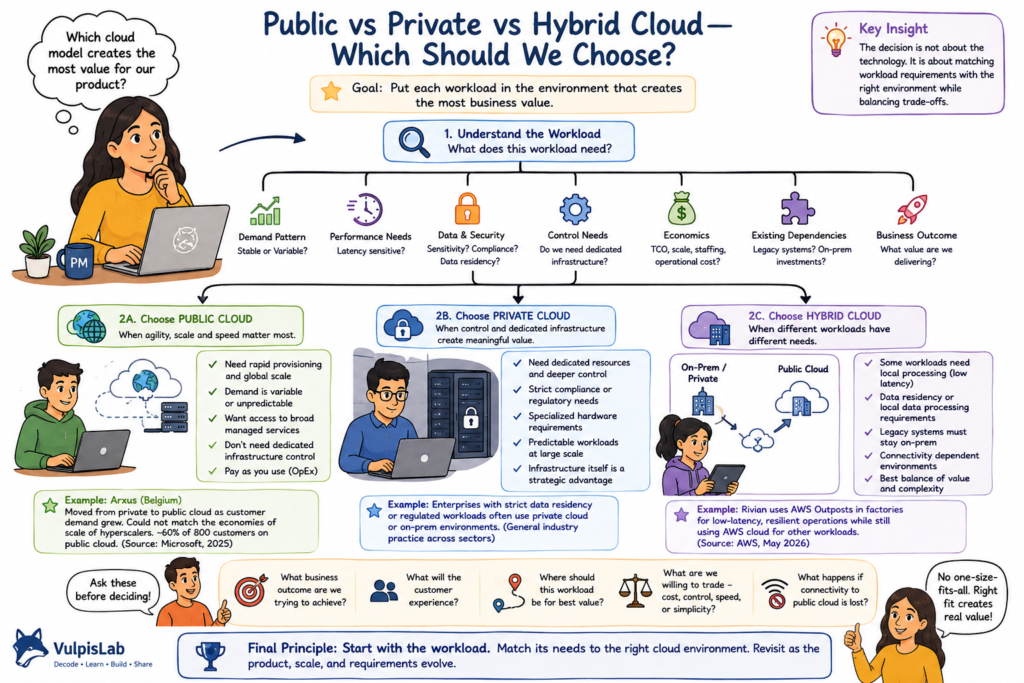
Public vs private vs hybrid cloud: the simple answer
Choose public cloud when you need rapid access to infrastructure, flexible scaling, broad managed services, and don’t have a strong reason to operate dedicated infrastructure. Choose private cloud when dedicated infrastructure and deeper control are important enough to justify the additional responsibility and economics. Choose hybrid cloud when different workloads have different requirements and forcing everything into one environment would create unnecessary compromises.
That is the short answer.
The real decision starts with something else:
What does this particular workload need?
Notice that I said workload, not company.
That distinction will become important.
Public cloud is a little like staying at a hotel
Suppose you travel to another city.
You could buy a house there, but that would be an enormous commitment for something you may need only occasionally.
Instead, you book a hotel.
The hotel company owns the building and operates the infrastructure. Many customers use the hotel, but each customer gets their own room and controlled access to it.
Public cloud follows a somewhat similar idea.
Providers such as AWS, Microsoft Azure, and Google Cloud operate enormous computing infrastructures. Companies consume computing power, storage, databases, networking, AI services, and many other capabilities without owning the underlying data centres themselves.
Multiple customers use the provider’s infrastructure, while technical controls isolate their resources.
For a company building a new digital product, this can remove a huge amount of work.
Instead of buying servers before knowing whether 1,000 or one million customers will arrive, the company can provision resources as needed.
That flexibility can be extremely valuable.
But public cloud isn’t automatically the answer for every workload.
Why would anyone build a private cloud?
This was the question that confused me initially.
If public cloud providers already have enormous infrastructure, advanced security capabilities, global regions, managed databases, AI platforms, and thousands of engineers maintaining everything, why would a company still want a private cloud?
The answer is control and requirements.
A private cloud provides cloud-like computing capabilities for a single organisation rather than sharing the underlying environment in the same way as a public cloud service.
That can matter when an organisation has specialised infrastructure requirements, strict internal governance, particular regulatory obligations, or workloads where deeper control over the environment creates meaningful value.
But that control comes with responsibility.
Someone still has to operate, secure, update, monitor, scale, and maintain the environment.
This means private cloud should not simply be treated as:
Public cloud, but safer.
It is a different operating model with different economics.
The Product Manager question I would ask is:
What requirement do we have that makes dedicated infrastructure valuable enough to justify the additional cost and operational responsibility?
If nobody can answer that clearly, I would challenge whether private cloud is actually necessary.
A real company discovered that private cloud was no longer enough
Arxus provides an interesting example.
The Belgian cloud-solutions company had historically provided services through its own private-cloud infrastructure. As the market evolved, however, it began seeing increasing customer demand for public cloud.
According to a 2025 Microsoft customer story, Arxus concluded that it could not match the economies of scale available to large public-cloud providers. It consequently adopted a public-cloud-first strategy while using Azure Arc to manage resources across different environments. Around 60% of its 800 customers were on public cloud at the time of Microsoft’s case study.
There is an important Product Management lesson here.
Private cloud gave Arxus control, but control was not the only business requirement.
The company also needed scale, capabilities, and a service portfolio that could remain competitive as customer expectations changed.
So the question wasn’t simply:
Which cloud is technically better?
It was:
Which model allows us to create the strongest customer and business value over the next several years?
Infrastructure decisions should consider where the product is going, not only where it is today.
Then why not put everything in public cloud?
This is where hybrid cloud starts making sense.
Imagine a manufacturing company operating a factory.
Some workloads may involve customer portals, analytics, business applications, or long-term data storage. These may work perfectly well in public cloud.
But another application may control equipment on the factory floor.
Now latency becomes important.
Latency simply means delay.
If a machine sends information somewhere and has to wait for a response before taking its next action, sending that information to a distant cloud region may sometimes introduce more delay than the application can tolerate.
Other workloads may need to process information locally because of data-location, bandwidth, connectivity, or regulatory requirements.
Moving everything to public cloud simply to achieve architectural consistency could therefore make the system worse.
Keeping everything private could create the opposite problem by preventing teams from benefiting from public-cloud services where they make sense.
Hybrid cloud exists partly because real businesses contain these kinds of conflicting requirements.
Rivian gives us a useful example
Electric-vehicle manufacturer Rivian provides a recent example of why cloud architecture can extend all the way to the factory floor.
AWS described in May 2026 how Rivian uses AWS Outposts in manufacturing environments. Outposts brings AWS infrastructure and services into a customer’s own location, allowing certain workloads to operate locally while still using a broader AWS environment.
For critical manufacturing workloads, local computing can help address requirements such as low latency and resiliency at the factory edge.
This is what makes hybrid cloud easier for me to understand.
Rivian doesn’t have to choose between:
Everything inside the factory
and
Everything in a distant public-cloud data centre.
Different workloads can live where they make the most sense.
That changes the Product Manager question from:
“Which cloud should our company choose?”
to:
“Where should this workload run to deliver the outcome we need?”
That is a much better question.
Hybrid cloud is not simply “half public + half private”
This is another misconception worth clearing up.
Hybrid cloud does not mean taking 50% of your servers and putting them in public cloud while keeping the other 50% somewhere else.
The environments need to work together in a useful way.
Perhaps sensitive data stays within a controlled environment while another system performs less-sensitive processing in public cloud.
Maybe a factory application processes time-critical information locally while aggregated data moves to cloud analytics systems.
A legacy application might remain in an existing environment while new digital capabilities are built in public cloud.
The architecture follows the requirements.
AWS, for example, identifies low-latency access to local systems, local data processing, data residency, and dependencies on on-premises applications as situations where hybrid infrastructure can be useful.
Hybrid cloud therefore isn’t automatically the “best of both worlds.”
It is the ability to put different workloads where they make sense.
But flexibility creates another problem: complexity
At this point hybrid cloud may sound like the obvious winner.
Why choose between public and private when we can have both?
Because every additional environment creates something else we need to manage.
Imagine having one application in public cloud, another in private infrastructure, databases in different locations, and legacy systems still running in a company data centre.
Now think about identity.
Who has access to what?
Then networking.
How do the systems communicate securely?
Then monitoring.
How do we know which part has failed?
Then security policies, software updates, deployment processes, backups, governance, and costs.
The architecture may give us more flexibility while simultaneously increasing operational complexity.
Fujitsu encountered this kind of challenge while modernising its infrastructure. According to Microsoft, the company was moving systems toward cloud but still needed to retain many on-premises servers. It adopted Azure Arc to help manage 134 servers and is working toward a more unified way of managing its hybrid environment.
That leads to an important rule:
Don’t choose hybrid because it sounds flexible. Choose it when the value of placing workloads in different environments is greater than the complexity you introduce.
Security should not decide the model by itself
Another oversimplification I often see is:
Public cloud = less secure
Private cloud = more secure
Security doesn’t work that neatly.
A private environment gives an organisation greater control over its infrastructure, but that organisation also needs the people, processes, monitoring, patching, governance, and expertise required to secure it.
Public-cloud providers operate large security programmes and offer extensive security capabilities, but customers still remain responsible for correctly configuring and protecting many parts of their applications and data.
This is why I would not begin with:
“Which cloud is most secure?”
I would begin with:
“What exactly are our security requirements?”
What information does the product process?
Who should access it?
Where can the data live?
What encryption is required?
What happens if credentials are compromised?
Which regulations apply?
What evidence will customers or auditors require?
Once those questions are clear, the architecture team can evaluate which model satisfies them.
Security is a requirement.
The cloud model is one way of meeting it.
Data residency can change the answer
Suppose your product handles information that must remain within a particular country or location because of regulatory, contractual, or security requirements.
This is known as data residency.
Suddenly the infrastructure decision changes.
Perhaps the public-cloud provider has an appropriate region available.
If it does, public cloud may still work perfectly well.
If it does not, another architecture may be necessary.
Hybrid infrastructure can also support situations where information needs to remain locally while other workloads use public-cloud capabilities. AWS specifically identifies data residency and local data processing as use cases for Outposts.
The important lesson is that:
“We have sensitive data” does not automatically mean “we need private cloud.”
We need to understand the actual requirement first.
Cost also looks different across the three models
Public cloud can reduce the need for large upfront infrastructure purchases because resources are consumed as services.
That can be particularly useful when demand is uncertain.
Private cloud may require greater investment because dedicated infrastructure must exist somewhere and someone must operate it.
However, at large and predictable scale, the economics can change. We already saw this principle in the previous Cloud Product Challenge with Dropbox, where infrastructure choices evolved as the company and its workloads became enormous.
Hybrid cloud introduces yet another cost dimension because the organisation may now operate and connect multiple environments.
This is why I would never decide between public, private, and hybrid using only the monthly infrastructure bill.
I would look at total cost of ownership (TCO), including infrastructure, licences, networking, people, maintenance, security, operational complexity, migration, and the cost of unused capacity.
Then I would ask the question Product Managers should care about:
What business value are we getting in exchange for that cost?
How I would choose as a Product Manager
I would start with the workload rather than choosing one model for the entire organisation.
For each important workload, I would ask what business outcome it supports and what customers expect from it.
Then I would understand how demand behaves. If usage can increase dramatically without warning, public-cloud elasticity may be valuable.
Next, I would examine control. Does the workload genuinely need dedicated infrastructure, or would that simply create additional operational work?
I would also look at latency. Does processing need to happen close to a factory, device, user, or data source?
Then come security, compliance, and data residency. What requirements actually exist, and which architecture can satisfy them?
Finally, I would compare economics and complexity.
Only after answering those questions would I decide whether that workload belongs in public cloud, private cloud, or a hybrid environment.
Notice what I would not do:
“We are a hybrid-cloud company, so everything must follow the hybrid strategy.”
Architecture labels should not dictate product requirements.
Product requirements should shape the architecture.
What I learned while working through this question
Initially, I thought public, private, and hybrid cloud were three choices a company makes at an organisational level.
You select one and then build around it.
Looking at real situations changed that for me.
The more useful unit of decision is often the workload.
A company can have a customer-facing application that benefits from public-cloud scalability, a factory workload that needs local processing, and a legacy system that cannot yet be moved economically.
Trying to force all three into the same environment simply because we want a clean architecture diagram may create the wrong product decision.
So the question I would now ask is not:
“Which cloud model should our company choose?”
It is:
“What does this workload need, and where can we deliver those requirements with the best balance of value, cost, control, and complexity?”
That makes public vs private vs hybrid much easier to reason about.
When should you choose public cloud?
Public cloud is often a strong choice when the product needs to scale quickly, demand is uncertain, the organisation wants faster access to infrastructure, global reach is important, or managed cloud services can reduce operational work.
It can also make sense when owning infrastructure provides no meaningful competitive advantage.
For many new digital products, this is why public cloud becomes a natural starting point.
But “public cloud first” should still be a decision, not an unquestioned rule.
When should you choose private cloud?
Private cloud becomes worth considering when dedicated infrastructure provides meaningful value.
That could come from specialised hardware, strict control requirements, particular regulatory or contractual constraints, predictable workloads at sufficient scale, or circumstances where deep infrastructure customisation matters.
The important part is being able to explain why dedicated infrastructure is necessary.
If the answer is simply:
“Private sounds safer,”
the analysis is probably incomplete.
When should you choose hybrid cloud?
Hybrid cloud becomes useful when different workloads have requirements that cannot be satisfied efficiently in one environment.
You might need local processing for one workload while using public-cloud analytics for another. A legacy system may need to remain on-premises while new capabilities are developed in cloud. Sensitive information may need additional locality controls while other services benefit from cloud scalability.
Hybrid provides flexibility.
But that flexibility should create enough value to justify the additional integration, security, governance, networking, and operational complexity.
Questions I would ask before choosing
Before making the decision, I would want answers to these questions:
- What business outcome are we trying to achieve?
- What does the customer need from this workload?
- How predictable is demand?
- How quickly must the system scale?
- Does processing need to happen locally?
- How sensitive is latency?
- What data does the workload handle?
- Where is that data allowed to live?
- What security and compliance requirements apply?
- Do we genuinely need dedicated infrastructure?
- What does each option cost over time?
- What operational complexity will each option introduce?
- What happens if connectivity to the public cloud is lost?
- Are we choosing one model for convenience when different workloads actually need different answers?
If we cannot answer those questions yet, choosing the cloud model is probably premature.
We need more discovery.
Frequently Asked Questions
What is the difference between public, private, and hybrid cloud?
Public cloud provides computing services using infrastructure operated by a third-party cloud provider. Private cloud provides cloud infrastructure dedicated to a single organisation. Hybrid cloud connects different environments so workloads can run where their requirements are best met.
Is private cloud more secure than public cloud?
Not automatically. Private cloud can provide greater infrastructure control, but security also depends on configuration, access management, monitoring, patching, governance, and operational expertise. Public cloud can also support highly secure workloads when appropriately designed and configured.
Is hybrid cloud better than public cloud?
Not necessarily. Hybrid cloud provides more deployment flexibility but introduces additional integration and operational complexity. It makes sense when workloads genuinely have different location, latency, control, regulatory, or technical requirements.
Can sensitive data be stored in public cloud?
Potentially, yes. The answer depends on the sensitivity of the data, applicable laws and contracts, available cloud regions, security architecture, encryption, access controls, and other requirements. “Sensitive” alone does not automatically require private cloud.
Can a company use all three cloud models?
Yes. Different workloads can have different requirements. An organisation may use public-cloud services, dedicated environments, and hybrid architectures simultaneously when there is a business or technical reason to do so.
The question to remember
Public, private, and hybrid cloud are useful terms.
But I don’t want to memorise them simply as three definitions anymore.
I want to remember the decision behind them:
Business outcome → workload → requirements → constraints → placement → trade-offs → decision
Start with what the workload needs.
Then determine where it should run.
Because the goal is not to become a public-cloud company, a private-cloud company, or a hybrid-cloud company.
The goal is to put each workload in the environment where it can create the most customer and business value.