
When I first started looking at cloud vs on-prem, the comparison seemed simple.
With on-premises infrastructure, a company owns or directly manages the servers running its applications. With cloud infrastructure, the company consumes computing resources from a provider such as AWS, Microsoft Azure, or Google Cloud.
That explanation is technically correct, but it does not help a Product Manager make a decision.
The more useful question is:
Which option creates more value for this product, at this stage of its life?
That changes the conversation completely.
Cloud is not automatically better because it is modern. On-prem is not automatically cheaper because the hardware already belongs to the company. The right choice depends on the product, its users, its workload, the business outcome we are trying to achieve, and the constraints we cannot ignore.
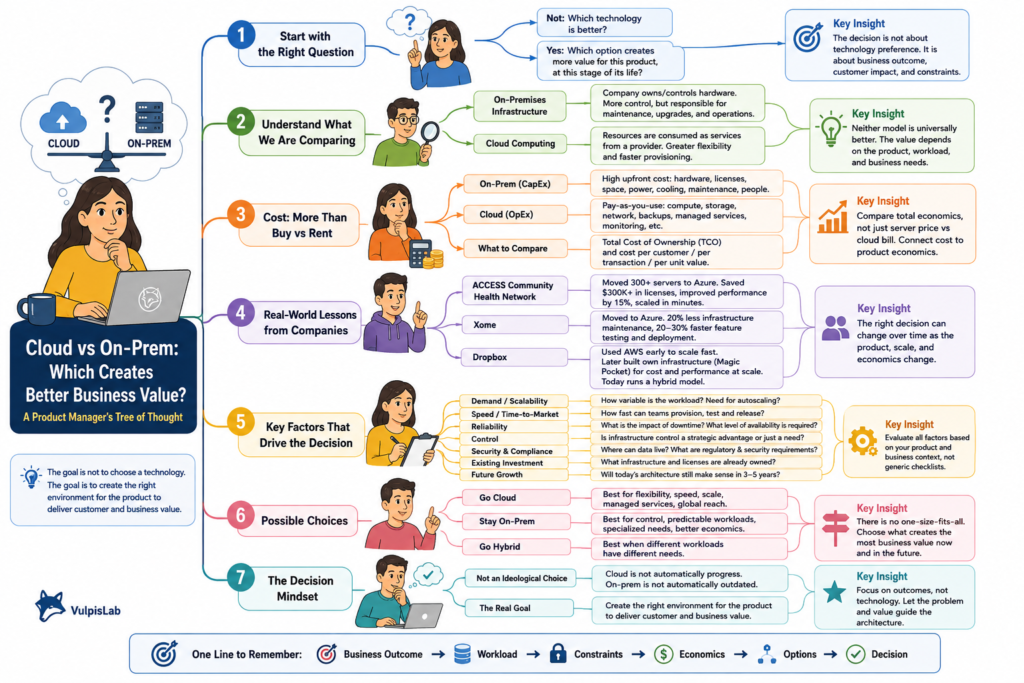
Cloud vs on-prem: the simple answer
Cloud usually creates more business value when a product needs flexibility, faster infrastructure provisioning, changing capacity, geographic reach, or access to managed services. On-prem can create more value when workloads are predictable, infrastructure-level control matters, specialised hardware is required, or owning infrastructure makes better economic sense.
Sometimes the strongest answer is neither extreme.
A combination of cloud and company-controlled infrastructure can also be appropriate. This is usually called hybrid cloud.
The important point is that the decision should start with the product problem, not the infrastructure preference.
A healthcare organisation faced this decision for a very practical reason
ACCESS Community Health Network gives us a useful real example.
ACCESS is a nonprofit healthcare provider in the Chicago area. According to a Microsoft customer case study, its on-premises infrastructure was reaching the end of its useful life. The organisation had been spending about $400,000 every three to five years to refresh servers, while some software licensing costs had tripled. Increasing capacity also required additional hardware purchases and installation.
That context matters.
ACCESS did not begin with:
“Cloud is the future, so we need Azure.”
It had a real operating problem.
Hardware was aging, expansion required more infrastructure investment, and software costs were increasing.
The organisation eventually moved more than 300 servers supporting its electronic medical record environment to Azure. Microsoft reports that ACCESS eliminated more than $300,000 in third-party software licensing costs, improved system performance by 15%, and gained the ability to add servers or storage in minutes rather than months.
As a Product Manager, the lesson I take from this is not that cloud always saves money.
The lesson is:
Understand what staying on-prem actually costs before comparing it with cloud.
If your current environment is approaching a major hardware refresh, requires expensive licences, takes months to expand, or consumes significant operational effort, those costs belong in the decision.
What are we really comparing?
Think of on-prem and cloud like two different ways of getting transportation.
If you own a car, you control it. You decide how it is maintained, where it stays, and how it is used. But you also pay for the vehicle, maintenance, insurance, and unused time when it sits in your driveway.
Using a taxi is different. You do not own the vehicle, but you can request transportation when you need it without purchasing the car itself.
Cloud and on-prem are not exactly the same as cars and taxis, but the analogy helps explain the trade-off.
With on-premises infrastructure, the organisation owns or directly controls much of the physical environment. It is responsible for purchasing capacity, maintaining hardware, replacing equipment, and operating the infrastructure.
With cloud computing, the company consumes computing resources as services. Capacity can often be provisioned much faster, and the cloud provider manages much of the underlying physical infrastructure.
Neither model is universally superior.
The correct question remains:
What does our product need?
Cost is not simply “buy versus rent”
This is where cloud vs on-prem discussions often become misleading.
On-prem infrastructure can involve large upfront investments in servers, storage, networking equipment, software, physical space, maintenance, power, cooling, and operational teams.
That upfront investment is commonly associated with CapEx, or capital expenditure.
Cloud often shifts more spending toward OpEx, or operational expenditure, because infrastructure is consumed as an ongoing service.
At first glance, that makes cloud look financially simpler.
But cloud has its own costs.
Compute, databases, storage, network traffic, backups, monitoring, logging, security services, and managed platforms can all contribute to the monthly bill. Resources can also continue generating cost when they are poorly configured or no longer needed.
So I would never compare only:
Price of server vs monthly cloud invoice
I would compare the total cost of ownership, or TCO.
That means asking:
What does the infrastructure itself cost?
How much do licences cost?
How much engineering time is spent maintaining it?
How often must hardware be replaced?
How much unused capacity are we paying for?
How does cost change when the product grows?
For Product Managers, I would go one step further.
Instead of looking only at the total infrastructure bill, connect that bill to product economics.
Ask:
What does infrastructure cost per customer?
What does it cost per transaction?
How does the infrastructure cost change as usage grows?
Now we are no longer discussing infrastructure in isolation.
We are discussing business value.
Sometimes cloud creates value by giving engineers time back
The Xome case is interesting for a different reason.
Xome operates an online real-estate marketplace. Microsoft says the company was maintaining multiple physical data centres and cloud environments, which was becoming expensive and difficult to scale. Xome eventually consolidated much of that environment onto Azure.
After the migration, Xome reported that infrastructure-maintenance effort dropped by around 20%, while engineers were able to test and deploy features 20% to 30% faster.
This is where I think the Product Manager’s perspective becomes especially important.
The value was not simply:
“Our servers require less maintenance.”
The more meaningful chain is:
Less infrastructure maintenance → more engineering capacity → faster testing and delivery → faster customer value
That changes the economics of the decision.
Cloud may cost more in one infrastructure category and still create greater business value if it allows the organisation to launch important product improvements much faster.
This is why time-to-market belongs in a cloud vs on-prem decision.
What happens when demand changes?
Now consider scalability.
Suppose a product normally needs enough computing capacity for 10,000 users, but during a major event it suddenly needs enough capacity for 100,000.
With on-prem infrastructure, a company may need to buy enough hardware to support the peak even though most of that capacity sits unused for much of the year.
Cloud can make it easier to add capacity when demand rises and reduce it when demand falls.
When this happens automatically, it is commonly called autoscaling.
For a product with highly unpredictable demand, that flexibility can create significant value.
But now consider a factory application running the same workload every day with very little variation. If the organisation already owns efficient infrastructure that comfortably supports the workload, elasticity may create much less value.
That is why I would not ask:
“Does cloud scale better?”
I would ask:
How variable is our workload, and what does insufficient or unused capacity cost the business?
That is a question we can investigate.
The interesting part: sometimes a company moves the other way
Dropbox makes this discussion much more useful because its story prevents us from turning cloud vs on-prem into a one-sided argument.
During Dropbox’s early growth, public cloud infrastructure helped the company scale without first building massive storage infrastructure of its own.
But as Dropbox grew to enormous scale, its needs changed.
The company eventually built Magic Pocket, its own custom storage infrastructure. Dropbox has described how it designed this system specifically around its workload and scale rather than depending entirely on public-cloud storage.
That does not mean Dropbox discovered that cloud was a mistake.
The cloud had solved an earlier problem.
Later, scale and economics created a different problem, so the architecture changed.
This is one of the most important lessons for me:
The right infrastructure decision can change as the product changes.
A startup serving 10,000 users and a mature company serving hundreds of millions of users may reach completely different conclusions even if they are building similar products.
The architecture should evolve with the product.
Control can also create business value
On-prem infrastructure gives organisations greater control over the physical environment.
Sometimes that matters.
A company may depend on specialised hardware. A workload may need to operate extremely close to a factory or medical device. An organisation may have regulatory or operational constraints that make certain cloud architectures difficult.
At very large scale, controlling infrastructure can also provide opportunities for deep optimisation.
Dropbox is a useful example of this because customising its own storage system made sense at a scale where infrastructure itself had become strategically important.
But most businesses are not Dropbox.
For a typical SaaS company, running storage hardware probably does not create customer differentiation.
That gives me another useful Product Manager question:
Is controlling this infrastructure strategically valuable, or are we spending time operating something customers will never pay us for?
If infrastructure is not part of the company’s competitive advantage, using managed cloud capabilities may free teams to focus on what actually differentiates the product.
Reliability needs to start with customer impact
Cloud providers offer many capabilities for improving resilience, backup, and disaster recovery.
However, saying “cloud is more reliable” is too simplistic.
Both cloud and on-prem environments can be designed well or badly.
The better starting point is:
What happens to our customers and business if this product becomes unavailable?
If an internal administrative application is unavailable for ten minutes, the impact may be manageable.
If a payment platform is unavailable during peak shopping hours, those same ten minutes could mean failed transactions, customer frustration, support requests, and revenue loss.
That business impact should determine how much reliability we need.
Technical concepts such as availability, SLA, RTO, RPO, and disaster recovery then help convert that business expectation into architecture requirements.
The order matters.
First understand how much failure hurts.
Then decide how much resilience is worth paying for.
Security is not simply cloud versus on-prem
Security is another area where absolute statements are dangerous.
You may hear:
“On-prem is safer because we control everything.”
Or:
“Cloud is safer because the providers have better security.”
Both statements can be wrong.
Security depends on how systems are designed, configured, monitored, and operated.
Cloud providers may manage many security responsibilities at the infrastructure level, while customers remain responsible for how they configure services, manage access, protect data, and secure applications.
The exact division is commonly called the shared responsibility model.
For a Product Manager, I would focus on requirements rather than ideology.
What data does the product handle?
Who should be able to access it?
Where can it legally be stored?
How quickly must access be removed?
Which controls do enterprise customers require?
What evidence must we provide during audits?
Once those requirements are understood, architecture teams can determine whether cloud, on-prem, or a combination of both satisfies them best.
Hybrid can be a perfectly sensible answer
Cloud vs on-prem is often presented as if a company must choose one side forever.
Real systems are rarely that simple.
Some applications may be excellent cloud candidates, while other systems may need to remain inside company-controlled environments.
A business might keep a specialised manufacturing system on-prem while moving customer-facing applications, analytics, backups, or other workloads to cloud infrastructure.
That combination is usually described as hybrid cloud.
A hybrid approach is not necessarily indecision.
Sometimes it is simply the result of treating different workloads according to their actual needs.
How I would make the decision as a Product Manager
I would begin with the business outcome.
What problem are we trying to solve?
Then I would understand the customer impact. If infrastructure changes, what actually becomes better for the user?
Next comes the workload. Is demand predictable or volatile? Does the product need global reach? Is latency critical? Are there specialised hardware dependencies?
Then I would look at economics, not just infrastructure pricing. What is the current TCO? What would cloud cost at today’s scale? What happens at five times today’s usage?
I would also examine reliability, security, compliance, migration risk, and the value of existing infrastructure investments.
Only after understanding those things would I compare three realistic options:
Stay on-prem.
Move to cloud.
Use a hybrid approach.
The goal is not to find the option with the most technical capabilities.
The goal is to find the option that best supports the product’s business outcome while keeping customer experience, cost, risk, and future flexibility within acceptable limits.
What I learned while working through this question
Before I started looking at these situations more deeply, cloud vs on-prem felt like a technology comparison.
Now I see it differently.
It is really a product-strategy and economics decision that eventually becomes an architecture decision.
The Dropbox story made this particularly clear to me.
Cloud can be exactly the right answer when a company needs to scale quickly without building enormous infrastructure first. The same company can later reach a point where owning part of the infrastructure makes more sense.
Neither decision has to be wrong.
The context changed.
That has changed the question I would ask as a Product Manager.
Instead of:
“Which is better, cloud or on-prem?”
I would ask:
“Which option creates more value for this product at this stage of its life?”
That is the question I find much more useful.
So, which creates better business value?
There is no universal winner.
Cloud tends to create stronger value when the product needs flexibility, variable capacity, faster provisioning, geographic reach, managed services, or reduced dependence on large upfront infrastructure investments.
On-prem can create stronger value when workloads are predictable, specialised infrastructure is important, infrastructure-level control is strategically valuable, or owning infrastructure provides better economics at the required scale.
Hybrid can make sense when different workloads have different requirements.
The decision should not become ideological.
Cloud is not automatically progress.
On-prem is not automatically outdated.
The infrastructure has one job:
Help the product create customer and business value.
Frequently Asked Questions
Is cloud always better than on-prem?
No. Cloud provides advantages such as flexible capacity, faster provisioning, and access to managed services. On-prem can provide greater infrastructure control and may offer better economics for some predictable or specialised workloads.
Is cloud always cheaper than on-prem?
No. The comparison should include total cost of ownership, not just server costs. Hardware, licences, staffing, maintenance, network costs, cloud consumption, existing infrastructure, and expected growth can all change the answer.
What is the biggest advantage of cloud over on-prem?
For many products, flexibility is the biggest advantage. Teams can often provision resources faster and adjust capacity as demand changes without purchasing physical infrastructure far in advance.
Why would a company choose on-prem today?
A company may prefer on-prem for specialised hardware, predictable large-scale workloads, strict infrastructure-control requirements, legacy dependencies, or situations where owning the infrastructure provides better economics.
Can cloud and on-prem be used together?
Yes. A hybrid cloud approach allows organisations to keep some workloads in their own environment while running others in public cloud infrastructure.
The question to remember
If you remember only one thing from this article, don’t remember:
Cloud is better.
And don’t remember:
On-prem is better.
Remember this:
Business outcome → workload → constraints → economics → options → decision
Technology comes after understanding the problem.
Because the goal is not to win the cloud vs on-prem debate.
The goal is to create the right environment for the product to deliver value.